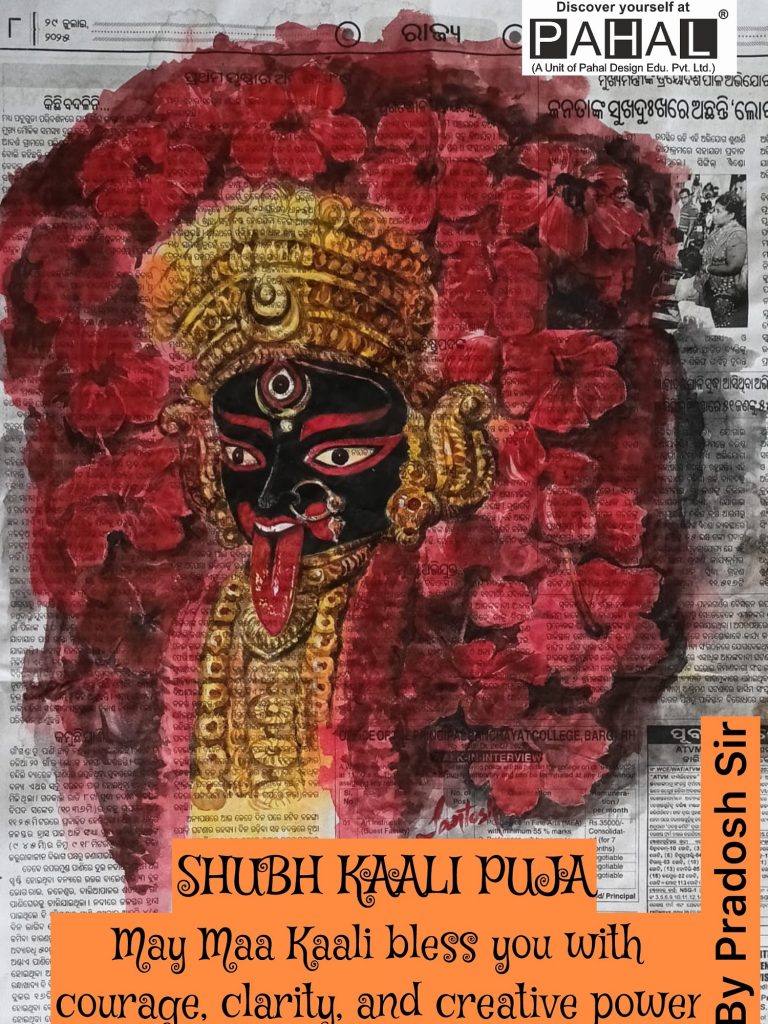
Kaali Puja, also known as Shyama Puja, is a deeply spiritual festival celebrated with devotion across India, especially in West Bengal, Odisha, and Assam. It coincides with the new moon night of Diwali and honors Goddess Kaali, the fierce manifestation of Shakti — the ultimate feminine energy of creation and destruction.
Maa Kaali represents the victory of good over evil and the eternal cycle of life, death, and rebirth. Her black complexion symbolizes the infinite, her red tongue signifies the power of transformation, and her garland of skulls reflects the triumph of wisdom over ignorance. She is the destroyer of darkness and ego, reminding devotees to conquer inner fears and attachments to attain true liberation.
During Kaali Puja, devotees decorate altars with red hibiscus flowers, lamps, and offerings of sweets, rice, and lentils. Tantric rituals and hymns are chanted to invoke the goddess’s blessings for strength, courage, and protection. The atmosphere resonates with the sounds of bells and drums, symbolizing the awakening of inner consciousness.
Beyond religious devotion, Kaali Puja carries a deeper creative message. She represents transformation — a process every artist, designer, and creator experiences. Just as Maa Kaali destroys the old to give birth to the new, creativity too thrives on breaking boundaries and reinventing forms.
At Pahal Design, we celebrate Kaali Puja as a reminder that creation is inseparable from transformation. The goddess inspires us to channel fearless creativity, challenge conventions, and embrace change with boldness and faith.
May Maa Kaali bless us all with courage, clarity, and creative energy.
Deepavali, or Diwali, is one of India’s most cherished festivals — a time when homes sparkle with lamps, streets echo with laughter, and hearts overflow with joy. Yet, beyond the shimmer of lights and sweetness of celebrations lies a profound spiritual essence — a reminder to awaken the light within us.
The word Deepavali comes from deepa (lamp) and avali (a row), signifying a series of lights that dispel darkness. It symbolizes the triumph of light over shadow, knowledge over ignorance, and remembrance over forgetfulness of the Divine.
Traditionally, Deepavali marks Lord Rama’s return to Ayodhya after 14 years of exile. The people of Ayodhya illuminated the entire city to celebrate His homecoming — a symbolic act of welcoming divine presence back into their lives. Just as they lit lamps to honor the Lord’s return, we too must light the lamps of devotion and awareness within our own hearts.
When the light of God is absent, darkness takes form as fear, restlessness, and discontent. In the Bhagavad Gita, Lord Krishna explains that wisdom and devotion together destroy this inner darkness. By lighting a lamp, we are in fact igniting our spiritual consciousness — making space for peace, clarity, and divine love to dwell.
Another story often remembered during this time is Damodar Lila — when little Krishna mischievously broke pots of butter, much to Mother Yashoda’s dismay. When she tried to bind Him as gentle punishment, she found every rope two inches short. Finally, when she was exhausted, Krishna allowed Himself to be tied — those missing two inches representing our sincere effort and the Lord’s grace.
This story beautifully teaches us that without devotion, we cannot receive divine mercy; and without mercy, our efforts remain incomplete. Both are needed for true spiritual perfection.
As we celebrate Deepavali, let us not only light our homes but also illuminate our inner world — with devotion, humility, and love. Let each flame remind us to invite the Lord back into our hearts, where He truly belongs.
If you’re dreaming of getting into top design colleges like IIT Bombay, IIT Delhi, IIT Guwahati, or IIT Hyderabad, then cracking UCEED (Undergraduate Common Entrance Examination for Design) is your first step!
UCEED 2026 will test not just your drawing skills, but also how you think, observe, imagine, and connect ideas with the world around you. The exam has two parts – Part A and Part B, and understanding the syllabus deeply will help you prepare smartly.
Part A focuses on your observation, reasoning, and creativity through objective-type questions. It’s about how you see, analyze, and interpret the world — skills that every great designer needs.
🔹 1. Visualization and Spatial Reasoning
You’ll be tested on how well you can visualize and mentally manipulate 2D shapes and 3D objects. Imagine folding paper, rotating cubes, or understanding the geometry behind everyday objects.
🔹 2. Practical and Scientific Knowledge
Design and science go hand-in-hand. This section checks your understanding of basic scientific principles and how things work in real life — from levers to light to everyday gadgets.
🔹 3. Observation and Design Sensitivity
Great designers notice what others miss. This part tests your ability to observe minute details, identify patterns, and think critically about form, function, and context.
🔹 4. Environment and Society
Design isn’t just about aesthetics — it’s about solving real-world problems. Be ready to answer questions on environmental issues, culture, and how design impacts society.
🔹 5. Analytical and Logical Reasoning
Here, your reasoning and problem-solving skills take the spotlight. Expect puzzles, data interpretation, and logic-based questions that test your qualitative and quantitative thinking.
🔹 6. Language and Comprehension
You’ll need to understand and interpret Standard English texts — passages, conversations, or descriptions — to assess your comprehension and interpretive skills.
🔹 7. Creativity
This is where your imagination shines! You’ll face questions that test your ability to think out of the box, use analogies, and connect ideas through symbols, metaphors, and visual logic.
Part B – Drawing and Design Aptitude
Part B is hands-on. It tests your ability to sketch, visualize, and communicate ideas through drawing.
🔸 1. Drawing Skills
You’ll need to draw products, people, or scenes accurately with attention to proportion, perspective, and line quality. Composition, light, and shading also matter — because your drawing should tell a story.
🔸 2. Design Aptitude
This section measures how you apply creativity to real-life challenges. It’s about design thinking, empathy, and practical innovation — solving problems visually and meaningfully.
ngg_shortcode_0_placeholder
FAQ’s
What is the structure of the UCEED exam and what topics does it cover?
The UCEED exam is divided into two parts, Part A and Part B. Part A focuses on design and analytical thinking, testing visualization, scientific knowledge, observation, environment, reasoning, language comprehension, and creativity. Part B emphasizes drawing skills and design aptitude, assessing the ability to sketch, visualize, and communicate ideas visually.
How should I prepare for Part A of the UCEED exam to enhance my chances of success?
Preparation for Part A should include practicing visualization and spatial reasoning exercises, understanding basic scientific principles, improving observation skills, studying environmental and societal issues, enhancing logical reasoning abilities, strengthening language comprehension, and fostering creativity through various problem-solving activities.
What skills are assessed in Part B of the UCEED exam, and how can I improve my performance in this section?
Part B evaluates your drawing skills and design aptitude. To improve performance, practice sketching products, people, and scenes with attention to proportion, perspective, and shading. Additionally, develop your ability to think creatively, approach design challenges with empathy, and communicate ideas clearly through visual means.
Are there any specific requirements or instructions regarding the use of a scribe during the UCEED exam?
Yes, a scribe is allowed to assist candidates in reading questions or entering answers as per the candidate’s instructions. However, the scribe is not permitted to explain the questions or suggest solutions, ensuring that the exam remains fair and based on the candidate’s own abilities.
Will there be any spot round of counselling or admissions for UCEED candidates?
There are no spot admission rounds for IITs after the counseling process. However, IIITDM Jabalpur may conduct a spot round of admissions at the institutional level if there are remaining vacant seats after the main counseling process.
If you have any doubts then feel free to connect us at 8800-22-6864
You’re a Class 12 student with Pahal Design coaching (12 hrs/week), strong in Creative Thinking, and want to improve Time Management — and you’d like Weekly Mock Tests included.
Here’s your 6-Month Structured NID DAT (B.Des) 2026 Prelims Plan – Oct 2025 to Mar 2026
🗓️ MONTH 1: OCTOBER 2025 — FOUNDATION & CONSISTENCY
Goal: Strengthen sketching discipline + basics of design aptitude
Weekly Focus:
Week 1: Line quality, proportion, shading, basic objects (cups, bottles, furniture) Week 2: Human figures, gesture drawing, basic anatomy Week 3: Perspective (1-point, 2-point), indoor/outdoor spaces Week 4: Observation exercises — draw from life (daily 15–20 min)
Theory + Aptitude:
Daily 15–20 min GK (design, art, culture, logos, current affairs) 2 reasoning exercises (pattern, analogy, visual puzzles) each week
Mock Test: 1 every Sunday (2 hours)
→ Focus on completing all questions within time.
Creative Challenge: “Everyday Object, New Use” — redesign an object with a new function.
🗓️ MONTH 2: NOVEMBER 2025 — IDEA DEVELOPMENT & SPEED
Goal: Improve idea generation + learn to draw fast & clean
Weekly Focus:
Week 1: Storyboard sketches – create 4-frame visual stories Week 2: Product sketching – draw 10 everyday products in 30 mins Week 3: Scene composition – perspective + storytelling Week 4: Design thinking prompts (“How to reduce waste?”, “Redesign a classroom”)
Our Fashion Styling students had the incredible opportunity to assist Nora Fatehi during an editorial shoot for Cosmopolitan, held right here on campus. At Istituto Marangoni Mumbai, we continuously strive to bridge the gap between academics and industry. This hands-on experience provided our students with real-world exposure to professional styling, creative direction, and the high standards of a leading editorial production. Go behind the scenes : https://bit.ly/Norafateh IMStudents #IndustryExperience #CosmopolitanIndia #NoraFatehi #FashionStyling #IstitutoMarangoniMumbai
World University of Design (WUD), Haryana, is India’s premier institution dedicated entirely to creative education, ranked A+ (Diamond Band) by QS I-GAUGE for academic excellence. Spread over 12 acres with specialized labs, hostels, and world-class studios, WUD offers 30+ programs across Design, Architecture, Fashion, Communication, Visual Arts, Performing Arts, and Business. The faculty includes alumni from NID, NIFT, IIT, and top global institutions.
With ₹10 crore worth of scholarships awarded annually and collaborations with 20+ international universities under Cumulus and Erasmus+, WUD empowers students to think, create, and innovate. Its outcome-based education model, industry memberships with CII, FICCI, and ASSOCHAM, and a vibrant, diverse student body from 22 Indian states make it a universe of creative possibilities.
Admissions to the Bachelor of Design (BDes) programmes at IIT Bombay, IIT Delhi, IIT Guwahati, IIT Hyderabad, IIT Indore, IIT Roorkee and IIITDM Jabalpur are done through the Undergraduate Common Entrance Examination for Design (UCEED). Students who have passed Class XII (or equivalent) in 2025, or appearing in 2026, in ANY STREAM (Science, Commerce, or Arts & Humanities) are eligible to appear for UCEED 2026.
Important Dates
Activity
Date
Start date for Online Registration
October 01, 2025, 01:00 pm
Last date for Online Registration with regular fee
October 31, 2025
Last date for Online Registration with late fee
November 07, 2025, 5:00 pm
Start date for Admit Card downloading
January 02, 2026, 01:00 pm
Last date for rectification of discrepancies in Admit card
January 08, 2026, 05:00 pm
UCEED 2025: date and time of exam
January 18, 2026 (Sunday)
09:00 am to 12:00 noon
Release of Draft Answer Key and candidates’ response for Part-A
January 20, 2026
Last date for uploading comments (if any)
on the Draft Answer Key in the candidate’s portal
Any request for change in the examination date and time will not be considered.
The dates for the seat allotment rounds are tentative. The change in date(s) (if any) will be posted on the official website (www.uceed.iitb.ac.in).
Syllabus
UCEED 2026 will have two parts.
Part-A will have questions from the following topics:
Visualization and spatial reasoning: Ability to visualise and transform 2D shapes and 3D objects and their spatial relationships.
Practical and scientific knowledge: Know-how of scientific principles and everyday objects.
Observation and design sensitivity: The capacity to detect concealed properties in daily life and think critically about them. Attention to detail, classification, analysis, inference and prediction.
Environment and society: General awareness of environmental, social and cultural connections with design.
Analytical and logical reasoning: Ability to analyse qualitative and quantitative information.
Language: Proficiency in reading and comprehending Standard English.
Creativity: Grasp of verbal and non-verbal analogies, metaphors, signs and symbols.
Part-B will have questions on the following topics:
Drawing: Ability to draw products, people or scenes in proportion with good line quality, composition, proportion, perspective and shading.
Design aptitude: Capability to practically and appropriately respond to problems/situations with ingenuity and empathy.
Starting a career in fashion design can be exciting and rewarding. Here are some steps you can take to kickstart your fashion design career:
1. Education: Consider enrolling in a reputable fashion design school or program to gain formal education and training in the field. A degree or diploma in fashion design will provide you with a solid foundation of knowledge and skills.
2. Build your portfolio: Create a strong portfolio showcasing your design work, sketches, projects, and any relevant experience. Your portfolio is a visual representation of your skills and creativity, which can help you stand out to potential employers or clients.
3. Gain experience: Seek internships, apprenticeships, or entry-level positions in the fashion industry to gain hands-on experience and practical knowledge. This will also help you network and make valuable connections within the industry.
4. Stay updated: Keep yourself updated with the latest trends, techniques, and technologies in the fashion industry. Attend fashion shows, workshops, and events to stay informed and inspired.
5. Develop your unique style: Experiment with different styles, techniques, and materials to develop your signature aesthetic as a fashion designer. Having a distinct and recognizable style can set you apart from others in the industry.
6. Network: Build relationships with other professionals in the fashion industry, such as designers, stylists, buyers, and manufacturers. Networking can open up opportunities for collaborations, projects, and potential career advancements.
7. Stay persistent and dedicated: Pursuing a career in fashion design requires hard work, dedication, and persistence. Be prepared to face challenges and setbacks along the way but stay focused on your goals and continue honing your craft.
Remember that the fashion industry is competitive, but with talent, passion, and perseverance, you can carve out a successful career as a fashion designer. Good luck!
Career Pathways:
Graduates find employment opportunities with fashion designers, in-house design teams of textile mills, export houses, buying agencies, retail sector, design studios in the couture, bespoke and ready to wear segments for women, men and children.
Some of the notable employers are fashion designers Sabyasachi Mukherjee, Rajesh Pratap Singh, Ritu Beri, Gaurav Gupta, Amit Agarwal, Suket Dhir, Manish Arora, Rahul Mishra, Anita Dongre, Manish Malhotra, Abu Jani Sandeep Khosla, Tarun Tahiliani, Rohit Bal and others; export and buying houses such as Shahi Exports, Orient Craft, Span India, Modelama, Li & Fung, Triburg, and Impulse; retail sector employers include Reliance Retail, Raymond, Aditya Birla Fashion and Retail Ltd., Taneira, Landmark, TCNS, Pantaloons, Good Earth, Blackberry.
There are opportunities with textile mills with in-house design labels such as Arvind Ltd. and Raymond Ltd., and NGOs working in the crafts sector. E-commerce platforms like Amazon, Myntra, Ajio, Tata CLiQ and First Cry; trend forecasting companies such as WGSN and Patternbank, digital and virtual fashion design consultancies offer creatively challenging career options.