
IMPORTANT INSTRUCTIONS FOR CANDIDATES

1. This Admit Card is provisional & subject to changes/modifications. Candidates are advised to follow the NIFT website,
notifications, information bulletin & check their mailbox on the registered E-mail address and SMS in their registered Mobile
No. for any latest updates and information.

2. Candidates are suggested to visit the examination venue, a day in advance, so that they can reach the venue on time on the day of the examination.

3. Candidates are required to present the following documents to the examination officials, for identity verification:
A. Admit Card downloaded from the NIFT website (a clear preferably colour printout on A4 size paper)
B. Any one of these original and valid Photo Identification Proof issued by the government — Passport/Aadhaar Card
(With photograph)/E- Aadhaar/Voter Card / Driving License.
Note: No Candidate would be allowed to enter the Examination Centre, without valid identity proof & verification.

4. Candidates are requested to carry their own Pen/ Pencil / Erasers /Ruler (In a transparent pouch). Candidates appearing for
CAT also need to carry their Colouring & Drawing material. For CAT a physical Question Booklet with space for responses
will be provided at the Centre. Candidates are NOT allowed to carry any personal belongings [except those listed above]
including electronic devices, mobile phone and other banned materials listed in the Information Bulletin/ NIFT Website / NIFT
Notice, to the Examination Centre. Examination Officials will not be responsible for safe keep of personal belongings and
can also debar the candidate for carrying any banned items.

5. Candidates should reach the Venue well before the reporting time given in the Admit Card. No candidate will be allowed
inside if he/she does not adhere to the reporting time.

6. Candidates are to sit at the designated seat allocated by the Centre Head. They can login using the credentials given on
their Admit Card and read instructions, before the commencement of the examination. In case of any issues they can report
the same immediately to the Invigilator. Candidate will be able to start ONLY after the Examination is started as per schedule
by the Centre Head. An announcement will also be made to that effect once the test is started.

7. Candidates will NOT be permitted to leave the Examination Room/Hall before the end of the examination. After the
completion of the examination, candidates should hand over their Question Booklet, Answer Sheets & Rough sheet to the
invigilator on duty (CAT Only).

8. An electronic attendance will be taken by the invigilator by scanning the QR Code of the Admit card carried by the candidate.

9. No Candidate should adopt any unfair-means, or indulge in any unfair examination practices. Speaking to others / Over
seeing another person’s responses / screen, trying to open other applications on the PC, carrying any form of electronic
device / peripheral / accessory, not obeying the instructions of the Centre Head / Invigilator are all fit ground for cancellation
of your examination.

10. Appearing for both GAT and CAT is mandatory. If a candidate does not appear for one or the other he/she will not be
shortlisted for the Situation Test/ PI (Personal Interview).

11. General Ability Test (GAT) is a Computer Based Test & Creative Ability Test (CAT) is a Paper Based Test.

For any further details connect us at 880022-6864.
  1. Tell me about yourself?
  2. Why do you think we should give you admission in our college/What special quality do you possess that we should consider you for our college?
  3. What are your greatest strengths?
  4. What is your greatest weakness?
  5. What are your career goals, and how do you plan to achieve them?
  6. Where do you see yourself 5 years down the line?
  7. What are your hobbies and interests?
  8. Who is your role model/Who inspires you?
  9. What does fashion mean to you? Is it important? Why is it important?
  10. What fashion designer’s design? What is fashion design?
  11. Why did you decide to choose fashion design as a career?
  12. How would you relate past and present fashion trends?
  13. How would you describe your personal style?
  14. What are your expectations from this design course?
  15. According to you, who is the most stylish celebrity?
  16. Name some of your favourite fashion writers, stylists, photographers etc.
  17. Describe something that excites you about the fashion Industry?
  18. Are you passionate about something apart from fashion?
  19. How do you stay up to date with fashion?
  20. Should fashionable clothes be allowed in colleges or should there be uniform clothing for all?
  21. What Fashion Means To You? Is It Crucial For You? If Yes, Then Justify.
  22. Why Do You Want to Enter the Fashion Industry as A Professional?
  23. How Would You Describe Your Style?

24. What Are Your Expectations From This Specific Course?

25. Why Do You Think That You Are The Most Suited Candidate For College Admission/ What Quality You Embody That We Should Consider Your Admission In Our Esteemed College?


Here is a list of questions that have been asked and you should prepare:

1.Why MFM or Masters of Fashion Management ?
2.Why National Institute of Fashion Technology or NIFT?
3.Questions from Graduation?
4.Where do you see yourself in a few years from now.
5.Define Fashion ?
6.How would you contribute to the fashion industry after MFM from NIFT?
7.Basic Fashion Terminology like haute couture etc.
8.Knowledge about some apparel/textile specialty of the state you belong
9.Would you join Masters of Fashion Management (MFM)if you don’t get a center of your choice?
10.Current textile minister
11.Textile/Retail terminology
12.Knowledge about the brand of clothing you are wearing to the interview
13.Retail and Textile brands. Who owns what?
14.Fashion GK/Fashion current Affairs is a must.
15.Also,brush up your static GK and General current affairs.
16.Questions from Work Experience if any.

Set up in 1986, NIFT is the pioneering institute of fashion education in the country and has been in the vanguard of providing professional human resource to the textile and apparel industry. It was made a statutory institute in 2006 by an Act of the Indian Parliament with the President of India as ‘Visitor’ and has full-fledged campuses all across the country. Over the years NIFT has also been working as a knowledge service provider to the Union and State governments in the area of design development and positioning of handlooms and handicrafts.

List of UG Programs

  • Fashion Design
  • Leather Design
  • Accessory Design
  • Textile Design
  • Knitwear Design
  • Fashion Communication
  • Apparel Production

List of PG Programs

  • Master of Design
  • Master of Fashion Management
  • Master of Fashion Technology

The National Institute of Fashion Technology (NIFT) has outlined the following key dates for the 2025 admission cycle:

  1. Online Registration Start Date: November 22, 2024
  2. Last Date for Online Application Submission: January 6, 2025
  3. Entrance Examination Date: February 9, 2025
  4. Result Declaration for B.Des and B.F.Tech: March 2025
  5. Situation Test and Personal Interviews: April 2025
  6. Final Result Announcement for M.Des, M.F.M., and M.F.Tech: May 2025
  7. Online Registration for Counselling (Round 1): May-June 2025
  8. Counselling Dates: June-July 2025

The NIFT entrance exam consists of multiple stages, depending on the program applied for. The exam structure generally includes the following:

1. Written Exam (GAT & CAT)

Applicable for: B.Des, M.Des, B.F.Tech, M.F.Tech, MFM

General Ability Test (GAT)

B.Des & M.Des:

  1. •Quantitative Ability
  2. •Communication Ability & English Comprehension
  3. •Analytical & Logical Ability
  4. •General Knowledge & Current Affairs

For B.F.Tech, M.F.Tech & MFM:

•All of the above plus Case Study (business domain-related scenarios)

Duration:

B.Des & M.Des: 2 hours

B.F.Tech, M.F.Tech, MFM: 3 hours

Creative Ability Test (CAT) (For B.Des & M.Des only)

•Evaluates creativity, illustration skills, and design thinking

•Duration: 3 hours

2. Situation Test / Studio Test & Personal Interview

For B.Des:

Situation Test (Practical test to assess material handling and innovative thinking)

For M.Des, M.F.Tech, MFM:

Studio Test (For M.Des)

Personal Interview (For all PG courses)

3. Final Selection

•Based on a combination of scores from GAT, CAT, Situation Test/Studio Test, and Personal Interview (depending on the course).

NIFT SEAT MATRIX 2025

NIFT EXAM PAPERS 

NOIDA

Address:- C-29, Ground Floor, Sector 2, Noida
(Nearby Metro – Noida Sector 15 Metro Station ), UP – 201301
Contact No: 93540-52529
Email: corporate@pahaldesign.com


Question 1*- a simple picture of tap was given and we had to design it for 3 different types of people in 3 different boxes, one for each.
a) a six year old 
b) an artist
c) impared eye person
 
Question 2*- story boarding 
A fisherman is sitting near the shore/sea and a kingfisher bird is there too. They both are having an intense conversation and it ends with 
*Kingfisher- ” at last, you’re a human being”*
Make the story and give it a title, write the story in the given box and illustrate the story in the 3 boxes given.
 
Question 3* – all the parts of a cycle were given (even the vvvvv little ones, way too many parts were there in different angles).
Draw a proper cycle using all the parts.
 
Question 4*- perspective question
A room was given with alot of details and a person was looking at his friend peeping from the window. We had to draw what the friend of the person would see. The whole composition was given in one point perspective.


Online Counselling Request

On the 2nd of January 2022, NID (National Institute of Design)Exam 2022 successfully conducted NID DAT Prelims in pen and paper mode across 23 test cities in the country. National institute of Design conducts its entrance exam in two phases; DAT Prelims & DAT Mains. NID DAT Prelims is the first examination of the two phase entrance process.
Students from across the country aspiring to study and build a career in the field of design appear for NID DAT exam every year. Candidates who qualify NID DAT secure admission in Bachelor of Design (B.Des), Graduate Diploma Program in Design (GDPD) & Master of Design (M.Des) courses offered by National Institute of Design.

Approximately 15000 students appeared for NID DAT Prelims 2022 across the country. Even though the candidate count of 2022 is 25-30% less than the number of candidates who appeared in NID DAT Prelims 2021, the dedication and enthusiasm of the students was clearly visible across all test centres in the country.

NID DAT Prelims for B.Des is a 3 hour examination of 100 marks comprising multiple choice questions (G.K, Logical Reasoning, and English) and creative section whereas NID DAT Prelims for M.Des is a 2 hr 30 minutes examination with a 30 minute common design aptitude section and a 2 hour discipline specific creative section. If the candidate has chosen 2 disciplines, then the exam duration is increased to 4 hours 30 mins.

Question 1a simple picture of tap was given and we had to design it for 3 different types of people in 3 different boxes, one for each.
a) a six year old 
b) an artist
c) impaired eye person
 
Question 2- story boarding 
A fisherman is sitting near the shore/sea and a kingfisher bird is there too. They both are having an intense conversation and it ends with 
Kingfisher- ” at last, you’re a human being”*
Make the story and give it a title, write the story in the given box and illustrate the story in the 3 boxes given.
 
Question 3 – all the parts of a cycle were given (even the vvvvv little ones, way too many parts were there in different angles).
Draw a proper cycle using all the parts.
 
Question 4 – perspective question
A room was given with alot of details and a person was looking at his friend peeping from the window. We had to draw what the friend of the person would see. The whole composition was given in one point perspective.

There are 5 major faculty/streams at NID for students to choose from –

  1. Faculty of Communication Design
    (Animation Design, Film & Video communication, Graphic Design, Photography Design)
  2. Faculty of Industrial Design
    (Ceramic & Glass Design, Furniture & Interior Design, Product Design, Toy & Game Design, Transportation & Automobile Design, Universal Design)
  3. Faculty of Inter-Disciplinary Design Studies
    (Design for retail experience, Strategic Design Management)
  4. Faculty of Information technology Integrated programmes
    (Digital Game Design, Information Design, Interaction Design, New Media Design)
  5. Faculty of Textile, Apparel, Lifestyle and Accessory Design
    (Apparel Design, Lifestyle accessory Design & Textile Design)

Students who appeared for DAT Prelims 2022, found the difficulty level of the examination to be moderate. The B.Des question paper had 27 multiple choice questions from static G.K, English and non verbal reasoning of 40 marks. The creative section carried 60 marks covering 4 questions of frames, observation and assembly, story boarding and perspective.

When interviewed by our counselors at Pahal Design, many students were ecstatic after attempting the examination and were extremely thankful to the faculties for their guidance. Maximum students found time management an essential component to deliver their best during the examination and were very grateful for the consecutive mock tests which helped them take a feel of the examination beforehand.

NID DAT is a tough examination; hence students need constant practice and guidance from faculties at every step of their preparation. The students who will qualify NID DAT Prelims will proceed for NID DAT Mains.

NID DAT Mains for B.Des/GDPD/M.Des is the studio test of 100 marks. It includes doodling concept, 3D Modeling, Clay Modeling, Wire moulding, Psychometric test, Audio Visual test, Interview and portfolio round. The final score of the candidate is calculated on the basis of both their DAT Prelims (30% weightage) and DAT mains score (70% weightage).

Bachelor of Design (B.Des) is offered at NID Ahmedabad (Gujarat), NID Vijayawada (Andhra Pradesh), NID Kurukshetra (Haryana), NID Bhopal (Madhya Pradesh) & NID Jorhat (Assam) with a total intake of 425 seats.

Masters of Design (M.Des) is offered at NID Bangalore (Karnataka), NID Ahmedabad & NID Gandhinagar (Gujarat) with a total intake of 347 seats.

Online Counselling Request

“We are India’s leading institution in design, fashion, business, and media, and have been a catalyst for the success of students across creative industries for 27 years. We offer over 40 uniquely designed UG, PG and professional development programs through its campuses in Delhi, Noida, Jaipur, Mumbai, Bangalore (Launchingsoon) and Kolkata (Launching soon). Our reputation of preparing ‘Industry ready’ professionals has been recognized by leading fashion, retail and design brands, which has helped in establishing a healthy track record of over 95 per cent placement for the last 3 years. Our path-breaking alliances with renowned organizations such as the Fashion Design Council of India (FDCI), Association of Designers of India (ADI), and Institute of Indian Interior Designers (IIID) have ensured that its faculty and students get exclusive access to ‘industry in the classroom’. Awards: – Best private fashion college in India 5th consecutive year by India Today – MDRA, Outlook – Drshti and The Week – Hansa survey. – Best Design Institute in India’ by ASSOCHAM, 4 years in a row since 2016. – Only Indian institute to feature in Business of Fashion’s Top 25 Global Fashion School Rankings (Graduate) in 2017. – Recognized as a Great Indian Institute 2018 by Forbes and Great Place to Study. – Jaipur campus ranked 1 of the most beautiful college campuses in India by India Today. – Best Education Brands 2017’ in Fashion Design Category by The Economic Times. Global Associations: – Manchester Metropolitan University (MMU), UK – University of Derby, UK – Torrens University, Australia – Fashion Institute of Design & Merchandising, US – Domus Academy, Italy – Media Design School, New Zealand
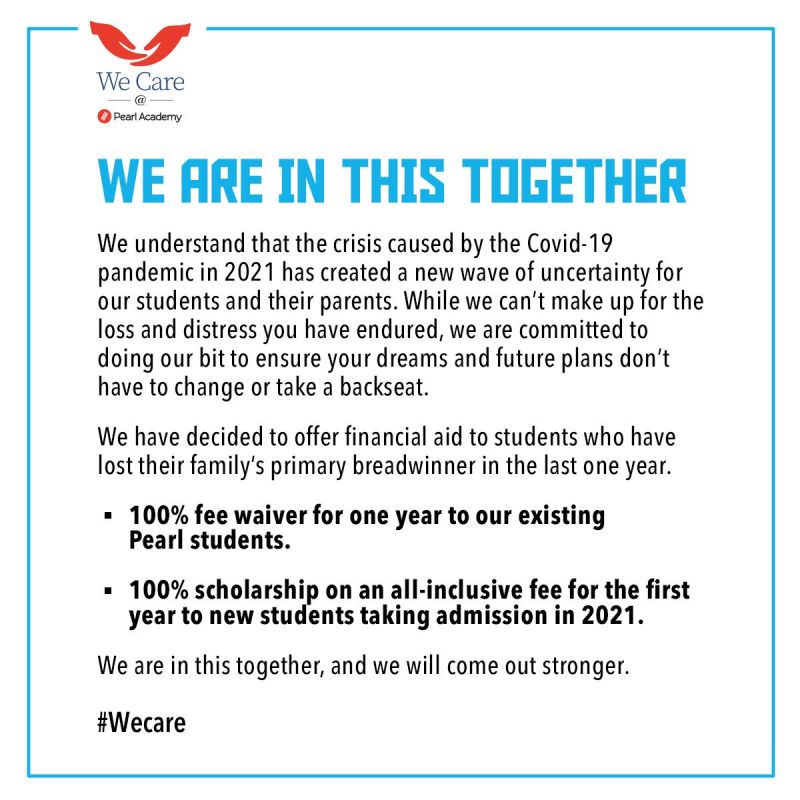
We believe that with support from each other, we can navigate the new reality better. Therefore we are offering special Covid scholarships to both our new and existing students, to reinforce our support on their creative journey.

We are in this together. And we will come out of this stronger! 

Online Counselling Request

Dear Students,

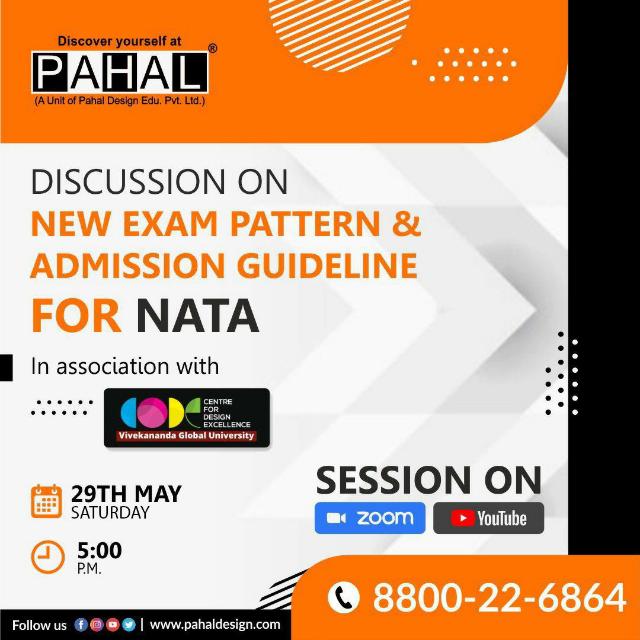
NATA 2021 exam pattern has been changed and we understand that you all have questions regarding the same. This year, the exam will completely have questions related to Aptitude.

NATA Exam

NATA measures the aptitude of the applicant for specific field of study, i.e. Architecture, through assessment of cognitive skills, visual perception and aesthetic sensitivity tests, logical reasoning and critical thinking ability, etc., besides the learning that the candidate has acquired over the past few years and is related to the specific field of study.

Schedule of Examinations

Examination shall be conducted in one session on the date of the first test and on the second date of the test. Second session for examination may be considered in the event of any restrictions imposed by the Government on the number of candidates appearing in a single session due to social distancing norms owing to pandemic Covid-19. The session during which the candidate will take the test will be allotted by the Council and Centre allotment will be done on the basis of choice provided by the candidate in the application form for preferred city for taking examination.

The aptitude test will comprise of questions that could be of the Multiple-Choice type (MCQ), Multiple Select type (MSQ), Preferential Choice type (PCQ) and Numerical Answer type (NAQ).

The questions will carry either 1 mark,2 marks or 3 marks and 125 questions have to be answered in 180 minutes.
The medium of Aptitude test will be the English language.

NATA Exam Type of Questions 

The aptitude of the candidate will be assessed using some or all of the following techniques:

  • Diagrammatic Reasoning – Tests the ability of logical reasoning, using diagrams and scenarios
  • Numerical Reasoning – Tests mathematical ability through simple problems
  • Verbal Reasoning – Assesses the ability to assess verbal logic.
  • Inductive Reasoning – Tests the ability to see patterns and analyse given data
  • Situational Judgment – Tests problem-solving ability.
  • Logical Reasoning – Tests ability to recognise patterns, sequences or relationships between shapes andimagery.
  • Abstract Reasoning – Will assess general knowledge, and ability to utilise knowledge in new situations.

Candidates who wish to apply for B.Arch and B. Planning programme must appear for the NATA and hence they are advised to check the exam pattern. The NATA 2021 will be conducted in a computer-based mode, the question paper of NATA 2021 will maximum questions from Aptitude.The question paper is a combination of MCQ, MSQ, PCQ (Preferential Choice Questions) and NAQ (Numerical Answer Questions).

Pahal Design in association with CODE-VGU, Jaipur will be answering all you queries.

To join the session register via below link:
https://bit.ly/3vokkP5

Reach us at 8800-22-6864

Who is this for?

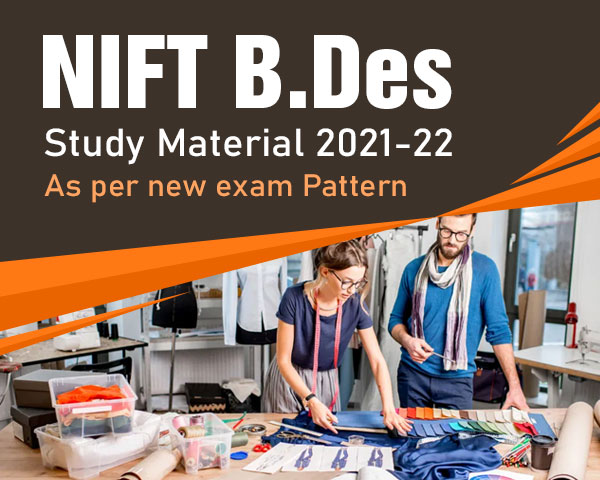
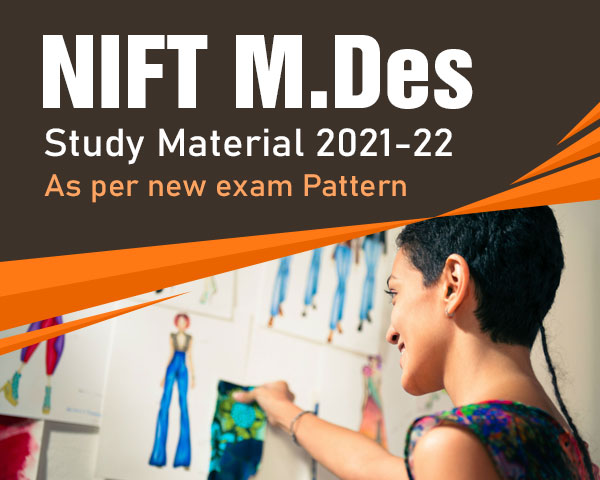
Many students those are not able to attend our classroom coaching classes of NIFT B.Des | M.Des | MFM | M.Ftech | B.Ftech so for them we have designed a comprehensive study material as per the requirement of entrance exams. The techniques which we have discussed in study material is easiest method to understand complex sketches.

How this helps?

In order to narrow down the ideal exam strategy a team of experts will be there to guide you through out your journey with Pahal Design. The platform is interlinked with our academic team and you are just a click away. In case of any Doubt in any section you are allowed to book a slot and share your queries.

We update our study material to reflect the changing demands of the latest editions of the NIFT as per new exam pattern. An outdated material presents several problems. Our practice materials are structured in a step-by-step manner. So, we worry about the relevance and position of each question that goes into our books. 

NIFT, one of the top competitive exams, is conducted every year in the month of February. In order to get a good score and marks, you need to plan your NIFT preparation in an effective and time-efficient manner. With innumerable books and study material available for NIFT, it is difficult to choose the right resources. Here, we present you with the best study material curated by our expert faculty. Additionally, you should take regular mock tests to assess your level of preparation. In our course packages, you will be able to access online classroom and live lectures at your convenience.

NIFT (B.Des)

5,000.00 4,000.00

Total Booklets

  1.  Quantitative Ability – 7 Booklets
  2.  Verbal & Analytical Ability – 4 Booklets
  3.  Communication Ability & English Comprehension – 2 Booklets
  4. General Knowledge and Current Affairs – Monthly
  5. Creative Booklet – 5 ( 3 booklets Hard Copy and 2 Booklets on LMS )
  6. Online Portal Access – 24 x 7 
  7. NIFT B.Des Previous Year Question Papers – The last 5 years original exam papers will be available over LMS.
  8. NIFT Guide book for Design
  9. Mock Tests as per new Exam Pattern – 5
  10. Monthly Tests 

NIFT (M.Des)

5,000.00 4,000.00

Total Booklets

  1.  Quantitative Ability – 7 Booklets
  2.  Verbal & Analytical Ability – 4 Booklets
  3.  Communication Ability & English Comprehension – 2 Booklets
  4.  General Knowledge and Current Affairs – Monthly
  5.  Creative Booklet – 3 ( 2 booklets Hard Copy and 1 Booklets on LMS )
  6.  Online Portal Access – 24 x 7 
  7.  NIFT M.Des Previous Year Question Papers – The last 5 years original exam papers will be available over LMS.
  8.  NIFT Guide book for Design
  9.  Mock Tests as per new Exam Pattern – 5
  10.  Monthly Tests 

NIFT (MFM)

4,000.00 3,000.00

Total Booklets

  1.  Quantitative Ability – 7 Booklets
  2.  Verbal & Analytical Ability – 4 Booklets
  3.  Communication Ability & English Comprehension – 2 Booklets
  4. General Knowledge and Current Affairs – Monthly
  5. Case Study – 1
  6. Online Portal Access – 24 x 7 
  7. NIFT B.Des Previous Year Question Papers – The last 5 years original exam papers will be available over LMS.
  8. NIFT Guide book for Design
  9. Mock Tests as per new Exam Pattern – 5
  10. Monthly Tests 


Key Features of DLP by Pahal Design

  1. Study Material as per new exam pattern
  2. Detailed analysis
  3. Prepared by Expert faculties
  4. Easy to understand
  5. Time savvy
  6. Interactive student LMS
  7. Online Doubt clearance sessions
  8. Learn at your own pace
  9. Mock Test Series
  10. Video Tutorials

Online Counselling Request

UPES School of Design nurtures responsible designers who possess cultural understanding, are agile and have broad-based innovation capabilities; designers who can create intelligent, inclusive, sensitive design, whether to make big differences or small ones. With an infrastructure comprising high-end computer workstations, vacuum-forming machines, spray-painting booths, among other creative learning aids, and industry collaborations that interweave practical learning with classroom teaching, students learn to employ design-led problem-solving techniques to address the most pressing issues of the world.



SCHOOL OF DESIGN

1. 100% Placement record
2. World-class labs and studios (Mac, CAD, Cintiq, Clay and Paint studio)
3. Non-Exam Pathway: Admissions through National Level(NID/NIFT/UCEED)

University of Petroleum and Energy Studies (UPES) is accepting registration form for Design UG/ PG programmes. The UPES Design application form for UG and PG programmes is available in both online and offline mode. For UG Design candidates will be shortlisted on the basis of UPES Design Aptitude Test (UPESDAT) score and for UPES Design PG programme, candidates UPESDAT/ CEED (Common Entrance Examination for Design) scorecard will be considered for the admission process.

UPES Design admission 2021- Programme offered and fee structure (UG Programme)

Programme name

Total fee

B.Des – Industrial & Product Design

Rs 16,04,500

B.Des – Interior & Retail Space Design

Rs 16,04,500

B.Des – Transportation & Mobility

Rs 16,04,500

B.Des – Animation & VFX Design

Rs 16,04,500

B.Des – Graphics & Communication Design

Rs 16,04,500

B.Des – Game Design

Rs 16,04,500

B.Des – Fashion Design

Rs 16,04,500

B.Des – User Experience & Interaction Design

Rs 16,04,500

UPES Design admission 2021- Programme offered and fee structure (PG Programme)

Programme name

Total fees

M.Des – Fashion Design

Rs 10,81,000

M.Des – Transportation Design

Rs 10,81,000

M.Des – Product Design

Rs 10,81,000

M.Des – User Experience & Interaction Design

Rs 10,81,000

M.Des – Transportation & Mobility Design

Rs 10,81,000

UPES Design 2021: Eligibility criteria (UG Programme)

  • Minimum 50% score in Class 10, 12

  • Minimum valid score from UPESDAT (Or)

  • Minimum 50% score in Class 10, 12 with valid JEE Main/UCEED scores

UPES Design 2021: Eligibility criteria (PG Programme)

  • Minimum 50% Score in 10 and 12

  • B. Tech / BE in any relevant discipline / B. Arch / BFA/ Interior Design/ B. Des/ BVA (or)

  • 3 year Degree such as B.Sc. / BA/ BFA/ BVA in Applied Art/ Design of any other relevant disciplines (with min. 50% marks)

  • 2 years M.Sc. / M.Tech. In Computer Science, CSE, IT subjects / domains (only for Interaction Design). Or equivalent.

Application fee and mode of application

Application fee (Online)

Rs 1,850

Mode of application

Online

Application fee (Offline)

Rs 1,750

Mode of application

Offline

UPES Design (UG): Selection process

  • Candidates are selected based on UPESDAT scores for personal interviews and to present work portfolio

  • Minimum valid score from JEE Main/UCEED are eligible for admission process

UPES Design (PG): Selection process

Candidates with minimum valid score from UPESDAT/CEED score above 40.5 is eligible for admission process and work portfolio presentation.

For any further details connect us at 9821-651-399


Schedule a free counselling session WhatsApp WhatsApp Enquiry