 Originally established in 1962 as the School of Architecture, Faculty of Architecture, CEPT University, is one of the vital centers of thought and education in the field of Architecture in India. It continues to aim for excellence in its teaching and research programs in the field of Architecture. The Faculty enjoys an excellent reputation nationally as well as internationally.
Architects play significant roles in the design and production of built environments. Those who focus on design are commissioned by clients to lead the work of the many experts who are required to put buildings and places together. When playing this leadership role architects ensure that the end product is architecturally meaningful, while meeting prosaic functional requirements. Many architects refrain from playing this expansive leadership role and prefer instead to focus on some aspect of the built environment. Others refrain from design altogether and focus instead on the study and critique of built environments in a bid to enrich architectural discourse. Yet others choose to proactively work with disadvantaged communities to improve living conditions.
Professional architects can build careers as independently practicing architects, as architects working within architectural firms, as academics focused on teaching and research, or within non-governmental organizations. In India, the architectural profession is regulated by the Council of Architecture (CoA), which was established by Parliament through the Architects Act, 1972.
This five-year long program leads up to the award of the B. Arch. degree. It equips students with the competencies necessary for being effective professional architects and exposes them to the aesthetic, technical, social, political and ethical dimensions of the built environment. Though the B. Arch degree is sufficient for professional registration with the CoA, many architects pursue postgraduate and doctoral studies. When doing this, one can continue focusing on architecture, concentrate on fields such as architectural conservation or urban design or shift to allied professions such as urban planning or construction management.
 The first year is called the CEPT Foundation Program. Here the focus is on developing basic architectural design skills. The following two years focus on advanced skill development. It is possible to exit the program at this stage with a B.Sc. in Building Design. The fourth and fifth years allow students to focus on areas and practice domains of their choice. During this period, students can choose to intern for any one of the four semesters with approved architectural offices anywhere in the world and also undertake research projects or design studios.
The program is centered on ‘studios’ where students are expected to resolve life-like design problems on their own. Studios operate as learning communities where teachers take on the role of coaches supporting students in their learning quests. In studios students develop capacities and come up with technically and architecturally meaningful designs to communicate their ideas. Many group exercises are structured to develop leadership capacities.
Courses, seminars, and workshops, which run parallel to studios, expose students to technology, history, architectural theory and various other dimensions of architecture. Four times, during breaks between semesters, students are required to sign up for study tours or courses organized as part of the Summer and Winter School programs.
To enable students to pursue individual interests only three quarters of the total academic workload is mandated. Students choose courses from the many available electives to complete the rest. Teachers are drawn from practicing professionals who bring practical experience to the classroom and academics who complement teaching with more theoretical and critical approaches.
This almost sixty year old program is internationally recognized. Its alumni are amongst the most successful architects of India, work at the foremost architectural practices across the world, teach and do research at the most reputable global universities and are amongst the most notable social entrepreneurs of the country. Many long lasting exchange programs link this program to other architectural programs in Europe, USA and Australia providing unparalleled opportunities to enrolled students.
1) Bachelor’s in Architecture Course, candidates who have cleared the qualifying examination from an eligible Board from the

NATA MOCK TESTS
school located in India (Including Gujarat State) with minimum eligibility criteria as prescribed by AICTE/Council from time to time and have obtained valid score in NATA as prescribed by the Council.
For admission to 1st year of 5-year B.Arch. Degree Course, as prescribed by Council of Architecture, a candidate should have passed in 10+2 scheme of examination with PCM subjects or pass in 10+3 Diploma* with Mathematics, as the case may be and have qualified the aptitude test i.e. NATA shall be eligible for admission to B.Arch. course for the academic session 2020-2021.
* – A candidate shall have passed the Diploma (I0+ 3) of any stream with Mathematics as a compulsory subject from,-
(a) The Technical Examination Board, Gujarat State or
(b) A University established or incorporated by or under a Central or a State Act or an institution declared to be deemed as a University under section 3 of the University Grants Commission Act. 1956 (3 or 1956)
2) Candidates who have cleared the qualifying examination from school located outside
India with minimum eligibility criteria as prescribed by AICTE/Council from time to time and equivalency defined by Association of Indian Universities (AIU), New Delhi shall be eligible for admission.
3) The candidate shall have to pass all the subjects of the qualifying examination from a single Board.
 Eligibility for seats to be filled in by GoG:
Eligibility for seats to be filled in by ACPC, GoG:
Please refer to official website of Admission Committee for Professional Courses of Government of Gujarat. www.jacpcldce.ac.in
Note: Additionally, the student will have to meet the minimum qualifying marks for the National Aptitude Test in Architecture (NATA) test for the corresponding year as per the Council of Architecture.
Seat:
| Program | 50% of total seats to be filled in by ACPC, GoG | 50% of total seats to be filled in by CEPT University (All India Seats) | Total Seats |
| Bachelor’s in Architecture (B Arch) |
40 | 40 | 80 |
|
CEPT has a comprehensive scheme for scholarship. It is the endeavor of the University that no student be denied opportunity to pursue their studies for want of adequate financial resources. However no financial aid or scholarship would be automatic and will be subject to norms and criteria laid down by the University. Pending sanction of financial aid / award of scholarship students are required to make payment of fees and charges on the due dates.
Address:- 9, 1st Floor, Sunrise Centre-II, Sunrise Park, Bodakdev,
Ahmedabad, Gujarat-380015
Landmark: Off Drive-in-Road
Contact No: 78029-49620, 079-40398630
Contact Person: Ms Manisha Malkani
Email: ahmedabad@pahaldesign.com

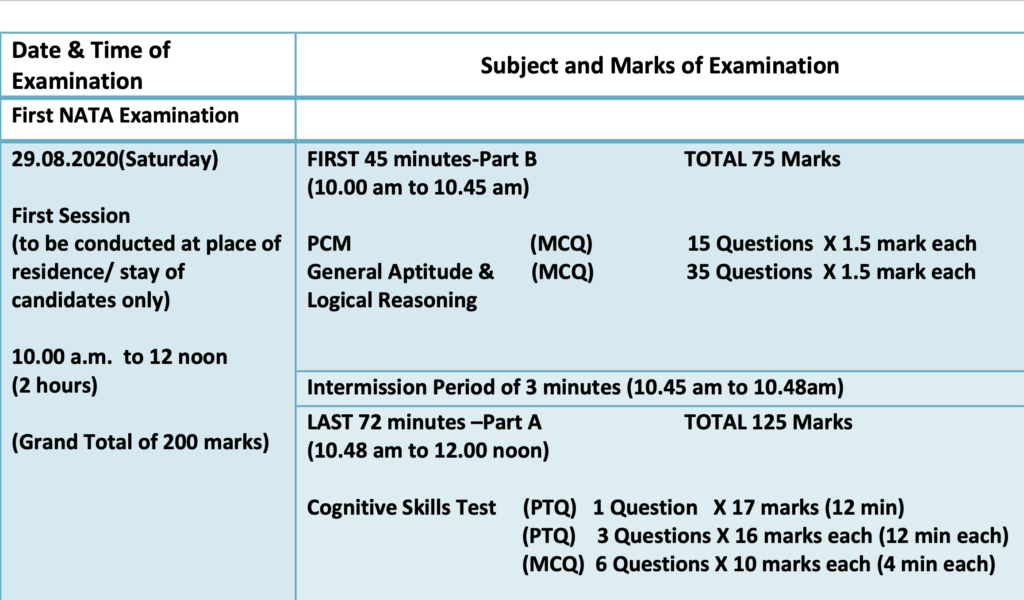
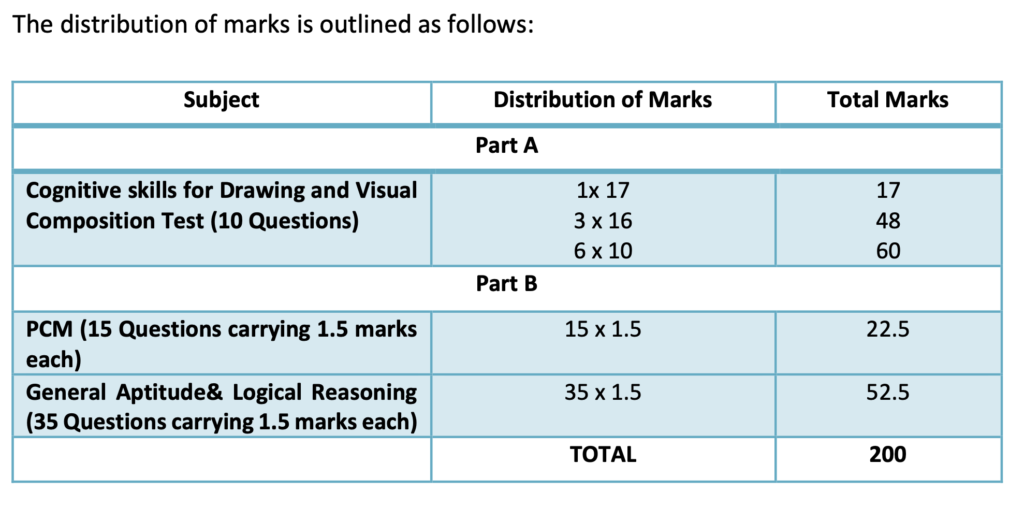
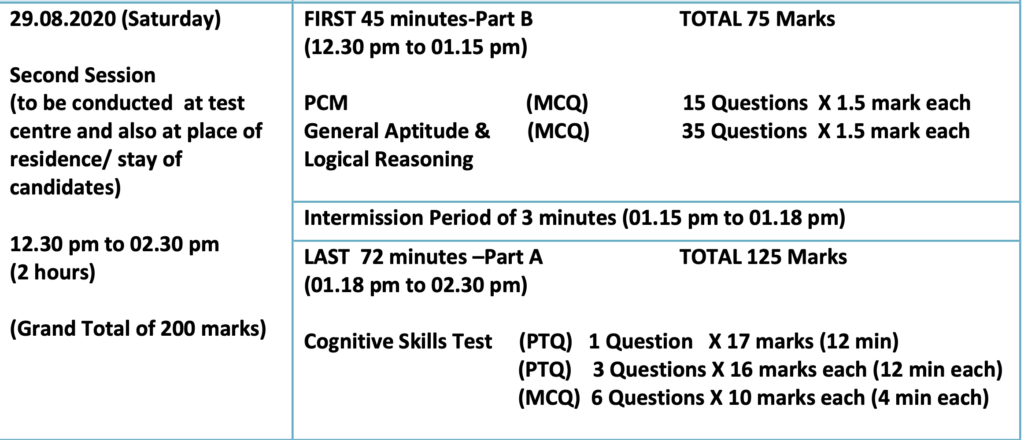
 NATA measures the aptitude of the applicant for specific field of study, i.e. Architecture, through assessment of cognitive skills, visual perception and aesthetic sensitivity tests, logical reasoning and critical thinking ability, etc., besides the learning that the candidate has acquired over the past few years and is related to the specific field of study.
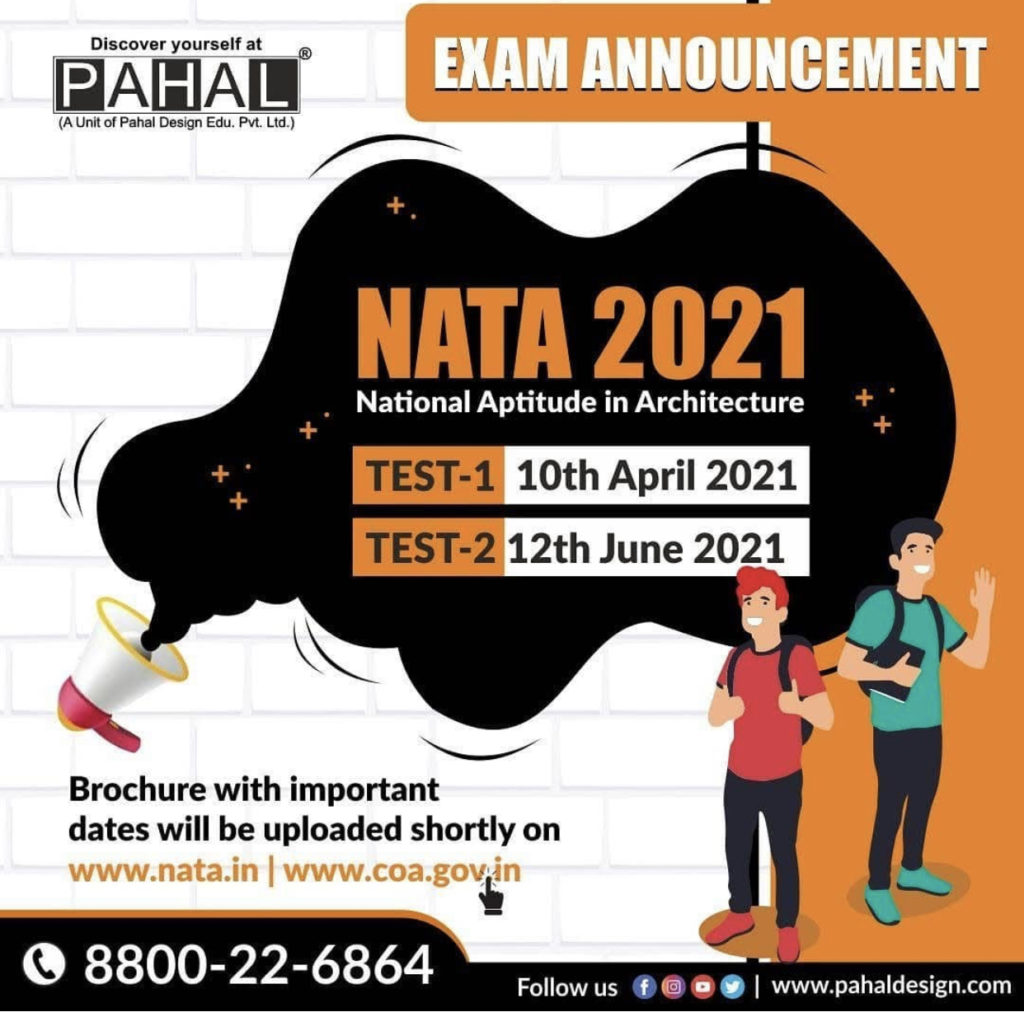 Questions could be asked in various topics that assess candidates on basic concepts in mathematics, physics and geometry, language and interpretation, elements and principles of design, aesthetic sensitivity, colour theory, lateral thinking and logical reasoning, visual perception and cognition, graphics and imagery, building anatomy and architectural vocabulary, basic techniques of building construction and knowledge of material, general knowledge and current affairs, etc. and are may not be limited to those outlined.
 6. Will the test fee be refunded for any valid reason?


 About NATA 2021
 Outline of Aptitude Test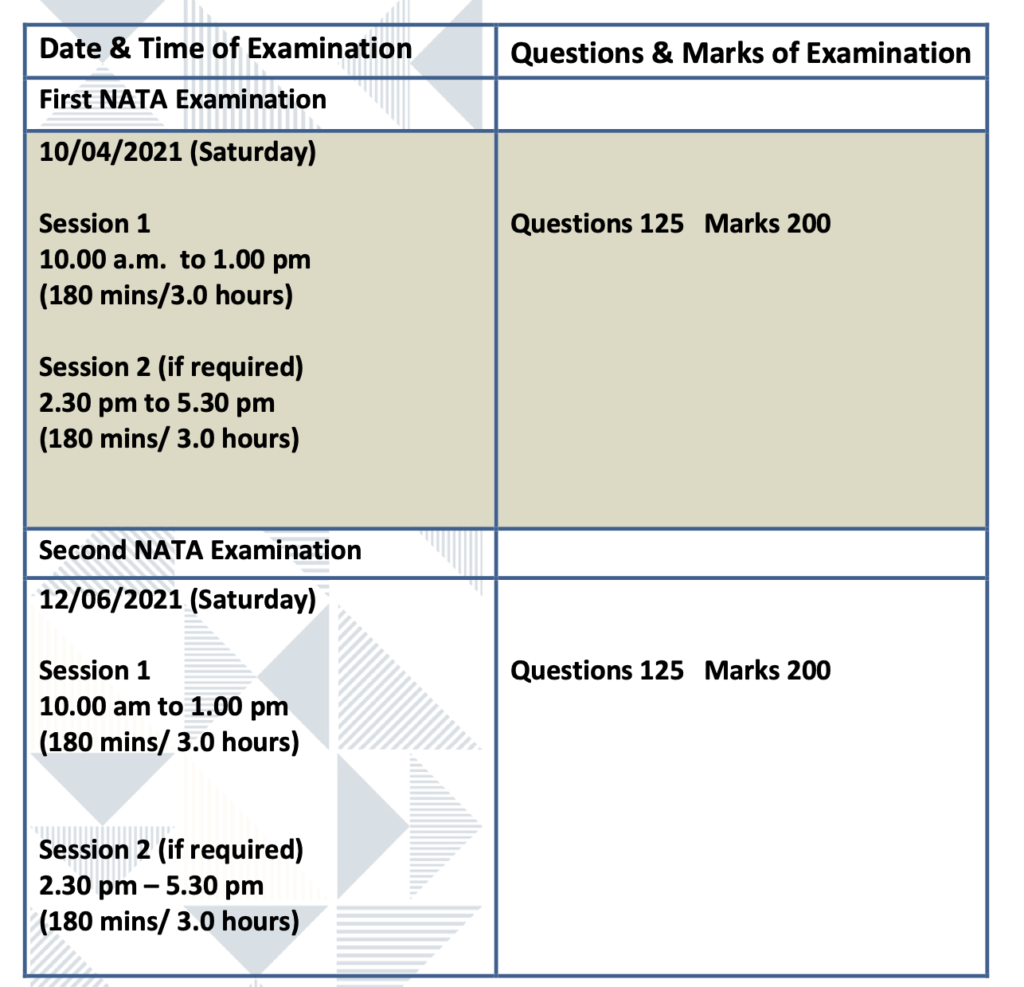

 Dear Parent/Student,
 So, before you say YES to join the fascinating field of design, do visit www.codevgu.in and experience a redefined Design Education.
 The Indian real estate industry in Dec 2020 was estimated to be, rising income levels, urbanization and the rapid growth of the IT sector are the key drivers for the Indian real estate sector. Currently as the economy is facing a slump due to global downturn, the real estate sector is facing difficulties. However, in the next 2-3 years most of the larger players are anticipated to expand aggressively across the country. With this slump considered momentary, Indian real estate industry is likely to witness huge growth again. With increase in growth, demand for allied services like architecture, interior design & landscape architecture is likely to increase.

 The capital of Rajasthan, built proudly by Maharaja Sawai Jai Singh II is famous for its majestic forts, opulent Havelis, beautiful lakes, and dunes. Jaipur is part of the famous Golden Triangle Tourist circuit that includes Delhi and Agra. But Jaipur is not only endowed with wonderful tourist attractions but the city also has an excellent infrastructure to support the tourism. Jaipur has some of India’s best hotels, which compliments the scenic and architectural beauty of the Pink City.
 Jaipur is considered one of the most prolific examples of a planned city, it exemplifies approaches to city planning, sustainability and spatial manifestation of the social fabric through architecture. The lessons that can be learned by understanding this place are deep rooted in its context and are beautiful. Each place has lessons that can teach us about the importance of foresight, planning and mindful use of resources. An effort should be made to make it an inherent part of education and moreover an integral part of design education.
 for a good education, then there cannot be a place better than Jaipur. A place where there is no political disturbance, no goons to threaten you here and there, a place to give you a busy life when you need it, a place which would give you the country’s heritage to enjoy any time you need, a place which would give you the mountains and the lakes for a relaxing tour, and the most comfortable evening for studies.
 There are abundant government and private universities present in Jaipur which focusses on the School of Architecture and design. Arch College of Design & Business. INIFD Jaipur, Indian Institute of Gems and Jewellery Jaipur, Indian Institute of Crafts & Design, IIFA INDIA are some of the best examples. As per the latest update among top colleges, the second-best private institute; Pearl Academy Jaipur for Fashion Design is recognized by India Today for the past three consecutive years. Pearl awards Professional Diploma from Pearl Academy and B. Des. Degree from Rajasthan ILD Skill University (RISU). Sounds exciting? Enroll in Pahal design and prepare for a better future in design and technology. Get the best practical experience with the rich heritage of Jaipur and let us help you to make your dreams come true in this beautiful city.
 Aditya Sinha, the all India topper of (NATA) 2020 entrance test, believed in the simple philosophy of ‘Be inspired; nothing is impossible’ to achieve this feat. Depending on rigorous efforts, the NATA topper from Delhi shares that he focused on enhancing his analytical skills and practised sketching as much as possible and worked on Architecture Aptitude.
 National Aptitude Test in Architecture (NATA) is being conducted by COA since 2006, in terms of the provisions of CoA (Minimum Standards of Architectural Education) Regulations, 1983, published in the Gazette of India. It is implied that a separate aptitude test in Architecture should be conducted and such test should not be combined with the tests for admissions to Engineering, Pharmacy, Medicine and other disciplines. Being the competent authority for fixing the norms and standards for architectural institutions, COA has the necessary expertise to hold a Common Aptitude Test in Architecture, at national level to provide a single window system for appearing in aptitude test and to facilitate institutions, students and public at large for admission to First year of 5 year B.Arch. Degree Course at all recognized Institutions all over country. The purpose of conducting NATA is to provide a single scheme of examination for holding aptitude test and to facilitate prospective students all over the country to apply for admissions in architecture seats in institutions spread across the country and to avoid appearing in multiple aptitude tests. However, the actual admissions shall be carried out only by the concerned competent authorities of the respective states/institutions based on valid NATA score. The NATA also ensures that the eligibility criteria for admission to five-year Bachelor of Architecture (B.Arch.) degree course, as prescribed by CoA and duly approved by the Central Government, are strictly adhered to and followed all over the country in Architectural Institutions.
 With the objective of attracting a greater number of bright aspirants for studying Architecture and practicing the same as a profession in future, Council like every year will be conducting NATA-2020 for admission to B.Arch. in the academic session 2020-2021. NATA-2020 shall be conducted twice a year, thus giving opportunity to those students who miss out the first test due to some reason or other or wish to improve upon their NATA score in the first test by re-appearing the second test. Both the first and second test will be conducted on different dates as totally computer-based examinations all over the country.