If you’re dreaming of getting into top design colleges like IIT Bombay, IIT Delhi, IIT Guwahati, or IIT Hyderabad, then cracking UCEED (Undergraduate Common Entrance Examination for Design) is your first step!

UCEED 2026 will test not just your drawing skills, but also how you think, observe, imagine, and connect ideas with the world around you. The exam has two parts – Part A and Part B, and understanding the syllabus deeply will help you prepare smartly.

UCEED (2010-2025) Original Exam papers

Part A – Design and Analytical Thinking

Part A focuses on your observation, reasoning, and creativity through objective-type questions. It’s about how you see, analyze, and interpret the world — skills that every great designer needs.

🔹 1. Visualization and Spatial Reasoning

You’ll be tested on how well you can visualize and mentally manipulate 2D shapes and 3D objects. Imagine folding paper, rotating cubes, or understanding the geometry behind everyday objects.

🔹 2. Practical and Scientific Knowledge

Design and science go hand-in-hand. This section checks your understanding of basic scientific principles and how things work in real life — from levers to light to everyday gadgets.

🔹 3. Observation and Design Sensitivity

Great designers notice what others miss. This part tests your ability to observe minute details, identify patterns, and think critically about form, function, and context.

🔹 4. Environment and Society

Design isn’t just about aesthetics — it’s about solving real-world problems. Be ready to answer questions on environmental issues, culture, and how design impacts society.

🔹 5. Analytical and Logical Reasoning

Here, your reasoning and problem-solving skills take the spotlight. Expect puzzles, data interpretation, and logic-based questions that test your qualitative and quantitative thinking.

🔹 6. Language and Comprehension

You’ll need to understand and interpret Standard English texts — passages, conversations, or descriptions — to assess your comprehension and interpretive skills.

🔹 7. Creativity

This is where your imagination shines! You’ll face questions that test your ability to think out of the box, use analogies, and connect ideas through symbols, metaphors, and visual logic.

Part B – Drawing and Design Aptitude

Part B is hands-on. It tests your ability to sketch, visualize, and communicate ideas through drawing.

🔸 1. Drawing Skills

You’ll need to draw products, people, or scenes accurately with attention to proportion, perspective, and line quality. Composition, light, and shading also matter — because your drawing should tell a story.

🔸 2. Design Aptitude

This section measures how you apply creativity to real-life challenges. It’s about design thinking, empathy, and practical innovation — solving problems visually and meaningfully.

ngg_shortcode_0_placeholder

FAQ’s

What is the structure of the UCEED exam and what topics does it cover?

The UCEED exam is divided into two parts, Part A and Part B. Part A focuses on design and analytical thinking, testing visualization, scientific knowledge, observation, environment, reasoning, language comprehension, and creativity. Part B emphasizes drawing skills and design aptitude, assessing the ability to sketch, visualize, and communicate ideas visually.

How should I prepare for Part A of the UCEED exam to enhance my chances of success?

Preparation for Part A should include practicing visualization and spatial reasoning exercises, understanding basic scientific principles, improving observation skills, studying environmental and societal issues, enhancing logical reasoning abilities, strengthening language comprehension, and fostering creativity through various problem-solving activities.

What skills are assessed in Part B of the UCEED exam, and how can I improve my performance in this section?

Part B evaluates your drawing skills and design aptitude. To improve performance, practice sketching products, people, and scenes with attention to proportion, perspective, and shading. Additionally, develop your ability to think creatively, approach design challenges with empathy, and communicate ideas clearly through visual means.

Are there any specific requirements or instructions regarding the use of a scribe during the UCEED exam?

Yes, a scribe is allowed to assist candidates in reading questions or entering answers as per the candidate’s instructions. However, the scribe is not permitted to explain the questions or suggest solutions, ensuring that the exam remains fair and based on the candidate’s own abilities.

Will there be any spot round of counselling or admissions for UCEED candidates?

There are no spot admission rounds for IITs after the counseling process. However, IIITDM Jabalpur may conduct a spot round of admissions at the institutional level if there are remaining vacant seats after the main counseling process.


If you have any doubts then feel free to connect us at 8800-22-6864

Pahal Design Centres 



On this World Standards Day, we celebrate the benchmarks that drive progress, innovation, and excellence.

At PAHAL Design, we believe that raising our standards — in creativity, design education, and integrity — is the key to elevating our world. 🌍✨

Let’s continue to set higher goals and inspire the next generation of design thinkers.

#WorldStandardsDay #PahalDesign #DesignExcellence #Innovation #CreativeEducation #Leadership #DesignThinking

Student Type: Class 12

Institute: Pahal Design

Exam Date: 21 December 2025 (Prelims)

Study Duration: 6 months (Oct 2025 – Mar 2026)

Perfect, thank you 🙌

You’re a Class 12 student with Pahal Design coaching (12 hrs/week), strong in Creative Thinking, and want to improve Time Management — and you’d like Weekly Mock Tests included.

Here’s your 6-Month Structured NID DAT (B.Des) 2026 Prelims Plan – Oct 2025 to Mar 2026

🗓️ MONTH 1: OCTOBER 2025 — FOUNDATION & CONSISTENCY

Goal: Strengthen sketching discipline + basics of design aptitude

Weekly Focus:

Week 1: Line quality, proportion, shading, basic objects (cups, bottles, furniture) Week 2: Human figures, gesture drawing, basic anatomy Week 3: Perspective (1-point, 2-point), indoor/outdoor spaces Week 4: Observation exercises — draw from life (daily 15–20 min)

Theory + Aptitude:

Daily 15–20 min GK (design, art, culture, logos, current affairs) 2 reasoning exercises (pattern, analogy, visual puzzles) each week

Mock Test: 1 every Sunday (2 hours)

→ Focus on completing all questions within time.

Creative Challenge: “Everyday Object, New Use” — redesign an object with a new function.

🗓️ MONTH 2: NOVEMBER 2025 — IDEA DEVELOPMENT & SPEED

Goal: Improve idea generation + learn to draw fast & clean

Weekly Focus:

Week 1: Storyboard sketches – create 4-frame visual stories Week 2: Product sketching – draw 10 everyday products in 30 mins Week 3: Scene composition – perspective + storytelling Week 4: Design thinking prompts (“How to reduce waste?”, “Redesign a classroom”)

Theory + Aptitude:

Logical reasoning: sequences, odd-one-out, spatial reasoning Visual GK: identify famous designs, logos, products

Mock Test: Every Sunday (3 hours full-length)

→ Target 90+% completion within time.

Creative Challenge: “Festival Reimagined” – redesign a festival logo/poster.

🗓️ MONTH 3: DECEMBER 2025 — EXAM SIMULATION PHASE

Goal: Full Prelims simulation, build confidence before exam

Weekly Focus:

2 full-length mocks per week Time practice: sketch completion in < 15 min per question Daily warm-up: 10-min object sketch + 1 creative idea prompt

Theory + Aptitude:

Quick revision: reasoning, GK (art movements, NID facts, design pioneers) Review all mock tests and note recurring mistakes

Mock Test:

Sunday = Full 3-hour DAT Prelims simulation Wednesday = Sectional speed test (Creative / Aptitude)

Creative Challenge: “Design for a Social Cause” – poster or visual concept.

🗓️ MONTH 4: JANUARY 2026 — FOUNDATION REVISIT + MAINS PREP START

Goal: Revisit weak areas + start early exposure to Studio Test-type activities

Weekly Focus:

Perspective + proportion refresh Quick idea thumbnails (draw 5 ideas for 1 topic) Basic model-making concepts (paper, clay, wire exercises)

Mock Test: 1 full paper weekly + 1 quick 60-min challenge midweek

Creative Challenge: “Redesign your school bag / workspace.”

🗓️ MONTH 5: FEBRUARY 2026 — ADVANCED IDEATION + MASTERY

Goal: Expand imagination and improve clarity in presentation

Weekly Focus:

Week 1: Product + environment combos Week 2: Comic strip storytelling Week 3: Unusual combinations (e.g., “Tree + Phone” design challenge) Week 4: Personal portfolio sketches

Theory + Aptitude:

Solve 1 reasoning set daily Design awareness flashcards (NID, NIFT, Indian crafts, famous logos)

Mock Test: 2 per week (alternate days)

Creative Challenge: “Nature + Technology” concept illustration.

🗓️ MONTH 6: MARCH 2026 — FINE-TUNING & MAINS BRIDGE

Goal: Maintain speed, polish creativity, and transition to Mains prep

Weekly Focus:

Time trials: finish full papers in 2.5 hours Focused improvement on weak areas from mock analysis Brainstorming drills (idea web, mind mapping)

Mock Test: Every Sunday (with peer or mentor review)

Creative Challenge: “Future Living” – visualize city life in 2050.

For any details call 8800-22-6864

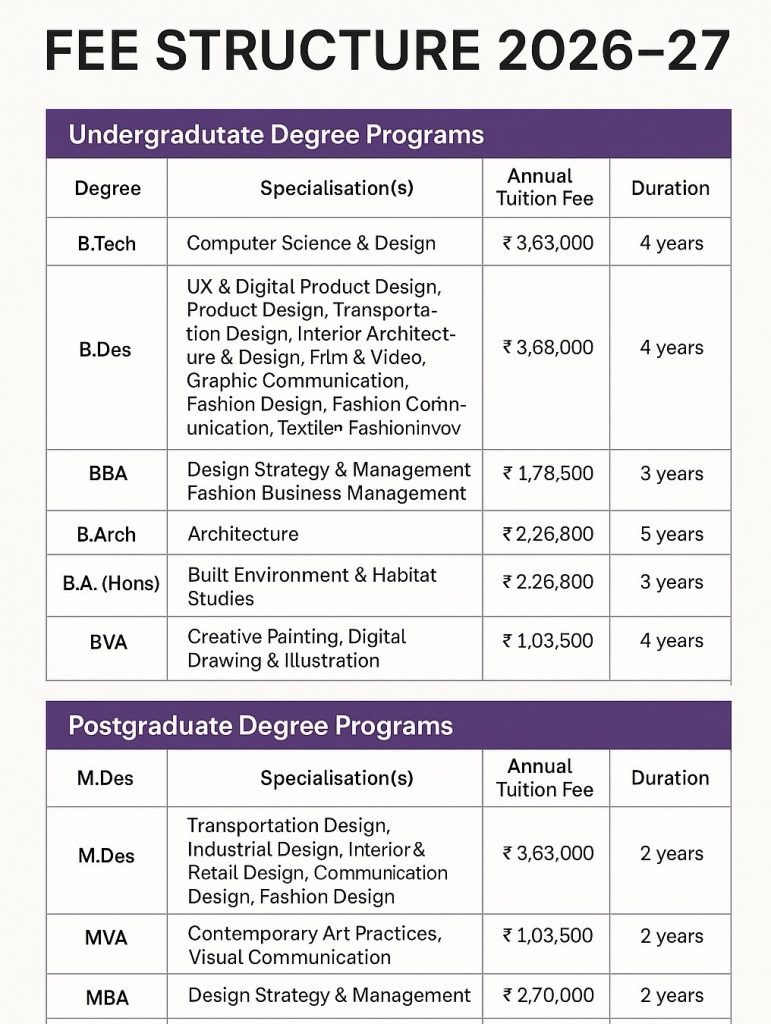
World University of Design (WUD), Haryana, is India’s premier institution dedicated entirely to creative education, ranked A+ (Diamond Band) by QS I-GAUGE for academic excellence. Spread over 12 acres with specialized labs, hostels, and world-class studios, WUD offers 30+ programs across Design, Architecture, Fashion, Communication, Visual Arts, Performing Arts, and Business. The faculty includes alumni from NID, NIFT, IIT, and top global institutions.

With ₹10 crore worth of scholarships awarded annually and collaborations with 20+ international universities under Cumulus and Erasmus+, WUD empowers students to think, create, and innovate. Its outcome-based education model, industry memberships with CII, FICCI, and ASSOCHAM, and a vibrant, diverse student body from 22 Indian states make it a universe of creative possibilities.

Admissions to the Bachelor of Design (BDes) programmes at IIT Bombay, IIT Delhi, IIT Guwahati, IIT Hyderabad, IIT Indore, IIT Roorkee and IIITDM Jabalpur are done through the Undergraduate Common Entrance Examination for Design (UCEED). Students who have passed Class XII (or equivalent) in 2025, or appearing in 2026, in ANY STREAM (Science, Commerce, or Arts & Humanities) are eligible to appear for UCEED 2026.

Important Dates

Activity Date
   
Start date for Online Registration October 01, 2025, 01:00 pm
Last date for Online Registration with regular fee October 31, 2025
Last date for Online Registration with late fee November 07, 2025, 5:00 pm
Start date for Admit Card downloading January 02, 2026, 01:00 pm
Last date for rectification of discrepancies in Admit card January 08, 2026, 05:00 pm
UCEED 2025: date and time of exam January 18, 2026 (Sunday)
09:00 am to 12:00 noon
Release of Draft Answer Key and candidates’ response for Part-A January 20, 2026
Last date for uploading comments (if any)
on the Draft Answer Key in the candidate’s portal
January 22, 2026, 05:00 pm
Release of Final Answer Key for Part-A January 28, 2026, 05:00 pm
Announcement of cut-off marks for Part-A February 05, 2026
Declaration of results March 06, 2026
Start date for Score Card downloading March 10, 2026
Application Process for BDes Programme starts Admission Schedule »
Last date for Score Card downloading July 31, 2026

Note:

  • Any request for change in the examination date and time will not be considered.
  • The dates for the seat allotment rounds are tentative. The change in date(s) (if any) will be posted on the official website (www.uceed.iitb.ac.in).

Syllabus

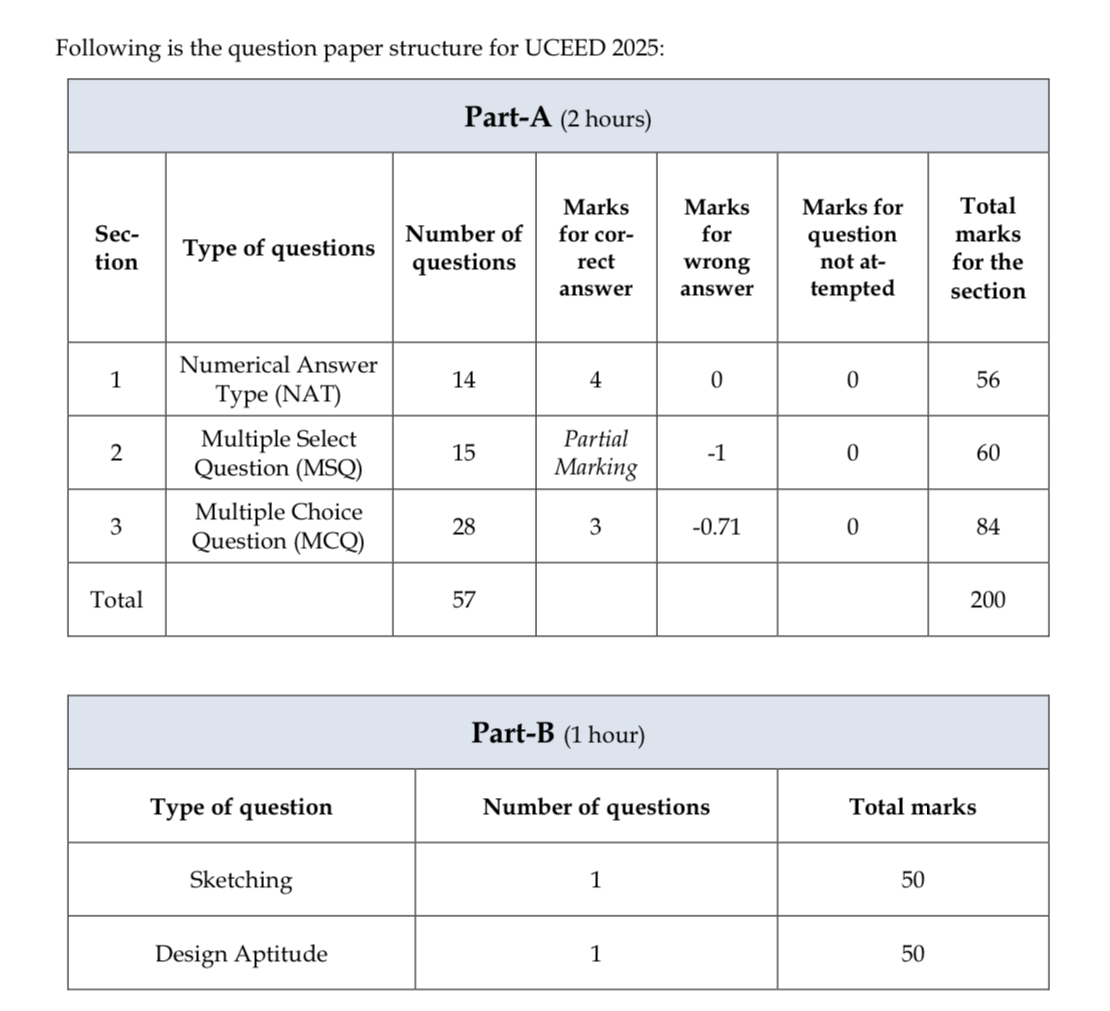
UCEED 2026 will have two parts.

Part-A will have questions from the following topics:

  • Visualization and spatial reasoning: Ability to visualise and transform 2D shapes and 3D objects and their spatial relationships.
  • Practical and scientific knowledge: Know-how of scientific principles and everyday objects.
  • Observation and design sensitivity: The capacity to detect concealed properties in daily life and think critically about them. Attention to detail, classification, analysis, inference and prediction.
  • Environment and society: General awareness of environmental, social and cultural connections with design.
  • Analytical and logical reasoning: Ability to analyse qualitative and quantitative information.
  • Language: Proficiency in reading and comprehending Standard English.
  • Creativity: Grasp of verbal and non-verbal analogies, metaphors, signs and symbols.

Part-B will have questions on the following topics:

  • Drawing: Ability to draw products, people or scenes in proportion with good line quality, composition, proportion, perspective and shading.
  • Design aptitude: Capability to practically and appropriately respond to problems/situations with ingenuity and empathy.


Launch Your Fashion Career: A 7-Step Action Plan

Starting a career in fashion design can be exciting and rewarding. Here are some steps you can take to kickstart your fashion design career:

NIFT_official_logo

1. Education: Consider enrolling in a reputable fashion design school or program to gain formal education and training in the field. A degree or diploma in fashion design will provide you with a solid foundation of knowledge and skills.

2. Build your portfolio: Create a strong portfolio showcasing your design work, sketches, projects, and any relevant experience. Your portfolio is a visual representation of your skills and creativity, which can help you stand out to potential employers or clients.

3. Gain experience: Seek internships, apprenticeships, or entry-level positions in the fashion industry to gain hands-on experience and practical knowledge. This will also help you network and make valuable connections within the industry.

4. Stay updated: Keep yourself updated with the latest trends, techniques, and technologies in the fashion industry. Attend fashion shows, workshops, and events to stay informed and inspired.

5. Develop your unique style: Experiment with different styles, techniques, and materials to develop your signature aesthetic as a fashion designer. Having a distinct and recognizable style can set you apart from others in the industry.

6. Network: Build relationships with other professionals in the fashion industry, such as designers, stylists, buyers, and manufacturers. Networking can open up opportunities for collaborations, projects, and potential career advancements.

7. Stay persistent and dedicated: Pursuing a career in fashion design requires hard work, dedication, and persistence. Be prepared to face challenges and setbacks along the way but stay focused on your goals and continue honing your craft.

Remember that the fashion industry is competitive, but with talent, passion, and perseverance, you can carve out a successful career as a fashion designer. Good luck!

Manav Rachna

Career Pathways:

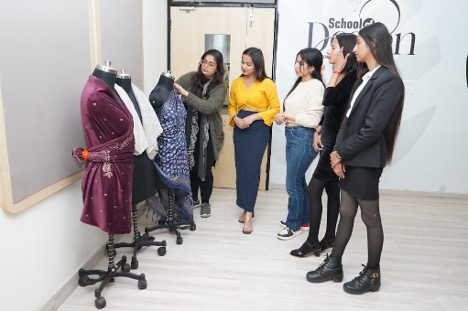
Graduates find employment opportunities with fashion designers, in-house design teams of textile mills, export houses, buying agencies, retail sector, design studios in the couture, bespoke and ready to wear segments for women, men and children.

Some of the notable employers are fashion designers Sabyasachi Mukherjee, Rajesh Pratap Singh, Ritu Beri, Gaurav Gupta, Amit Agarwal, Suket Dhir, Manish Arora, Rahul Mishra, Anita Dongre, Manish Malhotra, Abu Jani Sandeep Khosla, Tarun Tahiliani, Rohit Bal and others; export and buying houses such as Shahi Exports, Orient Craft, Span India, Modelama, Li & Fung, Triburg, and Impulse; retail sector employers include Reliance Retail, Raymond, Aditya Birla Fashion and Retail Ltd., Taneira, Landmark, TCNS, Pantaloons, Good Earth, Blackberry.

There are opportunities with textile mills with in-house design labels such as Arvind Ltd. and Raymond Ltd., and NGOs working in the crafts sector. E-commerce platforms like Amazon, Myntra, Ajio, Tata CLiQ and First Cry; trend forecasting companies such as WGSN and Patternbank, digital and virtual fashion design consultancies offer creatively challenging career options.

The objective of the Common Entrance Exam for Design (CEED) is to assess the candidate’s aptitude for design involving visual perception ability, drawing skills, logical reasoning, creativity, communication, and problem solving skills. CEED is conducted by IIT Bombay. It is a qualifying examination for admission to Master of Design (MDes) programmes at IISc Bangalore, IIT Bombay, IIT Delhi, IIT Guwahati, IIT Hyderabad, IIT Jodhpur, IIT Kanpur, IIT Roorkee, IIITDM Jabalpur, IIITDM Kancheepuram and PhD programmes at several IITs and design schools. Qualifying in CEED alone does not guarantee admission to any of these programmes. Admitting institutes may conduct further tests and/or interviews for the final selection/admission.

A CEED score does NOT guarantee admission. Admitting institutes will also verify the eligibility, category certificates and other documents along with the CEED score. The CEED 2025 score is valid for one year from the date of declaration of the result.


CEED 2025 Question Paper

CEED 2025 Answer key 

Eligibility

Candidates must have completed a graduate degree/diploma/postgraduate degree program of a minimum of THREE years (after 10+2 level) or must be appearing for the final examination of such a program by July 2025, or must have passed the GD Arts diploma program (10+5 level) by July 2025.

Note that the eligibility criteria for admission to various institutes may differ from those for appearing for CEED. Before applying for CEED, candidates must check whether they meet the required eligibility criteria for admission to various institutes.

There is no age limit to appear for CEED. Also, a candidate can appear for CEED any number of times.

Syllabus

CEED 2025 will be in two parts (A & B). Part-A will have questions related to the following topics:

  • ●  Visualization and spatial reasoning: Ability to visualise and transform 2D shapes and 3D objects and their spatial relationships.
  • ●  Practical and scientific knowledge: Know-how of scientific principles and everyday objects.
  • ●  Observation and design sensitivity: The capacity to detect concealed properties in daily life and think critically about them. Attention to detail, classification, analysis, inference, and prediction.
  • ●  Environment and society: General awareness of environmental, social and cultural connections with design.
  • ●  Analytical and logical reasoning: Ability to analyse qualitative and quantitative information.
  • ●  Language: Proficiency in reading and comprehending Standard English.
  • ●  Creativity: Grasp of verbal and non-verbal analogies, metaphors, signs, andsymbols.
  • ●  Art and Design knowledge: Awareness about art/artifact/product, artists/designers, art/design history, and trends.
  • ●  Design methods and practices: Knowledge of media, materials, production processes, and ergonomics.Part-B of CEED 2025 will have questions related to the following topics:
  • ●  Drawing: Ability to draw products, people or scenes in proportion with good line quality, composition, proportion, perspective, and shading.
  • ●  Creativity: Ability to think out-of-the-box and come up with unique as well as diverse solutions.
  • ●  Communication: Skills to communicate concepts and ideas clearly with the help of text and visuals.
  • ●  Problem identification: Skills to understand the user and the context, knowledge of properties of materials and their appropriate use in design.
Hauz Khas (Corporate Office)
Address:- G-13, Ground Floor, Hauz Khas, New Delhi-110016
Nearest Metro Station Hauz Khas Gate No-3, Mayfair Garden / RBI Colony
Landmark:
Opposite Joups
Contact No: 8800-22-6864
Contact Person: Karishma Gupta
Email: corporate@pahaldesign.com


UCEED 2025 will be conducted by the Indian Institute of Technology Bombay under the guidance of the UCEED-CEED Implementation Committee 2025 (henceforth referred to as the UCI Committee).

UCEED 2025 is open to all nationals (Indian/Foreign). Candidates seeking admission to the Bachelor’s Degree programme in Design (BDes) at Indian Institute of Technology Bombay (IITB), Indian Institute of Technology Delhi (IITD), Indian Institute of Technology Guwahati (IITG), Indian Institute of Technology Hyderabad (IITH), Indian Institute of Technology Roorkee (IITR) and Indian Institute of Information Technology Design and Manufacturing Jabalpur (IIITDMJ), must appear for UCEED 2025. UCEED 2025 score is valid only for admission to the programmes in the academic year 2025-2026.

SCHEDULE OF UCEED 2025

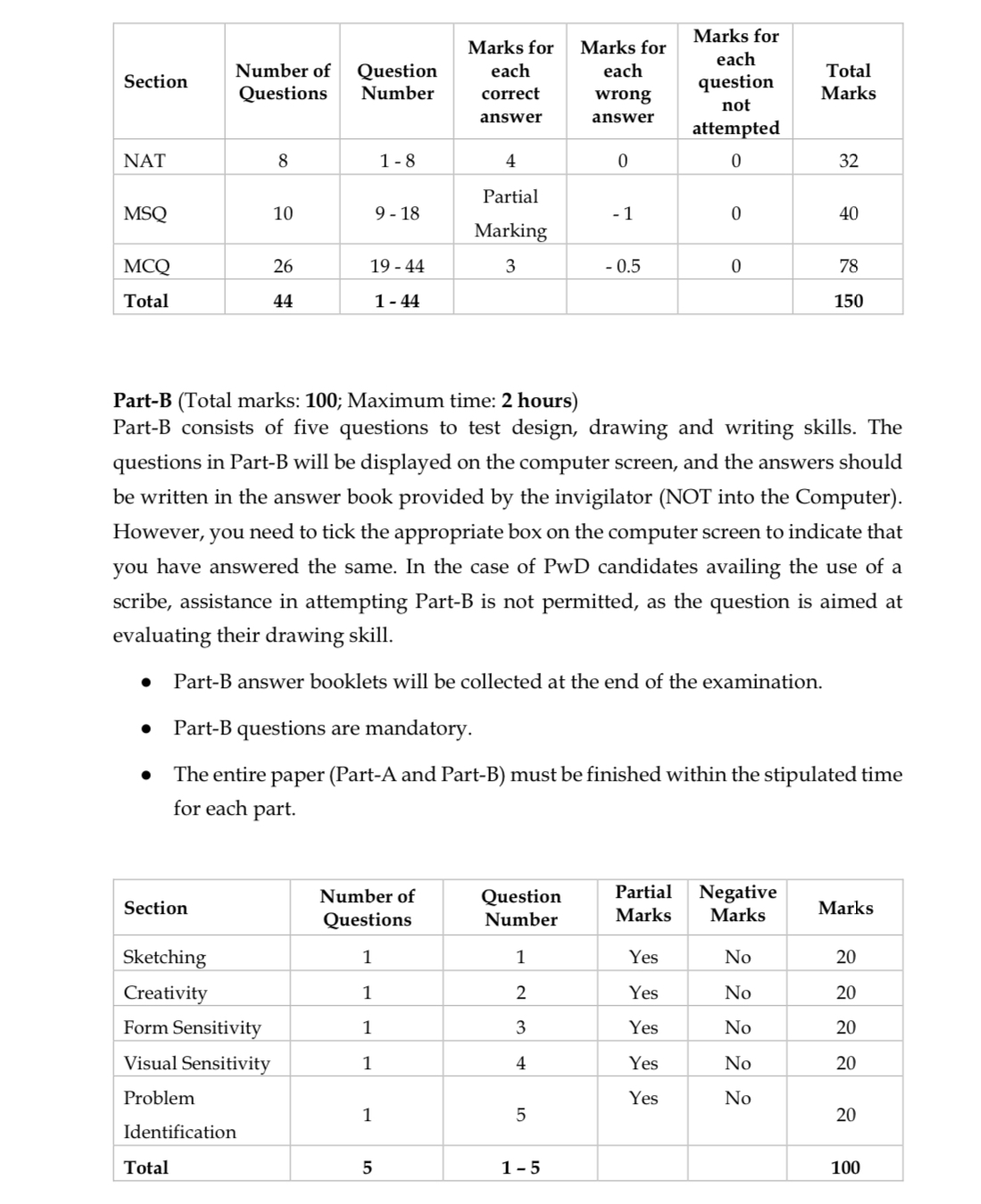
UCEED is a test centre-based examination and has two parts: Part-A is computer-based and Part-B contains questions related to sketching that needs to be attempted on the provided sheet. It is compulsory for the candidates to attempt both the parts in the given time.

The total time for the examination (that includes both Part-A and Part-B) is THREE hours and it will be held as per the following schedule:

Date

January 19, 2025 (Sunday)

Time

09:00 am to 12:00 noon

UCEED Brochure 2025

Important Dates

Activity Date
   
Start date for Online Registration October 01, 2024, 01:00 pm
Last date for Online Registration with regular fee October 31, 2024
Last date for Online Registration with late fee November 08, 2024, 5:00 pm
November 18, 2024, 5:00 pm
Start date for Admit Card downloading January 03, 2025, 01:00 pm
Last date for rectification of discrepancies in Admit card January 09, 2025, 05:00 pm
UCEED 2025: date and time of exam January 19, 2025 (Sunday)
09:00 am to 12:00 noon
Release of Draft Answer Key and candidates’ response for Part-A January 21, 2025
Last date for uploading comments (if any)
on the Draft Answer Key in the candidate’s portal
January 23, 2025, 05:00 pm
Release of Final Answer Key for Part-A January 29, 2025, 05:00 pm
Announcement of cut-off marks for Part-A February 06, 2025
Declaration of results March 07, 2025
Start date for Score Card downloading March 10, 2025
Application Process for BDes Programme starts Admission Schedule »
Last date for Score Card downloading June 11, 2025
 
Hauz Khas (Corporate Office)
 
Address:- G-13, Ground Floor, Hauz Khas, New Delhi-110016
Nearest Metro Station Hauz Khas Gate No-3, Mayfair Garden / RBI Colony
Landmark:
Opposite Joups
Contact No: 8800-22-6864
Contact Person: Karishma Gupta
Email: corporate@pahaldesign.com

Commonly Asked Questions in NID M.Des. Interview

 
1. Personal & Academic Background
 
•Tell us about yourself.
•Why do you want to pursue M.Des. at NID?
•Why did you choose this specific discipline?
•Walk us through your academic and professional journey so far.
•How has your background (educational/work experience) prepared you for this course?
•Why are you shifting from [your previous field] to this design discipline? (If applicable)
 
2. Portfolio & Work Review
 
•Walk us through your portfolio.
•What is your favorite project in your portfolio and why?
•How did you approach this project? What was your design process?
•What was the biggest challenge you faced in any project, and how did you solve it?
•If you had to redo one of your projects, what would you change?
•Which software, tools, and techniques do you use in your work?
•How do you ensure that your design is user-centric?
 
3. Design Thinking & Problem-Solving
 
•Define design in your own words.
•What is your understanding of design thinking?
•Can you describe a real-world problem and propose a design-based solution?
•How would you redesign a common object like a chair, ATM machine, or traffic signal?
•How do you incorporate sustainability in your designs?
•If given a tight deadline, how do you prioritize tasks?
•What inspires you as a designer?
 
4. Design Awareness & Industry Knowledge
 
•Who are your favorite designers or design studios, and why?
•Name a recent design innovation that impressed you.
•What are the current trends in your chosen design discipline?
•How do you think design can impact society?
•Which brands or companies do you admire for their design, and why?
 
5. Course & Career Goals
 
•Why did you choose NID over other design schools?
•Where do you see yourself after completing your M.Des.?
•Do you want to work in the industry, freelance, or pursue academia?
•How does this course align with your career goals?
•Are you open to interdisciplinary collaborations?
 
6. Situational & Hypothetical Questions
 
•If you had unlimited resources, what design problem would you solve?
•Suppose your design is criticized by a client or professor; how would you handle it?
•If given a team project where team members disagree, how would you manage the situation?
•If you were given ₹10 lakh to start a design-based business, what would you do?
 
7. General Knowledge & Creativity Challenges
 
•How would you explain design to a 5-year-old?
•If you had to design a product for the blind, what factors would you consider?
•Think of a random word (e.g., “circle”) and create a design concept around it.
•How would you use storytelling in design?

NID M.Des Result 2025-26

NID M.Des DAT Mains Schedule 2025-26

Master of Design Handbook 2025-26

Hauz Khas (Corporate Office)
Address:- G-13, Ground Floor, Hauz Khas, New Delhi-110016
Nearest Metro Station Hauz Khas Gate No-3, Mayfair Garden / RBI Colony
Landmark:
Opposite Joups
Contact No: 8800-22-6864
Contact Person: Karishma Gupta
Email: corporate@pahaldesign.com


The Indian Institute of Technology (IIT) Bombay has announced the results of the Common Entrance Examination for Design (CEED) 2025 today, March 5, 2025.   Candidates who appeared for the exam can now check their results on the official CEED website by logging in with their registered email address and password.  

The CEED 2025 exam was conducted on January 19, 2025, following registrations that began on October 1, 2024.   Candidates can download their scorecards from March 10 to June 11, 2025.   The scorecard will be valid for one year from the date of declaration of the result.

To check your CEED 2025 result, follow these steps:

1.Visit the official CEED website: ceed.iitb.ac.in.

2.On the homepage, click on the link that reads, “CEED 2025 results are now available to view on candidate portal after log-in.”

3.Enter your registered email ID and password.

4.Your CEED 2025 result will appear on the screen.

5.Check your result, download it, and take a printout for future reference.

For more information, candidates are advised to visit the official CEED 2025 website.


  1. CEED 2025 Original Exam paper
  2. CEED 2025 Answer Key
Schedule a free counselling session WhatsApp WhatsApp Enquiry