Introduction

India’s textiles sector is one of the oldest industries in the Indian economy, dating back to several centuries.

The industry is extremely varied, with hand-spun and hand-woven textiles sectors at one end of the spectrum, while the capital-intensive sophisticated mills sector on the other end. The decentralised power looms/ hosiery and knitting sector forms the largest component in the textiles sector. The close linkage of textiles industry to agriculture (for raw materials such as cotton) and the ancient culture and traditions of the country in terms of textiles makes it unique in comparison to other industries in the country. India’s textiles industry has a capacity to produce wide variety of products suitable for different market segments, both within India and across the world.

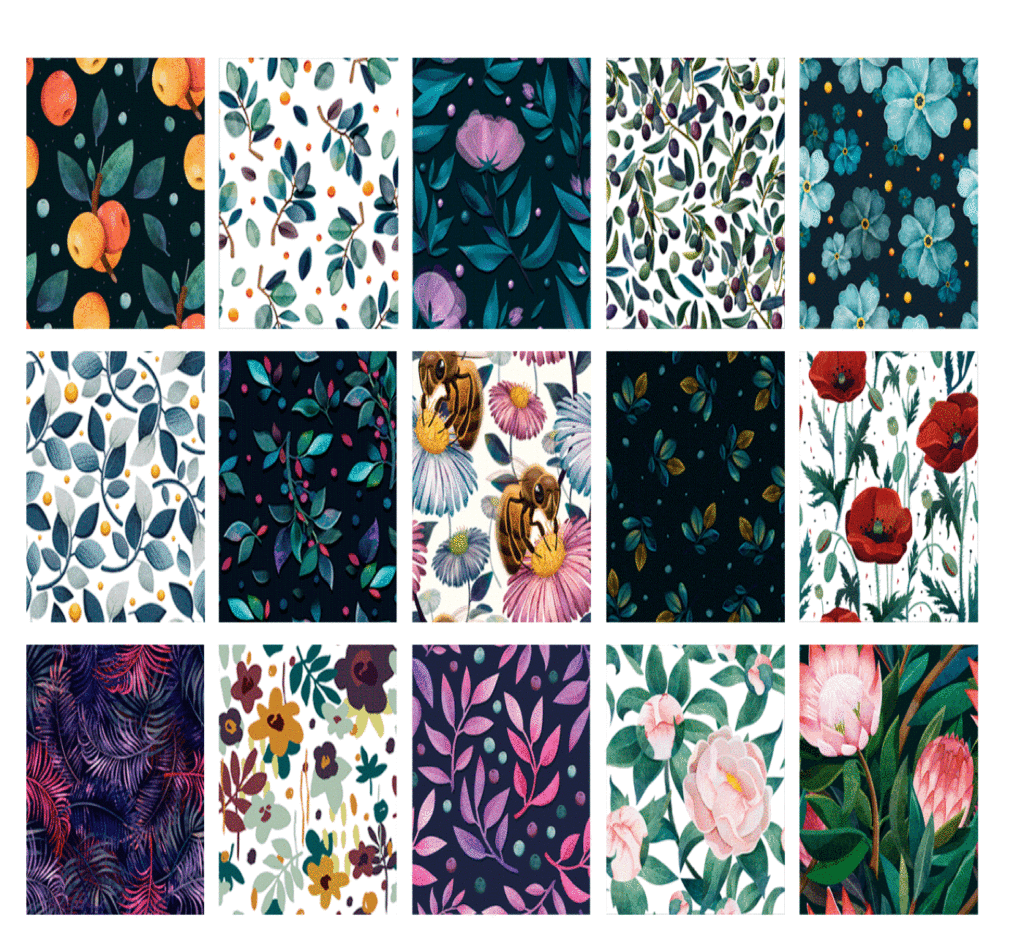
Textile design comprises both surface design and structural design and textile designers usually handle embroidery designs, print, weave and texture.
The courses focus on elementary ergonomics, textile fibers, color, composition, and basic textile design for weaving and printing. They also teach dyeing techniques, printing methods, sewing techniques, and construction of fabrics and surface design. These programs helps one understand all the intricacies of production, in order to find innovative solutions.
Textile designers work in garment manufacturing companies, fashion designing agencies, textile manufacturers, retail world, export houses or work as freelancers.

The textile and apparel industry is one of the earliest industries to have developed in India. Its inherent and unique strength is its incomparable employment potential owing to the presence of the entire value chain from fibre to apparel manufacturing within the country. It is the biggest employer after agriculture and provides direct employment to 4.5 crore people and another 6 crores in allied sectors. India needs to generate jobs that pay well, provide social protection to workers, support efficient production for export markets, and hold the potential for social transformation. The textile industry meets all these criteria.

India is the second-largest manufacturer of textiles and clothing in the world. India is also the second-largest exporter of textiles and apparel with a share of 5% of global trade. Exports of textile and clothing products, including handicrafts, from India have slightly increased to US$ 40.4 billion during the year 2018–19 from US$ 39.2 billion during 2017–18, registering a growth of 3%. However, India’s global share is way behind that of China, which has approximately 38% of the global textile and clothing trade. The share of textile and clothing in India’s total exports stood at 12% in 2018–19. With 48% total textile and apparel export, EU-28 and the United States are India’s major textile and apparel export destinations.

India has a very strong raw material base both in natural and manmade fibres (MMFs). India has emerged as the largest producer of cotton in the world with a production of 370 lakh bales in 2017–18 and the second-largest exporter of cotton. However, high contamination level and poor quality of fibre, both in fineness and length, are major concerns that need focused attention.

India has a strong presence in global exports of cotton yarn. Vietnam has increased its global export share of cotton yarn from 5% in 2012 to 15% in 2016. China and Bangladesh are the largest importers of cotton yarn from India, who in turn creates value addition to the yarn and then exports the same at a lower cost compared to India. India needs to upgrade its position from a supplier of cotton yarn to a producer of value-added fabrics and garments. As the world export value of cotton yarn has decreased over the years, it is an indication that the cotton textile trade is shifting towards different types of fibre such as MMF.
While India leads in cotton yarn exports, it has been a very marginal player when it comes to cotton fabric in world exports. China has a substantial share of 51% in cotton fabrics when compared to India’s 5%–6%; the situation is almost the same in case of MMF fabrics. This comparison suggests that India is not able to scale up the value chain significantly enough to meet the global demand despite being the largest producer and exporter of cotton yarn.

Approximately 95% of the weaving sector in India is unorganized in nature. The decentralized power loom and hosiery sector contributes 85% of total fabric production. The processing segment is also dominated by a large number of independent, small-scale enterprises. Since, the weaving/processing sector in India is dominated by small-scale enterprises, it has challenges such as inadequate know-how, low focus on research, innovation in new product development and low technology upgradation. Further, low productivity and automation levels also remain one of the biggest woes for the weaving industry. Due to these factors, the overall performance of fabric production in India is getting dampened. The weaving sector still remains one of the weakest links of the Indian textile and apparel industry.

India has one of the largest installed production bases in the world in weaving sector but at the same time it uses old technology with low productivity and quality levels. In terms of technology adoption in the weaving sector, India has only 2% share in global shuttle-less looms (i.e. modern looms) installed capacity. The cost of production in India also goes up due to poor technology levels and low scale of operations, as 95% of the weaving sector in India is unorganized and in small scale. India also lacks the presence of large fabric manufacturers when compared to China and the US.
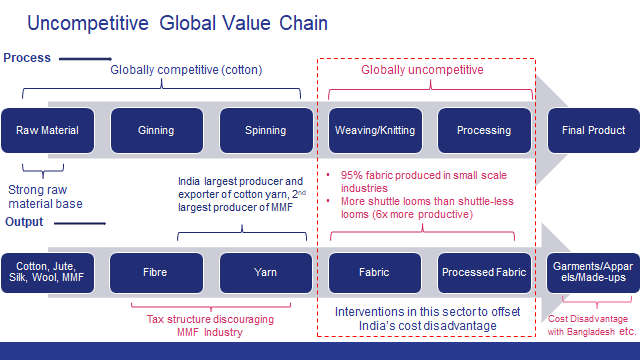
In order to make the textile industry competitive, industry needs to focus on investing in technology upgradation and expand weaving capacity to scale-up operations. To ensure rapid transformation of the weaving sector in India, under Amended Technology Upgradation Funds Scheme (ATUFS) of the Government of India, the weaving sector may be considered to get capital subsidy at par with garmenting and technical textiles. At present, the weaving sector is getting subsidy at 10% subject to cap of 20 crore under ATUFS, whereas for garmenting and technical textiles, subsidy is provided at 15% subject to cap of 30 crore. For creating few global champions in weaving sector in India, the Government of India may consider providing some enhanced subsidy under ATUFS, for select players, purely on outcome basis. Further, state governments should aggressively promote infrastructure and provide plug and play parks for the industry. Lands should be allotted in such parks for long-term lease. The supply of uninterrupted quality power at fixed price for a tenure of 15 years may also be considered in these parks. To ensure rapid scaling up of business, state governments should provide all the approvals in place, including the provision of CETPs/ZLD, as per need basis, in these parks.

The weaving sector is the backbone of the textile industry. On the one hand, promoting the weaving industry gives impetus to the domestic spinning industry and on the other, it makes our garment’ sector globally more competitive. With focused interventions in this sector, we might enhance its performance in terms of more investment, employment generation and export earnings.
Market Size

India’s textiles industry contributed 13% of the industry production in FY20. It contributed 2.3% to the GDP of India and employed more than 45 million people in FY20. The sector contributed 12% to India’s export earnings in FY20.

Textiles industry has around 4.5 crore employed workers including 35.22 lakh handloom workers across the country.

Cotton production in India is estimated to have reached 35.7 million bales in FY20.

The domestic textiles and apparel market stood at an estimated US$ 100 billion in FY19.

The production of raw cotton in India is estimated to have reached 36.04 million bales in FY20^. During FY19, production of fibre in India stood at 1.44 million tonnes (MT) and reached 1.60 MT in FY20 (till January 2020), while that for yarn, the production stood at 4,762 million kgs during same period.

Investment

The textiles sector has witnessed a spurt in investment during the last five years. The industry (including dyed and printed) attracted Foreign Direct Investment (FDI) worth US$ 3.45 billion from April 2000 to June 2020.

Government Initiatives

Indian government has come up with several export promotion policies for the textiles sector. It has also allowed 100% FDI in the sector under the automatic route.

Initiatives taken by Government of India are:

  • Government launched production linked incentive scheme to provide incentives for manufacture and export of specific textile products made of man-made fibre.
  • On September 2, 2020, the Union Cabinet approved signing an MOU between textile committee, India and M/s Nissenken Quality Evaluation Centre, Japan, for improving quality and testing Indian textiles and clothing for the Japanese market. This India-Japan pact on cooperation in textiles will facilitate Indian exporters to meet the requirements of Japanese importers as per the latter’s technical regulations.
  • Under Union Budget 2020-21, a National Technical Textiles Mission is proposed for a period from 2020-21 to 2023-24 at an estimated outlay of Rs. 1,480 crore (US$ 211.76 million).
  • In 2020, New Textiles Policy 2020 is expected to be released by the Ministry of Textiles.
  • CCEA approved mandatory packaging of foodgrains and sugar in jute material for the Jute Year 2019-20.
  • In September 2019, textiles export witnessed a 6.2% increase post GST as compared to the period pre-GST.
  • The Directorate General of Foreign Trade (DGFT) has revised rates for incentives under the Merchandise Exports from India Scheme (MEIS) for two subsectors of Textiles Industry – readymade garments and made-ups – from 2% to 4%.
  • The Government announced a special package of US$ 31 billion to boost export, create one crore job opportunity and attract investment worth Rs. 80,000 crore (US$ 11.93 billion) during 2018-2020. As of August 2018, it generated additional investments worth Rs. 25,345 crore (US$ 3.78 billion) and exports worth Rs. 57.28 billion (US$ 854.42 million).
  • The Government of India has taken several measures including Amended Technology Up-gradation Fund Scheme (A-TUFS), estimated to create employment for 35 lakh people and enable investment worth Rs. 95,000 crore (US$ 14.17 billion) by 2022.
  • Integrated Wool Development Programme (IWDP) was approved by Government of India to provide support to the wool sector, starting from wool rearer to end consumer, with an aim to enhance quality and increase production during 2017-18 and 2019-20.
  • The Cabinet Committee on Economic Affairs (CCEA), Government of India approved a new skill development scheme named ‘Scheme for Capacity Building in Textile Sector (SCBTS)’ with an outlay of Rs. 1,300 crore (US$ 202.9 million) from 2017-18 to 2019-20. As of August 2019, 16 states signed pacts with the Ministry of Textiles to partner with it for skilling about four lakh workers under the scheme.

Achievements

Following are the achievements of the Government in the past four years:

  • As of 2019, 348 technical textiles products were developed according to Bureau of Indian Standards (BIS).
  • I-ATUFS, a web-based claims monitoring and tracking mechanism was launched on April 21, 2016. 381 new block level clusters were sanctioned.
  • Under the Scheme for Integrated Textile Parks (SITP), 59 textile parks were sanctioned, out of which, 22 have been completed.
  • Employment increased to 45 million in FY19 from 8.03 in FY15.

Road Ahead

The future for the Indian textiles industry looks promising, buoyed by strong domestic consumption as well as export demand. With consumerism and disposable income on the rise, the retail sector has experienced a rapid growth in the past decade with the entry of several international players like Marks & Spencer, Guess and Next into the Indian market.

High economic growth has resulted in higher disposable income. This has led to rise in demand for products creating a huge domestic market.


Jaipur

Address:- 2nd Floor, F 18, Gautam Marg, Vaishali Nagar, Jaipur, Rajasthan -302021
Contact Person: Mr. Aman and Mr. Akbar
Contact No: 97721-99911, 0141-6656509
Email: jaipur@pahaldesign.com
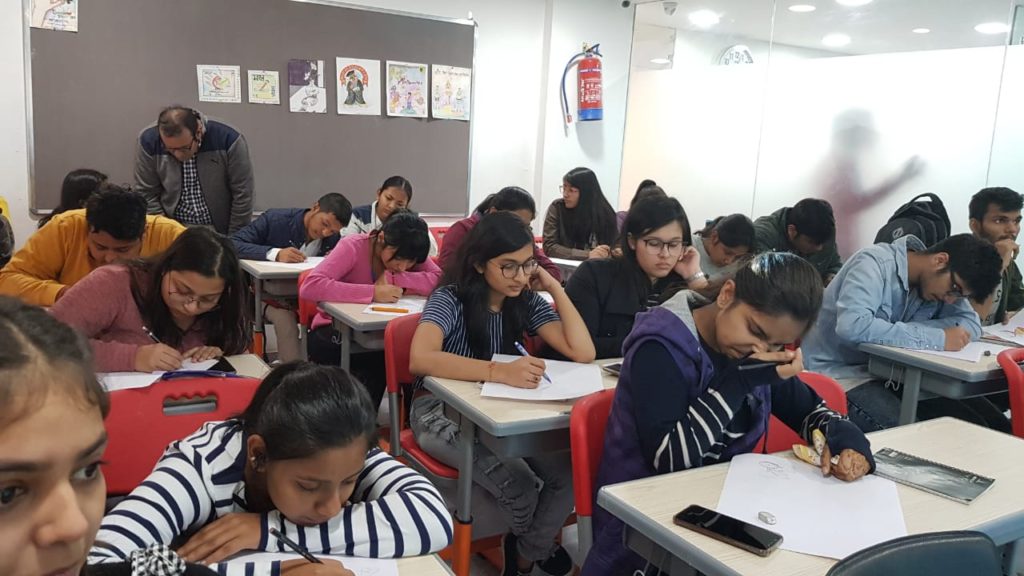
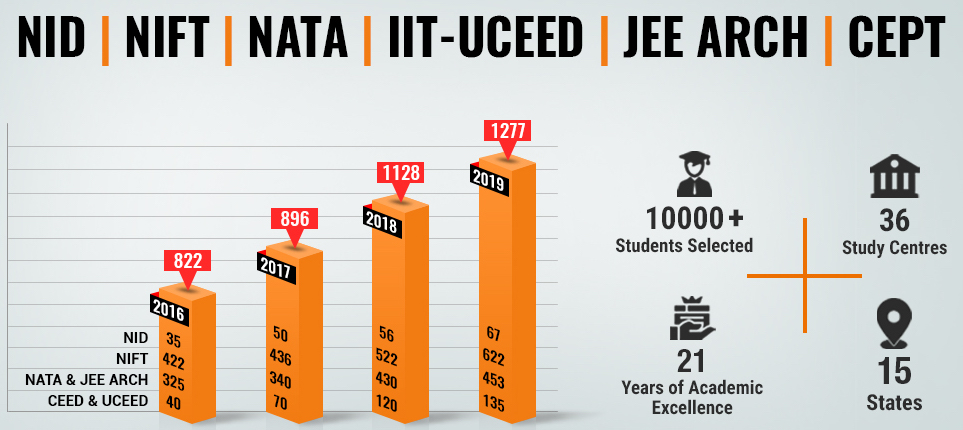
There are many Design Coaching in Jaipur but if we need to find out the best coaching classes, with best learning experience then Pahal Design comes with 22 Years of academic excellence and more than 40 centres across India including all the metros. (New Delhi, Mumbai, Bengaluru, Kolkata, Pune, Ahmedabad, Gurgaon, Jaipur, Lucknow, Dehradun, Chandigarh, Bhopal, Indore, Patna, Ranchi, Kanpur and many more other cities). Now Pahal Design is in Jaipur at Vaishali Nagar for Design, Architecture and Fine Arts Coaching. If any students are looking for Design, Fashion, Architecture and Fine Arts Coaching or any guidance related to Design Colleges then we have Free Guidance for all Design Students.

The design industry in India is growing at a staggering rate of 23 to 25 per cent annually – it’s an indicative of the qualitative change you find in the look and feel of consumer goods. Industry insiders believe that greater spending power and changing needs of consumers are responsible for the boom in the design industry. “People today are spending more money. From the interiors of their flats to the products they buy, all consumers are looking for that extra value-add. There is this new emphasis on vanity. The culture is shifting and design is a reflection of that shift.” With brand positioning and identity the new buzzwords, industries that form the designer’s client base are a lot more aware about design and its importance.

There are some sectors within the industry that have seen a higher growth of interest than others – animation, graphics, apparel, textiles, automotive, product and software interface design to name a few. This interest has also translated into a greater demand for industrial and communication designers.

Currently, India needs 8,000-10,000 designers a year, while overall availability of qualified designers is only 3,000. To make matters worse, only 500 of these 3,000 are said to be practicing designers. There is a reason why your new car is better looking than your last and why your refrigerator seems more functional than the one you had before. 

Design can transform the way we do things, and result in new economic benefits and a better quality of life. The strategic nature of design helps solve problems in ways that are functionally and aesthetically pleasing and make economic sense. Design helps to improve quality and differentiation, offer world class products and services, improve business efficiencies, productivity and margins, increase revenues and achieve higher market share and accelerated growth.

The design industry lags behind other professional services domains in numerical terms when looked at in terms of turnover and number of employees. Architecture, Interior, Animation / New Media, Fashion Design are leading domains within the design industry. Other segments are far behind at present. However with the change in the economic scenario, design domains such as graphic design, industrial design, human computer interaction are growing at a fast clip. The number of design companies is growing as also there is growth in existing companies. There is a good trend of designers opting to start their own setup. Hence most companies existing today are new. The existing companies are consolidating further by adding more services to their portfolio within diverse design disciplines.

India is a large market and at the same unique as well. There is no such thing called as a thumb rule which can describe Indian market or consumers. They vary in cultures, traditions, religions, customers, food, dressing, etc. At the same time the Indian consumer is becoming more demanding and is asserting himself / herself to get his / her aspirations satisfied.

Multinational corporations are focusing on India as a new market for trading their products / services. They understand that successes elsewhere may not necessarily translate in a similar way in India. They will need to understand the market, the sensibilities of the people and respond to them through their offerings. Global corporations will need to work with Indian designers to understand the local market.


To better understand the Indian consumer, to meet the needs and aspirations of this assertive, active, enlightened consumer, Indian businesses and multinational corporations will need to take assistance from Indian designers. This puts a spot light on the design industry as never before.

 
Jaipur

Address:- 2nd Floor, F 18, Gautam Marg, Vaishali Nagar, Jaipur, Rajasthan -302021
Contact Person: Mr. Aman and Mr. Akbar
Contact No: 97721-99911, 0141-6656509
Email: jaipur@pahaldesign.com

About Pahal Design Jaipur Rajasthan

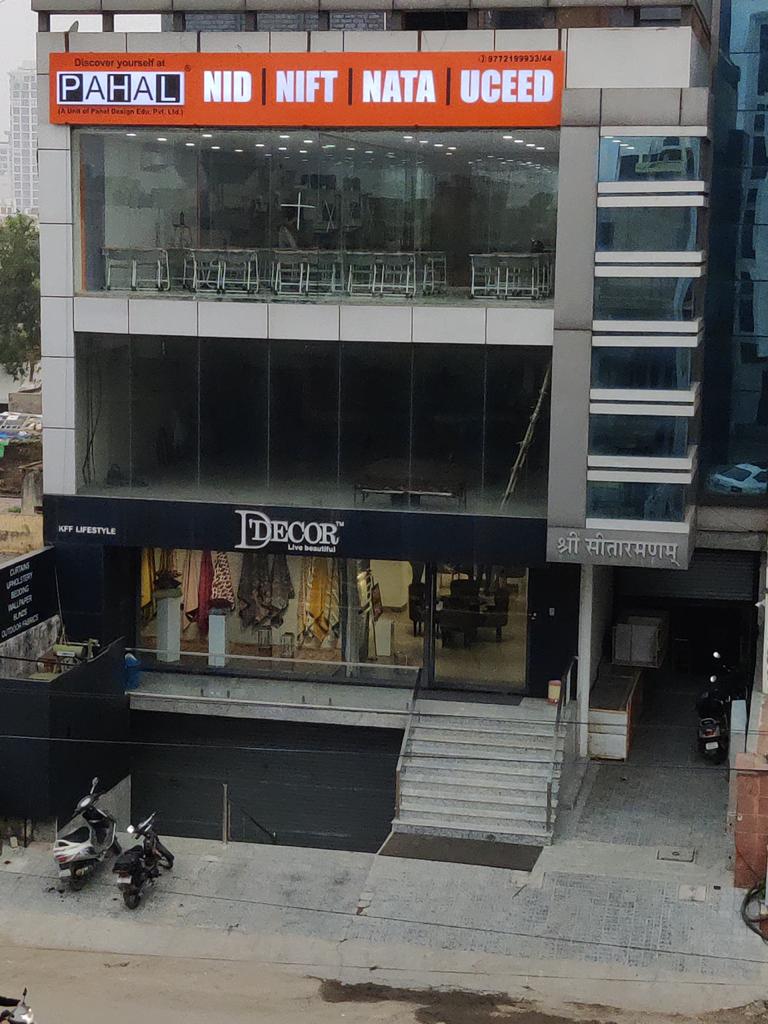
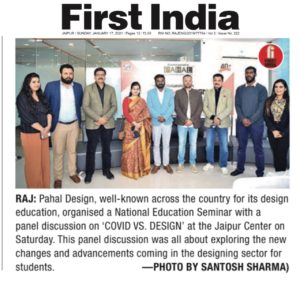
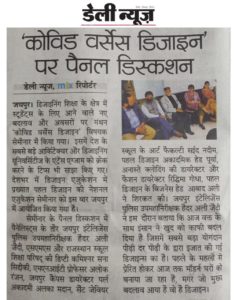
Pahal Design’s 40th Centre & 1st branch in Jaipur located at 2nd Floor F-18, Gautam Marg, Vaishali Nagar, Jaipur, Rajasthan 302021, Jaipur. A walking distance from Amrapali Circle, 22 minutes far from main railway station, 28 minutes far from Jaipur International Airport and 30 minutes’ drive from main bus stand. Kiran Jewellers, D- Decor, DAV Centenary Public School and Digambar Jain temple are the nearest landmarks to reach the centre. The centre offers entrance coaching for all the reputed design colleges in India and overseas. The centre is equipped with highly experienced design educationalists, expert faculty and visiting faculties, preparing and counselling design career enthusiasts for B. Des & M. Des entrance tests and professional career counselling for NID, NIFT, NATA, U/CEED, JEE-Arch and Fine Arts. Get ready to leave your footsteps and make your mark in the world of designing, communication and fashion. We are pleased to inform you that with this new year Pahal Design has added another cap in its feather and the inaugural ceremony at Jaipur Centre was successfully organized at 16th January, 2021.


About Jaipur

The capital of Rajasthan, built proudly by Maharaja Sawai Jai Singh II is famous for its majestic forts, opulent Havelis, beautiful lakes, and dunes. Jaipur is part of the famous Golden Triangle Tourist circuit that includes Delhi and Agra. But Jaipur is not only endowed with wonderful tourist attractions but the city also has an excellent infrastructure to support the tourism. Jaipur has some of India’s best hotels, which compliments the scenic and architectural beauty of the Pink City.
The historic walled city of Jaipur, was founded in 1727 A.D. by the Rajput ruler Sawai Jai Singh of Kacchawah dynasty. The city is roughly divided into nine rectangular sectors with straight roads intersecting only at right angles and is enclosed within massive wall to protect the city in a total area of 709 hectares.

The wall encircles the city and 9 city gates are present to provide the access to the city from various directions. Several iconic monuments and temples are housed within this walled city area with two main North South axes crossing to form 3 main pubic squares (Badi Chaupar, Choti Chaupar and a 3rd one Ramganj Chaupar extending on the eastern side) on the East West axes that define the overall grid iron city plan. It has a total of 12 main bazaar areas across the main axial streets.
The design of the new city was a breath taking departure from the prevalent practices in city development in the sub-continent. Its urban morphology reflected the coming together of cultural elements from eastern and western planning, expressing a culture of a ‘trade and commerce city’ and townscape that is unparalleled anywhere in South Asia.
Envisaged as a trade capital, the main avenues of the city are designed as markets, which remain characteristic bazaars of the city till date. Chaupar, or designed large public squares at the intersection of roads, is another feature that is distinct to Jaipur as are its single to multicourt havelis and haveli temples.
Besides an exemplary planning, its iconic monuments such as the Govind Dev temple, City Palace, Jantar Mantar and Hawa Mahal excel in artistic and architectural craftsmanship of the period. Jaipur is an expression of the

astronomical skills, living traditions, unique urban form and exemplary foresighted city planning of an 18th century city from India.

Jaipur is considered one of the most prolific examples of a planned city, it exemplifies approaches to city planning, sustainability and spatial manifestation of the social fabric through architecture. The lessons that can be learned by understanding this place are deep rooted in its context and are beautiful. Each place has lessons that can teach us about the importance of foresight, planning and mindful use of resources. An effort should be made to make it an inherent part of education and moreover an integral part of design education.
 

The newly prominent architectural buildings of Jaipur are a blend of advanced technology and exquisite design with a touch of traditional art. World Trade Park of Jaipur is a world-class infrastructure designed by renowned architects who have several architectural wonders in his account like the world’s biggest pillar-less rooftop (Sabha Mandap of Govind Devji Temple, which is notified by The Guinness Book of Records), first revolving tower of Rajasthan and many more. The Satsang hall within the Govind Devji’s Temple has a reinforced concrete cement flat roof with a simple soan of 119 ft.
With people from all over the country going to Jaipur for studies, today it has become an education hub also. If you are searching for a good education, then there cannot be a place better than Jaipur. A place where there is no political disturbance, no goons to threaten you here and there, a place to give you a busy life when you need it, a place which would give you the country’s heritage to enjoy any time you need, a place which would give you the mountains and the lakes for a relaxing tour, and the most comfortable evening for studies.
Within the context of formal education, the Art and design as a subject on the curriculum supports personal, social, moral, spiritual, cultural, and creative development, and enables participants to engage with and explore visual, tactile, and other sensory experiences and how to recognize and communicate ideas and meanings. These opportunities enable them to work with traditional and new media so that they develop confidence, competence, imagination, and creativity. Through these opportunities, they learn to appreciate and value images and artifacts across times and cultures, and to understand the contexts in which they were made. A fine arts education—be it in music, theatre, dance, creative writing, visual arts, or art history and visual studies—is not always an easy sell. The social utility and financial feasibility of the arts are often underrated. Innovation and adaptability are essential components of any fine arts education.

Experiences in art, craft, and design enable them to learn how to reflect critically on their own and others’ work. They learn to think and act as artists, makers, and designers, working creatively and intelligently. They develop an appreciation of and engagement in art, craft, and design as critical consumers and audiences and an understanding of its role in the creative and cultural industries that shape and enrich their lives.

There are abundant government and private universities present in Jaipur which focusses on the School of Architecture and design. Arch College of Design & Business. INIFD Jaipur, Indian Institute of Gems and Jewellery Jaipur, Indian Institute of Crafts & Design, IIFA INDIA are some of the best examples. As per the latest update among top colleges, the second-best private institute; Pearl Academy Jaipur for Fashion Design is recognized by India Today for the past three consecutive years. Pearl awards Professional Diploma from Pearl Academy and B. Des. Degree from Rajasthan ILD Skill University (RISU). Sounds exciting? Enroll in Pahal design and prepare for a better future in design and technology. Get the best practical experience with the rich heritage of Jaipur and let us help you to make your dreams come true in this beautiful city.

Pahal Design Jaipur – Vaishali Nagar

Address:- 2nd Floor, F 18, Gautam Marg, Vaishali Nagar, Jaipur, Rajasthan -302021
Contact Person: Mr. Aman and Mr. Akbar
Contact No: 97721-99911, 0141-6656509
Email: jaipur@pahaldesign.com

Set up in 1986, NIFT is the pioneering institute of fashion education in the country and has been in the vanguard of providing professional human resource to the textile and apparel industry. It was made a statutory institute in 2006 by an Act of the Indian Parliament with the President of India as ‘Visitor’ and has full fledged campuses all across the country. Over the years NIFT has also been working as a knowledge service provider to the Union and State governments in the area of design development and positioning of handlooms and handicrafts.

NIFT is committed to academic excellence in fashion education. The vision of the institute embraces challenges and provides the impetus in setting highest academic standards. NIFT continues to strive to be nothing but the best.

NIFT Exam Pattern 2020: Creative Ability Test (CAT)

NIFT CAT exam pattern is such that candidates are evaluated on the basis of their intuition skill, power of observation, innovation in the development of a concept as well as design ability of the candidate. One of the most important aspects of NIFT CAT exam is that it tests the creative as well as innovative use of colour and illustration skills of aspirants.

NIFT CAT is a paper-pencil based exam and it is of three hours duration.

NIFT Exam Pattern 2020: General Ability Test (GAT)

Candidates seeking NIFT admissions in BDes programmes offered at NIFT need to appear for GAT exam. This test comprises of the below-mentioned sections:

  • Quantitative Ability
  • Communication Ability
  • English Comprehension
  • Analytical Ability
  • General Knowledge and Current Affairs

NIFT CAT Exam Pattern for BDes Admissions

In NIFT exam pattern 2020 for BDes admissions, candidates need to appear for CAT. NIFT CAT exam paper has three questions which candidates need to attempt in three hours duration. In this design entrance exam, candidates are evaluated on the below mentioned parameters:

  • Design ability
  • Intuitive ability
  • Observation skills
  • Concept development skills
  • Creative use of colour
  • Illustration skills

NIFT Exam Pattern for Situation Test

Candidates who have been shortlisted for NIFT BDes admissions on the basis of their written test need to appear for NIFT Situation Test 2020 wherein their “material handling and innovative ability” will be tested.

Here, candidates will be evaluated on “on Space Visualization, Innovative and creative use of given material, composition of elements, colour scheme, construction skill , finesse of the model and overall presentation etc. These parameters will be checked with the write up explaining the concept / idea behind the model constructed. The weightage of the write up is 30%. Since the medium of teaching in NIFT is English, the write-up will be in English language.

NIFT Exam Pattern for Artisans Category

Candidates are informed that NIFT offers admission to Artisans/ Children of Artisans based on their performance in Studio Test, Interview round and verification of documents/ eligibility criteria.

NIFT Exam Pattern for Lateral Entry Admission 2020

NIFT lateral entry admission (NLEA) is the process through which candidates can secure admission directly in the third semester of UG courses offered at National Institute of Fashion Technology.

Q. What is NIFT exam pattern?

A. NIFT entrance exam is a three tiered process. Candidates can go through the list of tests they would need to appear for in order to secure admission in different courses offered at NIFT.

Q. What is the marking scheme for NIFT entrance exam?

A. NIFT exam marking scheme varies for CAT and GAT. In NIFT CAT exam, candidates are evaluated out of 100 marks. In GAT exam, aspirants are awarded for one mark for every correct answer and 0.25 marks are deducted for each wrong answer selected by them.

Q. How can I prepare for NIFT CAT?

A. Candidates need to go through the detailed exam pattern as well as syllabus for NIFT CAT and thereafter formulate a preparation strategy. In NIFT CAT exam, aspirants are evaluated on the basis of their power of observation, innovation and design ability.

Q. How can I prepare for NIFT GAT?

A. NIFT GAT comprises of multiple choice questions that aspirants need to solve in order to crack the exam. Questions in NIFT GAT are from subjects such as Quantitative Ability, Communication Ability, English Comprehension, Analytical Ability, General Knowledge and Current Affairs.

Q. Is there any negative marking in NIFT entrance exam?

A. There is no negative marking in NIFT CAT exam. However, for GAT exam, 0.25 marks will be deducted for each wrong answer selected by a candidate.

Q. How many questions are asked in NIFT CAT?

A. In NIFT CAT, candidates have to attempt three drawing questions.

Q. How many questions are asked in NIFT GAT?

A. The exam pattern for NIFT GAT varies from one course to the other. The total number of questions asked in NIFT GAT are mentioned below:

  • BDes: 100 questions
  • BFTech: 150 questions
  • MDes: 120 questions
  • MFTech: 150 questions
  • MFM: 150 questions

Q. What is the duration of NIFT CAT exam?

A. NIFT CAT for BDes and MDes course admissions is of three hours duration.

Q. What is the duration of NIFT GAT exam?

A. The duration of NIFT GAT for design course admissions is as mentioned below:

  • BDes: 2 hours
  • BFTech: 3 hours
  • MDes: 2 hours
  • MFTech: 3 hours
  • MFM: 3 hours

Q. What is NIFT exam pattern for BDes admissions?

A. Candidates can secure admission in BDes course offered at NIFT campuses by clearing NIFT Creative Ability Test (CAT) and General Ability Test (GAT). Aspirants who clear these written entrance exams then need to appear for Situation Test round.

Q. What is NIFT exam pattern for MDes admissions?

A. Candidates can secure admission in MDes course offered at NIFT campuses by clearing NIFT Creative Ability Test (CAT) and General Ability Test (GAT). Aspirants who clear these written entrance exams then need to appear for GD/PI admission round.


Set up in 1986, NIFT is the pioneering institute of fashion education in the country and has been in the vanguard of providing professional human resource to the textile and apparel industry. It was made a statutory institute in 2006 by an Act of the Indian Parliament with the President of India as ‘Visitor’ and has full fledged campuses all across the country. Over the years NIFT has also been working as a knowledge service provider to the Union and State governments in the area of design development and positioning of handlooms and handicrafts.

NIFT is committed to academic excellence in fashion education. The vision of the institute embraces challenges and provides the impetus in setting highest academic standards. NIFT continues to strive to be nothing but the best.

NIFT Exam Pattern 2020: Creative Ability Test (CAT)

NIFT CAT exam pattern is such that candidates are evaluated on the basis of their intuition skill, power of observation, innovation in the development of a concept as well as design ability of the candidate. One of the most important aspects of NIFT CAT exam is that it tests the creative as well as innovative use of colour and illustration skills of aspirants.

NIFT CAT is a paper-pencil based exam and it is of three hours duration.

NIFT Exam Pattern 2020: General Ability Test (GAT)

Candidates seeking NIFT admissions in BDes programmes offered at NIFT need to appear for GAT exam. This test comprises of the below-mentioned sections:

  • Quantitative Ability
  • Communication Ability
  • English Comprehension
  • Analytical Ability
  • General Knowledge and Current Affairs

NIFT CAT Exam Pattern for BDes Admissions

In NIFT exam pattern 2020 for BDes admissions, candidates need to appear for CAT. NIFT CAT exam paper has three questions which candidates need to attempt in three hours duration. In this design entrance exam, candidates are evaluated on the below mentioned parameters:

  • Design ability
  • Intuitive ability
  • Observation skills
  • Concept development skills
  • Creative use of colour
  • Illustration skills

NIFT Exam Pattern for Situation Test

Candidates who have been shortlisted for NIFT BDes admissions on the basis of their written test need to appear for NIFT Situation Test 2020 wherein their “material handling and innovative ability” will be tested.

Here, candidates will be evaluated on “on Space Visualization, Innovative and creative use of given material, composition of elements, colour scheme, construction skill , finesse of the model and overall presentation etc. These parameters will be checked with the write up explaining the concept / idea behind the model constructed. The weightage of the write up is 30%. Since the medium of teaching in NIFT is English, the write-up will be in English language.

NIFT Exam Pattern for Artisans Category

Candidates are informed that NIFT offers admission to Artisans/ Children of Artisans based on their performance in Studio Test, Interview round and verification of documents/ eligibility criteria.

NIFT Exam Pattern for Lateral Entry Admission 2020

NIFT lateral entry admission (NLEA) is the process through which candidates can secure admission directly in the third semester of UG courses offered at National Institute of Fashion Technology.

Q. What is NIFT exam pattern?

A. NIFT entrance exam is a three tiered process. Candidates can go through the list of tests they would need to appear for in order to secure admission in different courses offered at NIFT.

Q. What is the marking scheme for NIFT entrance exam?

A. NIFT exam marking scheme varies for CAT and GAT. In NIFT CAT exam, candidates are evaluated out of 100 marks. In GAT exam, aspirants are awarded for one mark for every correct answer and 0.25 marks are deducted for each wrong answer selected by them.

Q. How can I prepare for NIFT CAT?

A. Candidates need to go through the detailed exam pattern as well as syllabus for NIFT CAT and thereafter formulate a preparation strategy. In NIFT CAT exam, aspirants are evaluated on the basis of their power of observation, innovation and design ability.

Q. How can I prepare for NIFT GAT?

A. NIFT GAT comprises of multiple choice questions that aspirants need to solve in order to crack the exam. Questions in NIFT GAT are from subjects such as Quantitative Ability, Communication Ability, English Comprehension, Analytical Ability, General Knowledge and Current Affairs.

Q. Is there any negative marking in NIFT entrance exam?

A. There is no negative marking in NIFT CAT exam. However, for GAT exam, 0.25 marks will be deducted for each wrong answer selected by a candidate.

Q. How many questions are asked in NIFT CAT?

A. In NIFT CAT, candidates have to attempt three drawing questions.

Q. How many questions are asked in NIFT GAT?

A. The exam pattern for NIFT GAT varies from one course to the other. The total number of questions asked in NIFT GAT are mentioned below:

  • BDes: 100 questions
  • BFTech: 150 questions
  • MDes: 120 questions
  • MFTech: 150 questions
  • MFM: 150 questions

Q. What is the duration of NIFT CAT exam?

A. NIFT CAT for BDes and MDes course admissions is of three hours duration.

Q. What is the duration of NIFT GAT exam?

A. The duration of NIFT GAT for design course admissions is as mentioned below:

  • BDes: 2 hours
  • BFTech: 3 hours
  • MDes: 2 hours
  • MFTech: 3 hours
  • MFM: 3 hours

Q. What is NIFT exam pattern for BDes admissions?

A. Candidates can secure admission in BDes course offered at NIFT campuses by clearing NIFT Creative Ability Test (CAT) and General Ability Test (GAT). Aspirants who clear these written entrance exams then need to appear for Situation Test round.

Q. What is NIFT exam pattern for MDes admissions?

A. Candidates can secure admission in MDes course offered at NIFT campuses by clearing NIFT Creative Ability Test (CAT) and General Ability Test (GAT). Aspirants who clear these written entrance exams then need to appear for GD/PI admission round.


1. Hi How’s your day going on?

Vartika- I am having a pretty normal day the one which you have in lockdown.


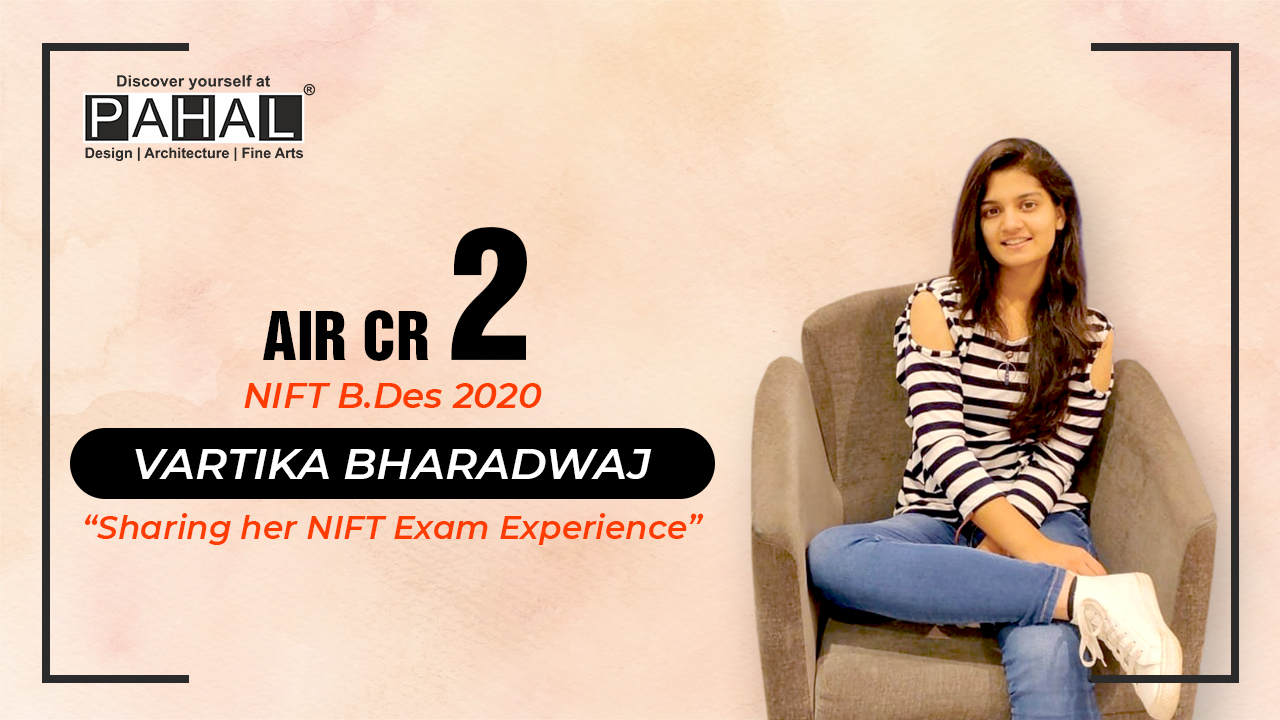
2. Congrats for securing AIR 2 in NIFT 2020. So how are you feeling after scoring such a good rank?

Vartika- Thank you so much I am very thrilled but and at the same time shocked as I didn’t expect such a good rank. But I am very happy about it.


3. So Vartika talking about this NIFT 2020 Exam how was the paper was it easy, difficult lengthy?

Vartika- It was CAT paper the creative ability test paper was lengthy but that depends upon how much you want to do because if you want to color and use all the techniques it will be a time consuming process but general ability test paper was completed within the allotted time and the time allotted was enough .If we talk about the difficulty level, I found some parts difficult but all in all the paper was not easy but was not that difficult too.


4. Some student came up saying that CAT was really lengthy.

Vartika- Yes, they did not specify generally in the questions they specify that don’t color it or color it but this time it was not specified in the questions so our first approach was to colour them all, so it got the paper lengthy.


5. Coming up to the creativity section, so were you good at creativity from the start or you nurtured it?

Vartika- I was able to copy things like when I saw some artists work I was able to copy it to some extent like 50-60% but I didn’t have my own ideas and I was not aware of the technique and color that should be used together. That’s where Pahal comes in what I had in mind I was not able to draw from memory or whatever I wanted to draw I always needed a reference that’s what they taught me that how to do that.


6. Now if we talk about the GAT section, what subjects or section were time consuming?

Vartika- Most time consuming one would definitely be English, the comprehension were really tough I would say because you know as a ICSE student we are expected to be very good English but it was very tough because I have to read it all again and again to mark the words and studied a lot because sir told me that English is very high level but I did not expected to be like this as it was time consuming too but that increased my marks I was able to attempt all the comprehensions and most of them were right but it took a lot of time doing comprehensions. The maths sections, it takes time because you have to do the calculation but it was not very hard if you have studied nicely in 10th and you remember the tricks you would be able to do it easily.


7. What about the GK section? How did you prepare for GK?

Vartika- Sir took a GK class every week and gave us a lot of notes and pdfs were there with us I thoroughly went through then I tried to remember everything that sir gave us but I am not good in general knowledge things and don’t read the newspaper but sir told me do so I did. The fashion related GK had some part but static GK came more this time about history of India & usual things which were going on. Some questions were easy but some questions I have not heard about it ever. We should pay more attention so the things for sure like in Maths, English, reasoning we can still predict what can come but in GK one is not sure what can come.


8. Through that coming to the negative marking which was implemented this year how did you cope up with it?

Vartika- I first did all the questions which I was sure that I will get them correct and after that I attempt the questions which I was doubtful about. Sir told me to attempt questions in a way that even if I suffer with negative marking it is balanced from the marks you get from the questions which were correct or through guess work guess in a way that it does not cost you anything and it favors you so I did the questions in a way that even I got the negative marking it did not affect me to that extent because I was not going to attempt those questions any way. So I actually got favour from it.


9. So, students should attempt only those questions which they know are 100% correct?
Vartika- First of all, we should attempt questions about which they are 100% sure about so because we don’t want to miss anything at least one is able to complete what they know. I was able to attempt everything but what you are good at If you implement it, It will help you so the teachers were amazing as they always helped us and If I was not able to attend the classes on weekend then he used to change slots, so the teachers were one who helped me manage it all.


10. Talking about the school studies the school studied are on subjective side and the entrance exam is conceptual based so how did Pahal helped you in seeking the level of success?

Vartika- I believe that in whatever stream you are it will benefit you in some way or the other like Arts students had leverage over me in the creative section but then I had leverage over them in the aptitude part because I know how things work because of my science background. So, Pahal motivated me to take advantage of being a science student by showing them that how things will work .so that actually helped me.


11. Great to hear that! What tips and suggestions you would like to give to the NIFT aspirants so that they can score well?

Vartika- Firstly, I feel that students take NIFT lightly thinking that if we study for one or two months, we can do it but it’s not like that! One has to study from the very beginning because if you thing you can cover all the creative part in a month you are wrong. It can take a lifetime as there is so much to the theories and practical. So you should practice from very beginning and you should create a schedule like sometimes, 12th Pursuing find it hard to take out time. I used to reduce the sleep time and study in the night woke up early. Don’t forget to rest I make a personal time table that I have to complete the topics. To be honest, we had 8 months to prepare, in which one can cover the syllabus provided. Some students complain that they are not good at drawing and I was that student but what matters the most is how creative you are and how you are able to present it. Even if you are good in drawing and not able convey exactly what you wanted to write there it is on your mind as examiner will also see whatever you are able to convey the thought and creativity. My only advice is that be focused don’t think that it is a fashion institute you will be able to get there easily. Ask from the rank holders that how much they have to work hard for! If you work hard you will get it!


12. Coming to the end of the session Vartika, you shared really good tips with the aspirants so I want to ask again the magical tips you want to give to the aspirants so that they can crack NIFT with a rank?
Vartika- First, it would be to join Pahal because they are actually are the ones who are behind it all. I was not filling up the form for NIFT but sir asked to fill it so I filled it and here I am. I will suggest that do comprehensions a lot try to increase the vocabulary as the English which comes in the paper is not like the usual English which we speak we can all speak English and good at it but you need to be extra good in English because in fashion line English will be used to communicate the most & I am going for fashion communication and my line is only communication so they take into consideration your English very much. I can say half of the GAT paper consisted of English and holds the maximum marks. Even if you are not very good at it they don’t ask you words out of the universe but if you read books as I love reading books. Pick up simple books that have easy language as sometimes in CAT also they ask you to write a paragraph this time also they asked you to fill the details and write what you want to convey so I wrote every sort of English I have in me. So, I feel one must work every day. Secondly, improve your English and thirdly, even if you are not good at art try to enhance your creative mind, I did that through teachers. There were workshops of creative abilities and they ask us to watch movies that will help us. I followed a lots of artist pages on Instagram and see how they work. Don’t follow the artist who just creative something by just seeing rather follow those who create abnormal things which you don’t usually see and invokes the feelings inside like I never thought like that. The art pages will help you looking at things in different way. Expand your creative mind as much as you can and that’s the easiest thing you can do among all the things like you can watch movies, you can read books or draw as every design aspirant loves to draw as that’s a necessity in an aspirant. Go through the past papers you will know what you will know what I am talking about because the English you have to be very good at it like if they say you should know what they mean, the antonyms, synonyms etc. One more thing, colour theory each colour conveys something and if you know the color theory I believe you will be able to attempt the question at least half of the questions brilliantly because if you know the colors you will create something which are appealing to the eyes and that what I feel examiner look for, As this year among the questions, color questions went good than the shading questions because color doesn’t smudge and shading smudges and it looks very untidy. I tried making it tidy and first impression should be extraordinary to get a good rank.


13. Thank you so much Vartika wish you all the best for your career.

Vartika- Thank you mam.

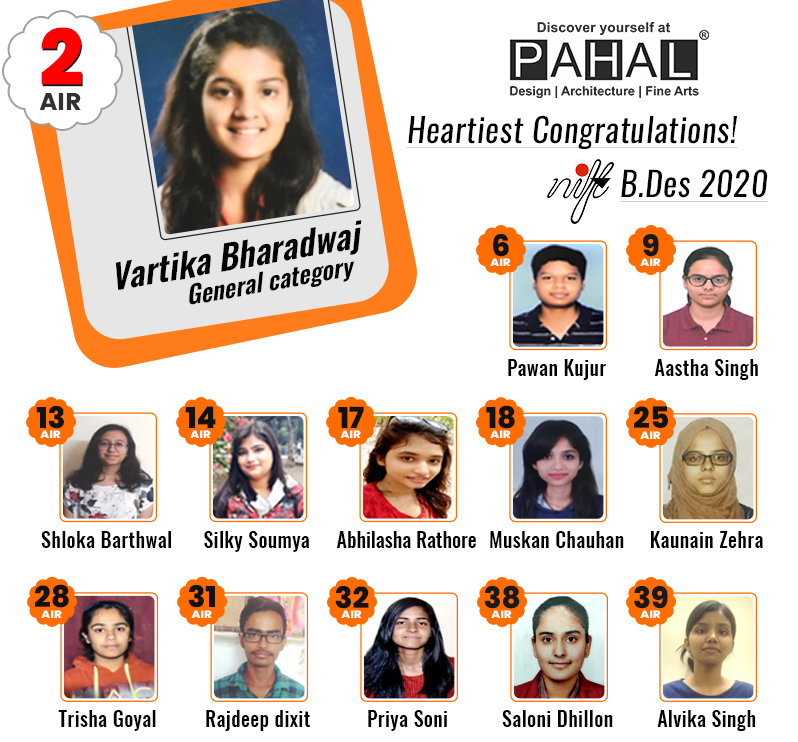
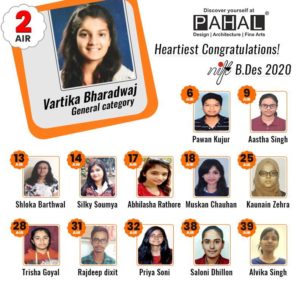
Vartika Bhardwaj, AIR 2, B.Des, NIFT 2020, General Category
Talk to NIFT B. Des Toppers 2020. NIFT Entrance Exam Preparation Tips, Study Plan ngg_shortcode_1_placeholder  

Pahal Design Books & Study Material is ideal for self-starters who like to study at their own pace. The comprehensive and regularly updated NID B.Des/GDPD exam books and mocks would prove to be beneficial for all kinds of aspirants. For appearing in NID DAT 2021, solving sample papers is essential. While solving the mock tests, aspirants will have a fair idea about the type of questions that are asked in the actual test. It is vital that aspirants refer the best books and other study material for DAT preparation in right direction and With so many books available in the market, Pahal Design NID Study Material is the best guidance which will guide students in the right direction.

Total – 24 booklets

  • General Aptitude -14 booklet
  • NID Aptitude -2 booklet
  • Creative -6 booklet
  • Previous year papers
  • NID guide book 
  1. Quantitative Ability : 7 booklets have various categories which deals with all important topics with concept ,explanation, practice exercises   and model Test Papers .It has important tips and tricks which facilitate student to increase the solving speed in superior way .
  2. Verbal and Analytical Ability : 4 booklets include all topics of analytical reasoning which help students to identify key information, apply logic and find patterns.
  3. Communication Ability & English Comprehension : This section is very important for NID B.des exam. The booklet 1 and 2 will cover all the topics with intensive practice exercises.
  4. Non Verbal Reasoning : 1 Booklet
  5. General Knowledge and Current Affairs :The GK and CA are made by experts on latest NID exam pattern .Monthly booklet will be shared with the students which will have all important events, facts and happenings in the country and across the globe.
  6. NID B.Des Previous Year Question Papers with Answer keys : The booklet have the last 5 years original exam papers with solutions.
  7. NID B.Des Guide book : This book is exclusive for Fashion and Design aspirants to know about this industry and related career options.
  8. Creative Booklet :Book provides a brief topic wise description with suitable illustration and references.1.     Basics of Drawing, rendering and drawing 2.     Colour Theory & Concept

    3.     Design Elements I

    4.     Design Elements II

    5.     Industrial Design

Why Pahal Design for NID Study Material ?

1. Test Series :

A. Monthly Test – The monthly test enables student to track their progress in most efficient way and pay attention to the section required.
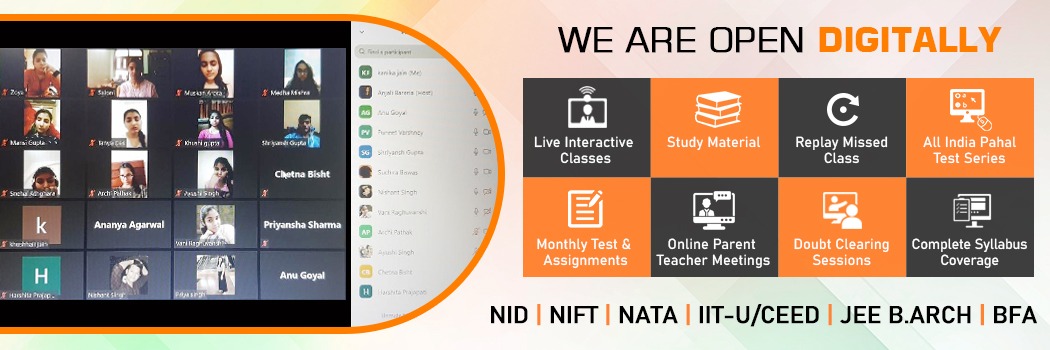
B. Mock Test –Its mandatory for all students to attempt mock test after competition of syllabus .The student can book their slot at any of Pahal Design Branch or choose online mode in order to appear in Mock Test Series. Each mock test will give you complete performance analysis, All India Ranking, practice to updated exam pattern and section wise performance report.

2. Doubt clearance & Feedback sessions : Students can attend doubt clearance session with our expert by booking their slot at nearest Pahal design centre or choose online mode for same .

3. Digital Learning Program (DLP) : Access to digital learning platform which has complete learning solution for the students .The Platform will enable students to avail video lectures ,Quiz practice sessions ,any time access to practice sets and tests with more than 5000+ questions .The student will be allotted with unique User Id and Password for their DLP account which they login from Pahal Digital.com or PD app .

4. Expert Team: Each student will get expert guidance for design career and will be assisted to explore their course interest. The team will also analyse and review the student’s performance and help them to improve their performance.

5. Preparation for other Design colleges : Student can get connect to us for the design college counselling or inform us regarding the colleges they are applying for and Pahal Design Team will provide complete guidance according to the updated exam pattern.

The study material is also available for Foundation Batch (2 Years) Program which aims at building strong foundation among Design and Architecture aspirants which is suitable for 10th and 11th appearing students. Study material package focuses on boosting confidence of student for facing National level competition by providing subject wise & topic wise Question Bank based on latest pattern, in addition to previous year question papers and formula booklets.

The content of the study material is deeply researched and developed as per new exam pattern by NID, NIFT, SPA, IDC, IIT, NIT’s and many more. The advance level problems along with each topic are specially designed to give the students an in-depth understanding of the particular subject and prepare them to stay ahead in the competition.

Hauz Khas (Corporate Branch)
 
Address:- G-8, G Block Market, 2nd Floor, Hauz Khas, New Delhi-110016
Contact No: 88-00-22-6864, 011-40106405
Contact Person: Ms Yashika 
Email: corporate@pahaldesign.com

CONNECT US

Pahal Design Books & Study Material is ideal for self-starters who like to study at their own pace. The comprehensive and regularly updated NID, NIFT, NATA, UCEED, CEED, BFA exam books and mocks would prove to be beneficial for all kinds of aspirants.

The comprehensive study material is prepared by most experienced faculties of Pahal Design which focuses on developing advance level skills in student. It intends to provide extensive support in preparation of students for prestigious Design, Architecture and Fine Art exams like NID, NIFT, NATA, JEE B Arch, IIT-UCEED, IIT-CEED, BFA. 

Pahal Study Material Features:

1. Test Series :

A. Monthly Test – The monthly test enables student to track their progress in most efficient way and pay attention to the section required.
B. Mock Test –Its mandatory for all students to attempt mock test after competition of syllabus .The student can book their slot at any of Pahal Design Branch or choose online mode in order to appear in Mock Test Series. Each mock test will give you complete performance analysis, All India Ranking, practice to updated exam pattern and section wise performance report.

2. Doubt clearance & Feedback sessions : Students can attend doubt clearance session with our expert by booking their slot at nearest Pahal design centre or choose online mode for same .

3. Digital Learning Program (DLP) : Access to digital learning platform which has complete learning solution for the students .The Platform will enable students to avail video lectures ,Quiz practice sessions ,any time access to practice sets and tests with more than 5000+ questions .The student will be allotted with unique User Id and Password for their DLP account which they login from Pahal Digital.com or PD app .

4. Expert Team: Each student will get expert guidance for design career and will be assisted to explore their course interest. The team will also analyse and review the student’s performance and help them to improve their performance.

5. Preparation for other Design colleges : Student can get connect to us for the design college counselling or inform us regarding the colleges they are applying for and Pahal Design Team will provide complete guidance according to the updated exam pattern.

The study material is also available for Foundation Batch (2 Years) Program which aims at building strong foundation among Design and Architecture aspirants which is suitable for 10th and 11th appearing students. Study material package focuses on boosting confidence of student for facing National level competition by providing subject wise & topic wise Question Bank based on latest pattern, in addition to previous year question papers and formula booklets.

The content of the study material is deeply researched and developed as per new exam pattern by NID, NIFT, SPA, IDC, IIT, NIT’s and many more. The advance level problems along with each topic are specially designed to give the students an in-depth understanding of the particular subject and prepare them to stay ahead in the competition.

Hauz Khas (Corporate Branch)
 
Address:- G-8, G Block Market, 2nd Floor, Hauz Khas, New Delhi-110016
Contact No: 88-00-22-6864
Contact Person: Ms Karishma Gupta
Email: corporate@pahaldesign.com

CONNECT US


This year, due to COVID-19 outbreak, National Institute of Fashion Technology has made major changes in its admission process. The Situation Test for NIFT BDes admissions 2020 was cancelled and admission in the programme was offered based on an aspirant’s performance in NIFT CAT and GAT exam only. Similarly, Group Discussion round was cancelled for MDes, MFM and MFTech course admissions 2020.

  1. Which city do you belong to and what is the USP of your city?
  2. What have you done during this quarantine?
  3. They are asking questions related to your academic background.
  4. Why do you want to do this course?
  5. Where did you do your graduation from ?
  6. What did you do after graduation ?
  7. What are your hobbies ?
  8. What did you do in the lockdown ?
  9. Introduce Yourself ?
  10. Why M.Des?
  11. What’s your future plan after M.Des?
  12. What will be your plan B?
  13. Who is your favourite designer?
  14. What did you do in quarantine period?
  15. The curriculum of NIFT, and what design do you want to go for?
  16. What will you do after NIFT?
  17. What do you want to do after NIFT ?
  18. Current scenario in Haryana Gurgaon in terms of Covid 19?
  19. Why there is a gap between your graduation and Master Program?
  20. Your Hobbies?
  21. Why MFM?
  22. What was your Favourite Graduation Subject?
  23. Did you read today’s newspaper
  24. Border with China
  25. Impact of covid 19
  26. What are you doing in this lockdown?
  27. Name 2 luxury brands
  28. My academic and my family background..
  29. What I did in lockdown..
  30. I was asked about my job..
  31. Where do you see yourself in the future?
  32. What you did during this lockdown?
  33. Where you see yourself after 5-8 years?
  34. Why nift?
  35. What you did in the drop year?
  36. Which campus you prefer?
  37. Tell me about the curriculum?
  38. One how you relate your bachelor course with it?
  39. What you like to be first one or the last one for the interview?
  40. They give me a problem and was asked to give the solution from designer point of view.
  41. Four P’s of management
  42. 7 S of management
  43. subjects taught in MFM
  44. About prospect, whether I’ve gone through or hot
  45. About specialisation. Which is my favourite and why?
  46. Why MFM after B.tech?
  47. Where u did ur job ?
  48. Name 5 brands of the company ?
  49. Other fashion business of the company ?
  50. Which online platform do u prefer for shopping?
  51. Do u want any changes in filters selection of myntra ?
  52. What is artificial intelligence ?
  53. Your graduation and percentage ?
  54. 5 international sports brand ?
  55. How would you market your product?
  56. Why didn’t you go for entrepreneurship as specialization
  57. Father’s business?
  58. ISO govt scheme ?
  59. Which sport do I play ?
  60. Why NIFT again ?
  61. What did I do in drop year ?
  62. Why didn’t I sat for campus placement ?
  63. Overall CGPA
  64. Also, how will I finance my education ?
  65. What does your father do
  66. Undergraduatation course
  67. What do u mean by lifestyle
  68. What are the elements of lifestyle
  69. How do u relate lifestyle from design
  70. Elements of design
  71. Why MFM
  72. What specialisation in MFM
  73. Why not your college and why NIFT
  74. We think nIft is a brand why NIFT ?
  75. Are u going to do your own work how will u contribute to NIFT
  76. How is your mother your inspiration she has also done PGBM
  77. HOW IS MBA different from MFM?
  78. How will u contribute to NIFT?
  79. Introduce yourself in 1 minute.
  80. why do you want to work with bamboo fibre?(because I said I want my sustainable Brand)
  81. What do you want to do after this course?
  82. Which is the nearest centre from your city and which one will you choose?
  83. What is fashion according to you.
  84. What is fast fashion.
  85. Which city offers fast fashion in India.
  86. Name the areas in that city that offers fast fashion
  87. How fashion was different 50 years ago?
  88. Name natural fibres
  89. India is the largest importer of bamboo and the second largest exporter of bamboo comment on that?
  90. If you become the head of the department that deals fibres what will you do?
  91. Bamboo has a cellulose base and rayon also has a cellulose base pollute industry what do you think?
  92. Properties of bamboo?
  93. Absorbency of bamboo as compared to cotton fibre?
  94. How will you stop polluting the industry through these fibres?
  95. Academic Background.
  96. Famous textile of my state.
  97. How will i contribute to NiFt.
  98. They ask what i learn during my graduation.
  99. The impact of covid-19.
  100. How would you relate your graduation to mfm?
  101. What do you understand my marketing communication?
  102. What is the role of a brand manager?
  103. And some graphic related questions since I am from graphic design background?

National Institute of Design (NID) at Ahmedabad and at its Bengaluru and Gandhinagar Extension campuses is an ‘Institute of National Importance’ as per the NID Act 2014 as well as an autonomous Institute under the Department for Promotion of Industry and Internal Trade (DPIIT), Ministry of Commerce & Industry, Government of India. As per the NID Act 2014, the Institute is a statutory authority empowered to award its own degrees— presently offering Bachelor of Design (B.Des.) of four-year duration, Masters of Design (M.Des.) of two-and-a-half year duration and PhD in Design. The Institute is also, a member of the Association of Indian Universities (AIU). NID Andhra Pradesh, NID Haryana, NID Madhya Pradesh & NID Assam are independent autonomous institutes under the DPIIT, Ministry of Commerce & Industry, Government of India and offer full time Graduate Diploma Programme in Design (GDPD) of four-year duration.

Admission to all the programmes at NID is on the basis of the candidates’ performance in the two-stages of Design Aptitude Test. The objective of these exams is to assess the knowledge, skills and behavioural abilities of candidates.

Stage 1: Design Aptitude Test (DAT) Prelims

Design Aptitude Test (DAT) Prelims will be conducted at various test centres across India Candidates should note that appearing for the DAT Prelims or being shortlisted for second stage of admission process does NOT guarantee automatic entitlement to admission.

Stage 2: Design Aptitude Test (DAT) Mains

Candidates shortlisted after the DAT Prelims will be invited to appear for the Stage 2 DAT Main exam at Ahmedabad or at all campuses of NID viz Ahmedabad, Bengaluru, Gandhinagar, Haryana, Andhra Pradesh, Assam and Madhya Pradesh. Exact details of the Test Centre will be mentioned in the DAT Mains Admit Card.

NID Entrance Exam 2020 Highlights

Event Details Specifications
Exam Name National Institute of Design Aptitude Test (NID DAT)
Exam Frequency Once a year
Exam Mode Offline
Exam Duration BDes/GDPD : 3 hours, MDes : 2 hours 30 minutes
Accepting Colleges 7
Official Website http://admissions.nid.edu/NIDA2020/Default.aspx

NID DAT 2020 Important Dates

Events Dates Salient Features
Release of NID admission notification 01-Oct-2019 NID released NID DAT 2020 exam dates and other admission details.
Window to fill NID application form (BDes/ GDPD) 01-Oct-2019 to 18-Nov-2019 NID application form had to be filled online for UG course admissions on the official website of the exam. No change in the application process from last year.

Last date to submit application form for BDes/ GDPD admissions at NID extended from November 7 to November 18, 2019.

Window to fill NID application form (MDes) 01-Oct-2019 to 18-Nov-2019 NID application form had to be filled online for PG course admissions on the official website of the exam. No change in the application process from last year.

Last date to submit application form for MDes admissions at NID extended from November 7 to November 18, 2019.

Download NID admit card 20-Dec-2019 Available for downloaded from the official website from 12 pm. Candidates can download NID DAT Prelims admit card by providing login details.
NID DAT Prelims 29-Dec-2019 NID Prelims was held across 21 test centres in the country for BDes admissions and 16 test centres for MDes entrance exam. NID DAT Prelims is the screening round for NID admissions 2020. 
Declaration of NID DAT (Prelims) result (MDes) 21-Feb-2020 Result for NID DAT 2020 for MDes admissions online on the official website of the exam by providing details like email address, date of birth and verification code.
Declaration of NID DAT (Prelims) result (BDes/ GDPD) 19-Mar-2020

10-Apr-2020 03-May-2020

Check the result for NID DAT 2020 for BDes/GDPD admissions online on the official website of the exam by providing details like email address, date of birth and verification code.
NID DAT (Mains) for BDes/ GDPD) 29-Apr-2020 to 03-May-2020 

22-Jun-2020 onwards

Candidates who clear NID DAT Prelims need to appear for NID DAT Mains which comprises of Studio Test and Interview round. NID DAT Mains is held at NID campuses at Ahmedabad, Bengaluru and Gandhinagar.
NID DAT (Mains) for MDes 06-Jul-2020 Candidates who clear NID DAT Prelims need to appear for NID DAT Mains which comprises of Studio Test and Interview round. NID DAT Mains is held at NID campuses at Ahmedabad, Bengaluru and Gandhinagar.
Declaration of NID admission test result for BDes & GDPD 28-May-2020 

24-Jul-2020

Aspirants need to check their result for NID DAT 2020 for BDes/GDPD admissions online on the official website of the exam by providing details like email address, date of birth and verification code.

NID DAT 2020 Eligibility Criteria

Candidates who want to apply for BDes or GDPD course at NID meet the eligibility criteria if they have cleared or are appearing for their higher secondary (10+2) qualifying examination from any stream (from any recognised board such as CBSE IB, ICSE or their equivalent in the year 2019-2020 can apply for the exam.

On the other hand, candidates are eligible to apply for MDes course if they have completed their bachelor’s degree from a recognised college/ university. Apart from this, aspirants applying for NID admission in MDes course should not be more than 30 years of age as on June 30, 2020.

NID Admission Process 2020

As part of NID admission process, candidates need to first fill their application form. Candidates who meet the eligibility criteria for this design entrance exam are then eligible to appear for NID DAT Prelims. Aspirants who clear the first stage of NID admissions then need to appear for NID DAT Mains. Finally, candidates who clear this admission round as well are offered admission in the course/ college of their choice.
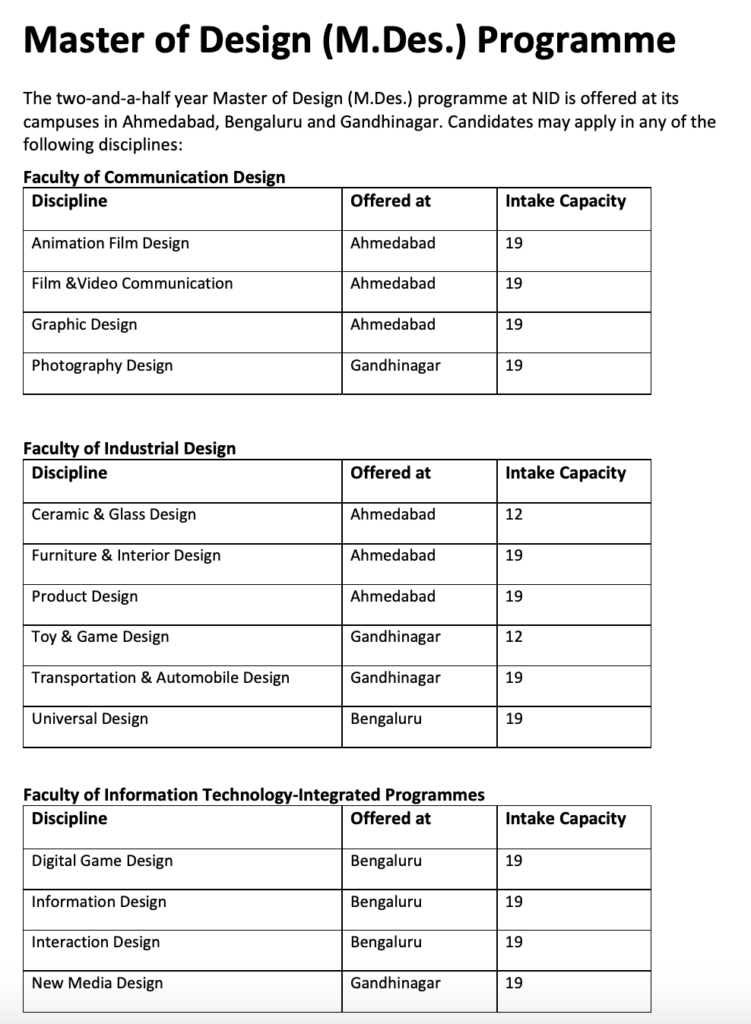
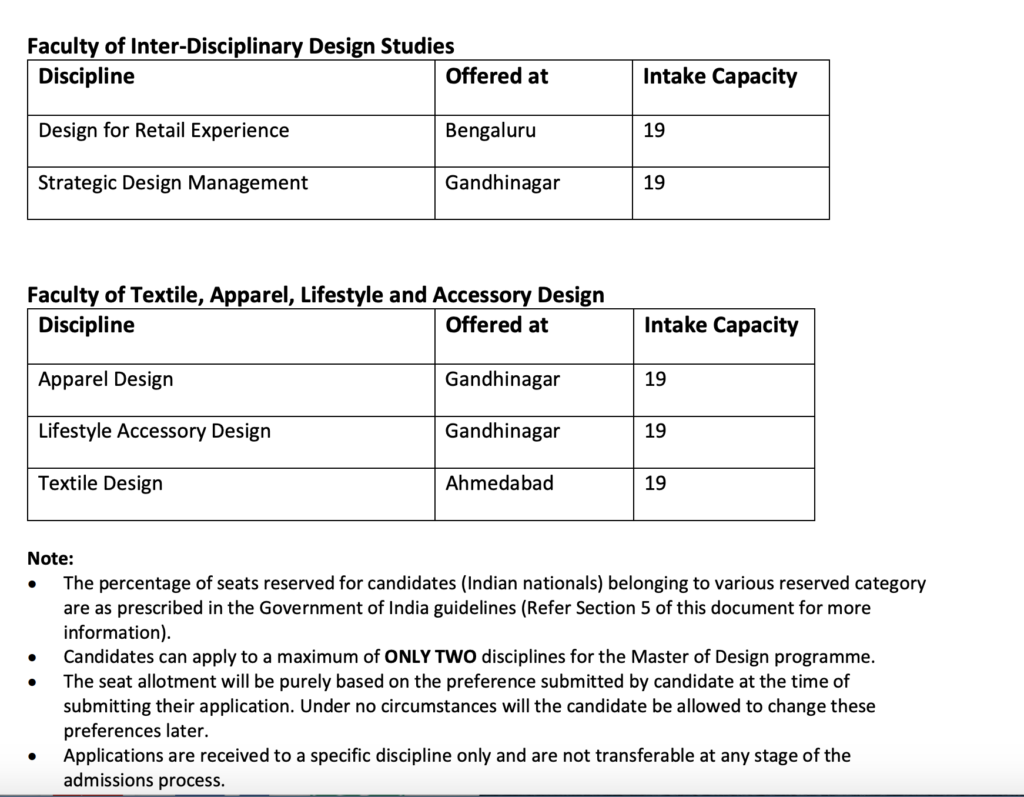

NID admissions 2020 is a two tier process. Thus, for NID admissions candidates need to appear for NID DAT (Prelims) and NID DAT (Mains). The objective of conducting both these tests is to assess knowledge, skills as well as behavioural abilities of candidates.

Graduate Diploma Programme in Design (GDPD) The four-year-long Graduate Diploma Programme in Design (GDPD) is offered at NID Andhra Pradesh, NID Haryana, NID Madhya Pradesh & NID Assam in the following areas of specialisation:

1. Industrial Design

2. Communication Design

3. Textile & Apparel Design

The details about the GDPD Programme and fees structure of respective campus can be viewed on official website of NID’s admission. The Handbook of all NID campuses are available for download on website http://admissions.nid.edu

New Delhi Hauz Khas- Corporate Branch

Address:- G8, 2nd Floor, G Block Market, Hauz Khas, New Delhi -110016
Contact No : 88-00-22-6864, 011-40106405
Contact Person : Ms. Yashika
Email : corporate@pahaldesign.com

AHMEDABAD (Drive-in-Road)

Address:- Sunrise Shopping Centre, 9, 1st Floor, II, Bodakdev Rd, Sunrise Park, Ahmedabad, Gujarat 380015
Landmark: Off Drive-in-Road
Contact No : 7802-949-620, 079-40398630
Contact Person : Ms. Manisha Malkani
Email : ahmedabad@pahaldesign.com

CONNECT US

Schedule a free counselling session WhatsApp WhatsApp Enquiry