National Institute of Design (NID) at Ahmedabad and at its Bengaluru and Gandhinagar Extension campuses is an ‘Institute of National Importance’ as per the NID Act 2014 as well as an autonomous Institute under the Department for Promotion of Industry and Internal Trade (DPIIT), Ministry of Commerce & Industry, Government of India. As per the NID Act 2014, the Institute is a statutory authority empowered to award its own degrees— presently offering Bachelor of Design (B.Des.) of four-year duration, Masters of Design (M.Des.) of two-and-a-half year duration and PhD in Design. The Institute is also, a member of the Association of Indian Universities (AIU). NID Andhra Pradesh, NID Haryana, NID Madhya Pradesh & NID Assam are independent autonomous institutes under the DPIIT, Ministry of Commerce & Industry, Government of India and offer full time Graduate Diploma Programme in Design (GDPD) of four-year duration.

Admission to all the programmes at NID is on the basis of the candidates’ performance in the two-stages of Design Aptitude Test. The objective of these exams is to assess the knowledge, skills and behavioural abilities of candidates.

Stage 1: Design Aptitude Test (DAT) Prelims

Design Aptitude Test (DAT) Prelims will be conducted at various test centres across India Candidates should note that appearing for the DAT Prelims or being shortlisted for second stage of admission process does NOT guarantee automatic entitlement to admission.

Stage 2: Design Aptitude Test (DAT) Mains

Candidates shortlisted after the DAT Prelims will be invited to appear for the Stage 2 DAT Main exam at Ahmedabad or at all campuses of NID viz Ahmedabad, Bengaluru, Gandhinagar, Haryana, Andhra Pradesh, Assam and Madhya Pradesh. Exact details of the Test Centre will be mentioned in the DAT Mains Admit Card.

NID Entrance Exam 2020 Highlights

Event Details Specifications
Exam Name National Institute of Design Aptitude Test (NID DAT)
Exam Frequency Once a year
Exam Mode Offline
Exam Duration BDes/GDPD : 3 hours, MDes : 2 hours 30 minutes
Accepting Colleges 7
Official Website http://admissions.nid.edu/NIDA2020/Default.aspx

NID DAT 2020 Important Dates

Events Dates Salient Features
Release of NID admission notification 01-Oct-2019 NID released NID DAT 2020 exam dates and other admission details.
Window to fill NID application form (BDes/ GDPD) 01-Oct-2019 to 18-Nov-2019 NID application form had to be filled online for UG course admissions on the official website of the exam. No change in the application process from last year.

Last date to submit application form for BDes/ GDPD admissions at NID extended from November 7 to November 18, 2019.

Window to fill NID application form (MDes) 01-Oct-2019 to 18-Nov-2019 NID application form had to be filled online for PG course admissions on the official website of the exam. No change in the application process from last year.

Last date to submit application form for MDes admissions at NID extended from November 7 to November 18, 2019.

Download NID admit card 20-Dec-2019 Available for downloaded from the official website from 12 pm. Candidates can download NID DAT Prelims admit card by providing login details.
NID DAT Prelims 29-Dec-2019 NID Prelims was held across 21 test centres in the country for BDes admissions and 16 test centres for MDes entrance exam. NID DAT Prelims is the screening round for NID admissions 2020. 
Declaration of NID DAT (Prelims) result (MDes) 21-Feb-2020 Result for NID DAT 2020 for MDes admissions online on the official website of the exam by providing details like email address, date of birth and verification code.
Declaration of NID DAT (Prelims) result (BDes/ GDPD) 19-Mar-2020

10-Apr-2020 03-May-2020

Check the result for NID DAT 2020 for BDes/GDPD admissions online on the official website of the exam by providing details like email address, date of birth and verification code.
NID DAT (Mains) for BDes/ GDPD) 29-Apr-2020 to 03-May-2020 

22-Jun-2020 onwards

Candidates who clear NID DAT Prelims need to appear for NID DAT Mains which comprises of Studio Test and Interview round. NID DAT Mains is held at NID campuses at Ahmedabad, Bengaluru and Gandhinagar.
NID DAT (Mains) for MDes 06-Jul-2020 Candidates who clear NID DAT Prelims need to appear for NID DAT Mains which comprises of Studio Test and Interview round. NID DAT Mains is held at NID campuses at Ahmedabad, Bengaluru and Gandhinagar.
Declaration of NID admission test result for BDes & GDPD 28-May-2020 

24-Jul-2020

Aspirants need to check their result for NID DAT 2020 for BDes/GDPD admissions online on the official website of the exam by providing details like email address, date of birth and verification code.

NID DAT 2020 Eligibility Criteria

Candidates who want to apply for BDes or GDPD course at NID meet the eligibility criteria if they have cleared or are appearing for their higher secondary (10+2) qualifying examination from any stream (from any recognised board such as CBSE IB, ICSE or their equivalent in the year 2019-2020 can apply for the exam.

On the other hand, candidates are eligible to apply for MDes course if they have completed their bachelor’s degree from a recognised college/ university. Apart from this, aspirants applying for NID admission in MDes course should not be more than 30 years of age as on June 30, 2020.

NID Admission Process 2020

As part of NID admission process, candidates need to first fill their application form. Candidates who meet the eligibility criteria for this design entrance exam are then eligible to appear for NID DAT Prelims. Aspirants who clear the first stage of NID admissions then need to appear for NID DAT Mains. Finally, candidates who clear this admission round as well are offered admission in the course/ college of their choice.
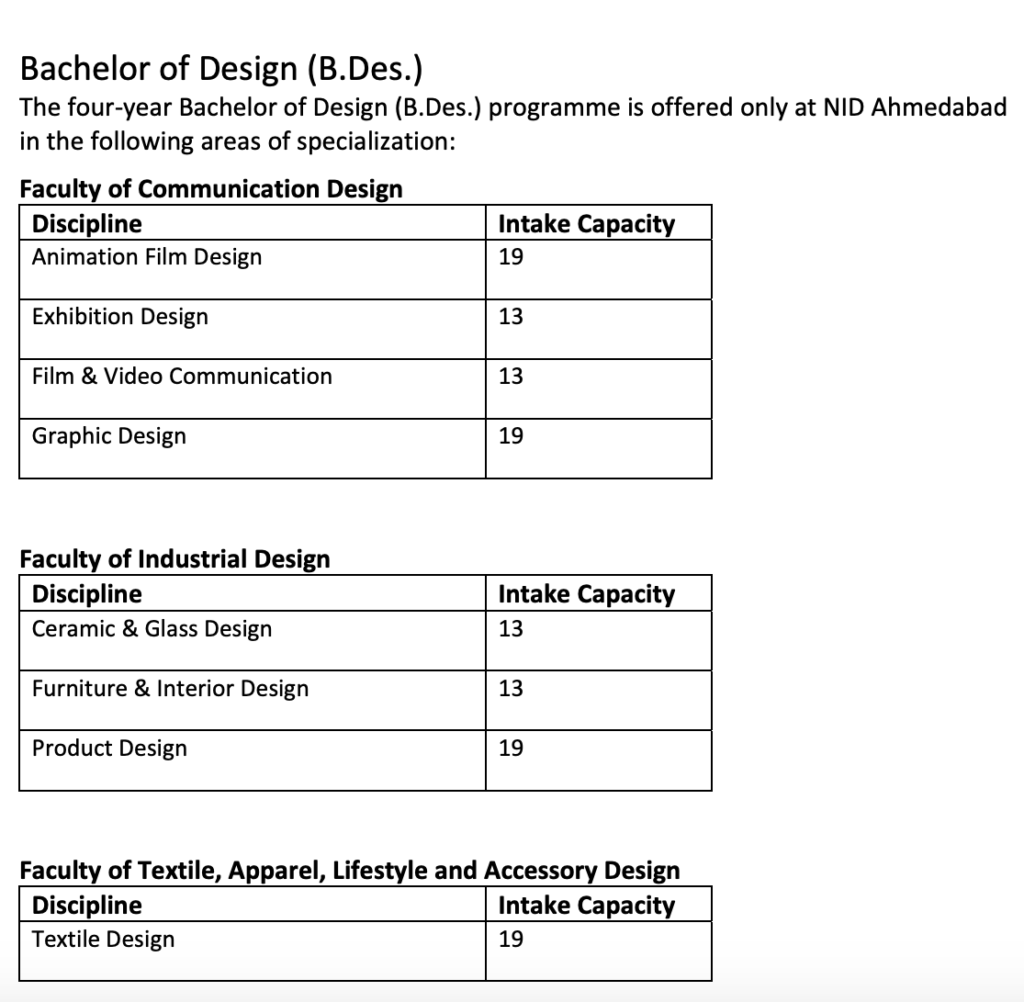
NID admissions 2020 is a two tier process. Thus, for NID admissions candidates need to appear for NID DAT (Prelims) and NID DAT (Mains). The objective of conducting both these tests is to assess knowledge, skills as well as behavioural abilities of candidates.

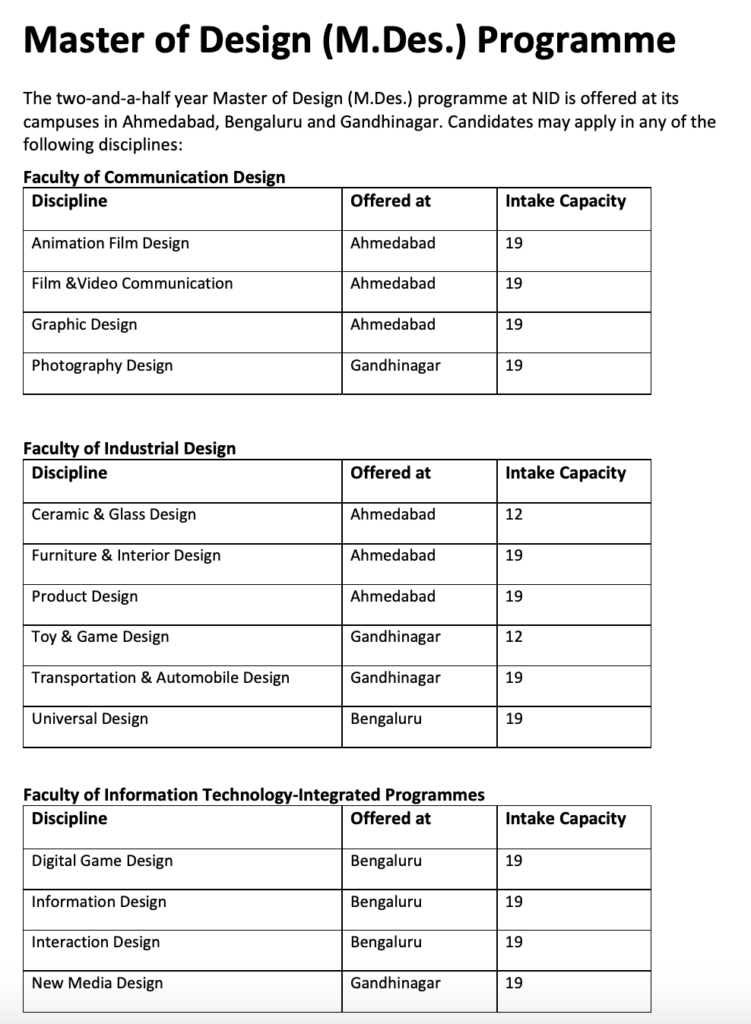
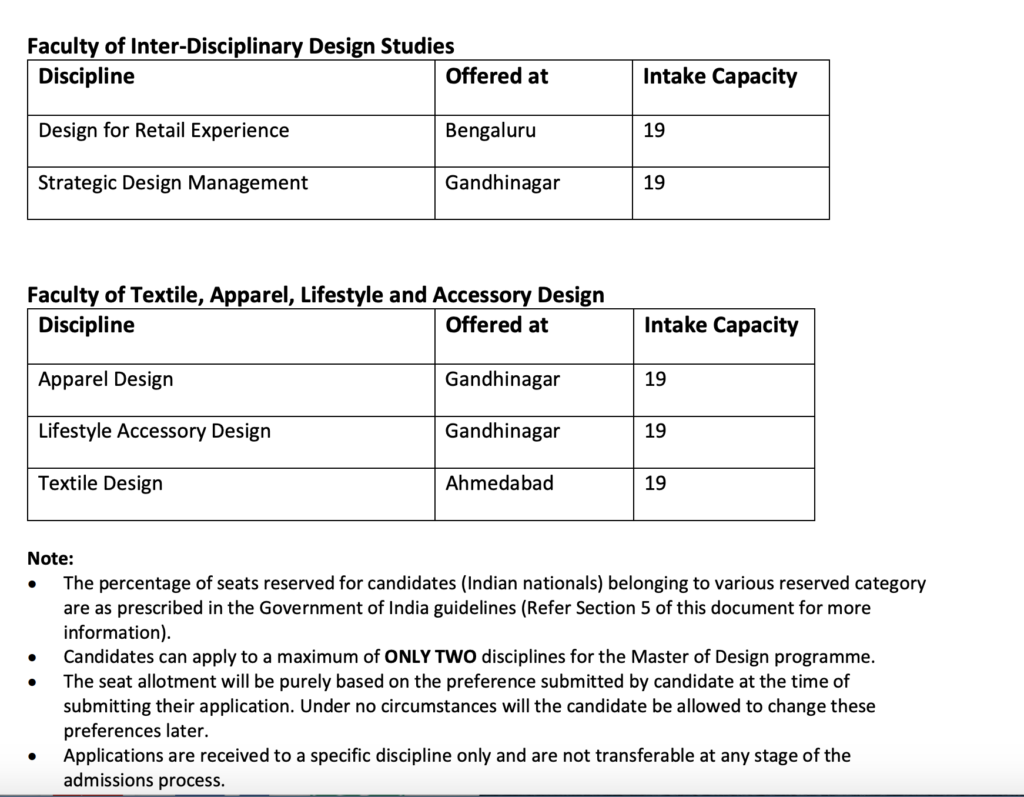
Graduate Diploma Programme in Design (GDPD) The four-year-long Graduate Diploma Programme in Design (GDPD) is offered at NID Andhra Pradesh, NID Haryana, NID Madhya Pradesh & NID Assam in the following areas of specialisation:

1. Industrial Design

2. Communication Design

3. Textile & Apparel Design

The details about the GDPD Programme and fees structure of respective campus can be viewed on official website of NID’s admission. The Handbook of all NID campuses are available for download on website http://admissions.nid.edu
SOUTH DELHI
CORPORATE BRANCH – HAUZ KHAS
 
Address:- G-8, G Block Market, 2nd Floor, Hauz Khas, New Delhi-110016
Nearest Metro Station Hauz Khas Gate No-3, Mayfair Garden / RBI Colony
Landmark –
 Near Punjab National Bank
Contact No: 88-00-22-6864, 011-40106405
Contact Person: Ms Yashika 
Email: corporate@pahaldesign.com
 
South Extension

Address:- E-17, Ground Floor, South Extension Part 1, New Delhi – 110049
Landmark: Mcdonald’s Lane, Nearest Metro – South Ex Metro Gate No 2
Contact No : 98994-29749, 011-41350505
Contact Person : Ms. Neha Siddiqui
Email : info@pahaldesign.com

EAST DELHI
Preet Vihar

Address:- C-57, Second Floor, Preet Vihar, Vikas Marg, Metro Pillar No-81.
(Near by Metro – Nirman Vihar / Preet Vihar ), New Delhi – 110092
Contact No : 011-45142542, 88264-92570, 93540-52529
Contact Person : Ms. Kanika Jain
Email : delhi@pahaldesign.com

NORTH WEST DELHI
Pitampura

Address:- 3rd Floor, 21 Kapil Vihar, Pitampura, Metro Pillar No.352
(Near by Metro-Kohat Enclave Gate 3), Opp. GULAB
Contact No : 011-42345936, 90311-70312
Contact Person :Ms. Kanika Bansal
Email : pitampura@pahaldesign.com

WEST DELHI
Janakpuri

Address:- 2nd Floor, S-4/63A, Shivaji Marg, New Mahavir Nagar, Janakpuri, New Delhi – 110018
Opposite – Metro Pillar No. 552, Landmark – Janakpuri East Metro Station
Contact Person: Ms Kanika Bansal
Contact No: 011-49879573, 90311-70312
Email : janakpuri@pahaldesign.com

DELHI NCR
Gurugram

Address:- M-44, Ground Floor, Old DLF Colony,
Sec-14 Market, Gurugram – 122001
Landmark – Opposite Ganpati Honda
Contact Person: Ms. Akanksha Pal
Contact No: 0124-4359032, 991060-9749
Email : gurugram@pahaldesign.com

Sonipat, Haryana

Address:- 2nd Floor, Atlas Road, Opposite Central Bank,
Above Verma Dental Clinic, Sonipat, Haryana – 131001
Contact Person: Ms. Kanika Bansal
Contact No: 90311-70312
Email : sonepat@pahaldesign.com
National Institute of Design (NID) at Ahmedabad and at its Bengaluru and Gandhinagar Extension campuses is an ‘Institute of National Importance’ as per the NID Act 2014 as well as an autonomous Institute under the Department for Promotion of Industry and Internal Trade (DPIIT), Ministry of Commerce & Industry, Government of India. As per the NID Act 2014, the Institute is a statutory authority empowered to award its own degrees— presently offering Bachelor of Design (B.Des.) of four-year duration, Masters of Design (M.Des.) of two-and-a-half year duration and PhD in Design. The Institute is also, a member of the Association of Indian Universities (AIU). NID Andhra Pradesh, NID Haryana, NID Madhya Pradesh & NID Assam are independent autonomous institutes under the DPIIT, Ministry of Commerce & Industry, Government of India and offer full time Graduate Diploma Programme in Design (GDPD) of four-year duration.

Admission to all the programmes at NID is on the basis of the candidates’ performance in the two-stages of Design Aptitude Test. The objective of these exams is to assess the knowledge, skills and behavioural abilities of candidates.

Stage 1: Design Aptitude Test (DAT) Prelims

Design Aptitude Test (DAT) Prelims will be conducted at various test centres across India Candidates should note that appearing for the DAT Prelims or being shortlisted for second stage of admission process does NOT guarantee automatic entitlement to admission.

Stage 2: Design Aptitude Test (DAT) Mains

Candidates shortlisted after the DAT Prelims will be invited to appear for the Stage 2 DAT Main exam at Ahmedabad or at all campuses of NID viz Ahmedabad, Bengaluru, Gandhinagar, Haryana, Andhra Pradesh, Assam and Madhya Pradesh. Exact details of the Test Centre will be mentioned in the DAT Mains Admit Card.

NID Entrance Exam 2020 Highlights

Event Details Specifications
Exam Name National Institute of Design Aptitude Test (NID DAT)
Exam Frequency Once a year
Exam Mode Offline
Exam Duration BDes/GDPD : 3 hours, MDes : 2 hours 30 minutes
Accepting Colleges 7
Official Website http://admissions.nid.edu/NIDA2020/Default.aspx

NID DAT 2020 Important Dates

Events Dates Salient Features
Release of NID admission notification 01-Oct-2019 NID released NID DAT 2020 exam dates and other admission details.
Window to fill NID application form (BDes/ GDPD) 01-Oct-2019 to 18-Nov-2019 NID application form had to be filled online for UG course admissions on the official website of the exam. No change in the application process from last year.

Last date to submit application form for BDes/ GDPD admissions at NID extended from November 7 to November 18, 2019.

Window to fill NID application form (MDes) 01-Oct-2019 to 18-Nov-2019 NID application form had to be filled online for PG course admissions on the official website of the exam. No change in the application process from last year.

Last date to submit application form for MDes admissions at NID extended from November 7 to November 18, 2019.

Download NID admit card 20-Dec-2019 Available for downloaded from the official website from 12 pm. Candidates can download NID DAT Prelims admit card by providing login details.
NID DAT Prelims 29-Dec-2019 NID Prelims was held across 21 test centres in the country for BDes admissions and 16 test centres for MDes entrance exam. NID DAT Prelims is the screening round for NID admissions 2020. 
Declaration of NID DAT (Prelims) result (MDes) 21-Feb-2020 Result for NID DAT 2020 for MDes admissions online on the official website of the exam by providing details like email address, date of birth and verification code.
Declaration of NID DAT (Prelims) result (BDes/ GDPD) 19-Mar-2020

10-Apr-2020 03-May-2020

Check the result for NID DAT 2020 for BDes/GDPD admissions online on the official website of the exam by providing details like email address, date of birth and verification code.
NID DAT (Mains) for BDes/ GDPD) 29-Apr-2020 to 03-May-2020 

22-Jun-2020 onwards

Candidates who clear NID DAT Prelims need to appear for NID DAT Mains which comprises of Studio Test and Interview round. NID DAT Mains is held at NID campuses at Ahmedabad, Bengaluru and Gandhinagar.
NID DAT (Mains) for MDes 06-Jul-2020 Candidates who clear NID DAT Prelims need to appear for NID DAT Mains which comprises of Studio Test and Interview round. NID DAT Mains is held at NID campuses at Ahmedabad, Bengaluru and Gandhinagar.
Declaration of NID admission test result for BDes & GDPD 28-May-2020 

24-Jul-2020

Aspirants need to check their result for NID DAT 2020 for BDes/GDPD admissions online on the official website of the exam by providing details like email address, date of birth and verification code.

NID DAT 2020 Eligibility Criteria

Candidates who want to apply for BDes or GDPD course at NID meet the eligibility criteria if they have cleared or are appearing for their higher secondary (10+2) qualifying examination from any stream (from any recognised board such as CBSE IB, ICSE or their equivalent in the year 2019-2020 can apply for the exam.

On the other hand, candidates are eligible to apply for MDes course if they have completed their bachelor’s degree from a recognised college/ university. Apart from this, aspirants applying for NID admission in MDes course should not be more than 30 years of age as on June 30, 2020.

NID Admission Process 2020

As part of NID admission process, candidates need to first fill their application form. Candidates who meet the eligibility criteria for this design entrance exam are then eligible to appear for NID DAT Prelims. Aspirants who clear the first stage of NID admissions then need to appear for NID DAT Mains. Finally, candidates who clear this admission round as well are offered admission in the course/ college of their choice.

NID admissions 2020 is a two tier process. Thus, for NID admissions candidates need to appear for NID DAT (Prelims) and NID DAT (Mains). The objective of conducting both these tests is to assess knowledge, skills as well as behavioural abilities of candidates.

Graduate Diploma Programme in Design (GDPD) The four-year-long Graduate Diploma Programme in Design (GDPD) is offered at NID Andhra Pradesh, NID Haryana, NID Madhya Pradesh & NID Assam in the following areas of specialisation:

1. Industrial Design

2. Communication Design

3. Textile & Apparel Design

The details about the GDPD Programme and fees structure of respective campus can be viewed on official website of NID’s admission. The Handbook of all NID campuses are available for download on website http://admissions.nid.edu

SOUTH DELHI
CORPORATE BRANCH – HAUZ KHAS
 
Address:- G-8, G Block Market, 2nd Floor, Hauz Khas, New Delhi-110016
Nearest Metro Station Hauz Khas Gate No-3, Mayfair Garden / RBI Colony
Landmark –
 Near Punjab National Bank
Contact No: 88-00-22-6864, 011-40106405
Contact Person: Ms Yashika 
Email: corporate@pahaldesign.com
 
South Extension

Address:- E-17, Ground Floor, South Extension Part 1, New Delhi – 110049
Landmark: Mcdonald’s Lane, Nearest Metro – South Ex Metro Gate No 2
Contact No : 98994-29749, 011-41350505
Contact Person : Ms. Neha Siddiqui
Email : info@pahaldesign.com

EAST DELHI
Preet Vihar

Address:- C-57, Second Floor, Preet Vihar, Vikas Marg, Metro Pillar No-81.
(Near by Metro – Nirman Vihar / Preet Vihar ), New Delhi – 110092
Contact No : 011-45142542, 88264-92570, 93540-52529
Contact Person : Ms. Kanika Jain
Email : delhi@pahaldesign.com

NORTH WEST DELHI
Pitampura

Address:- 3rd Floor, 21 Kapil Vihar, Pitampura, Metro Pillar No.352
(Near by Metro-Kohat Enclave Gate 3), Opp. GULAB
Contact No : 011-42345936, 90311-70312
Contact Person :Ms. Kanika Bansal
Email : pitampura@pahaldesign.com

WEST DELHI
Janakpuri

Address:- 2nd Floor, S-4/63A, Shivaji Marg, New Mahavir Nagar, Janakpuri, New Delhi – 110018
Opposite – Metro Pillar No. 552, Landmark – Janakpuri East Metro Station
Contact Person: Ms Kanika Bansal
Contact No: 011-49879573, 90311-70312
Email : janakpuri@pahaldesign.com

DELHI NCR
Gurugram

Address:- M-44, Ground Floor, Old DLF Colony,
Sec-14 Market, Gurugram – 122001
Landmark – Opposite Ganpati Honda
Contact Person: Ms. Akanksha Pal
Contact No: 0124-4359032, 991060-9749
Email : gurugram@pahaldesign.com

Sonipat, Haryana

Address:- 2nd Floor, Atlas Road, Opposite Central Bank,
Above Verma Dental Clinic, Sonipat, Haryana – 131001
Contact Person: Ms. Kanika Bansal
Contact No: 90311-70312
Email : sonepat@pahaldesign.com

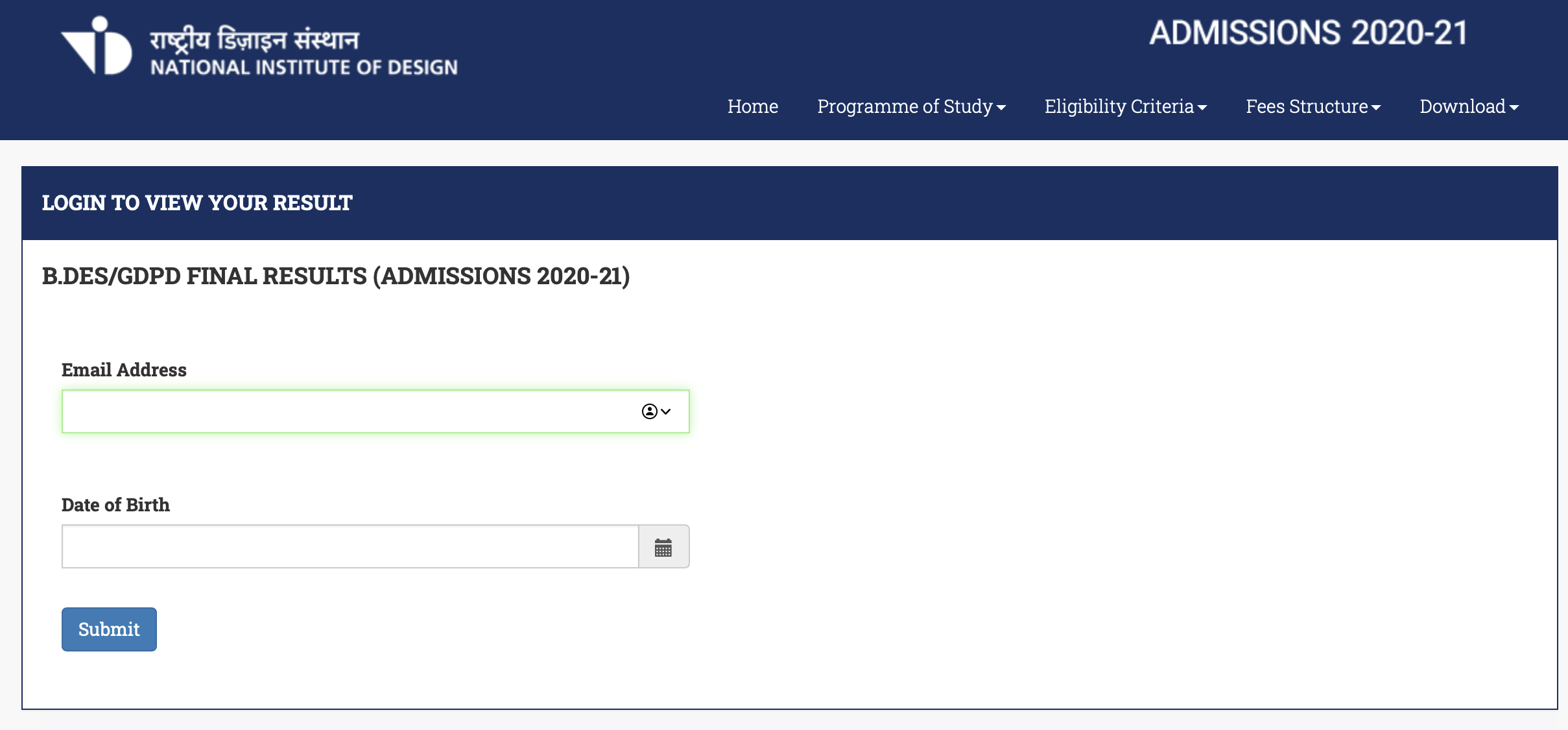
NID has made changes in the tie-break policy for BDes/ GDPD admissions 2020. NID Final result for BDes/ GDPD course admissions was declared on July 23, 2020. Candidates had to check their NID entrance exam Final result for on the official website of the exam (http://admissions.nid.edu). To check NID result 2020, candidates had to fill details like their registered email address and date of birth on the official website of NID entrance exam.  

NID result for BDes admission was expected on April 20 but the exam authorities postponed it due to COVID-19 outbreak. The NID admission cell has also changed the shortlisting criteria for NID BDes/ GDPD admissions 2020. Further, due to the current scenario, NID DAT Mains will be conducted as an online interaction.


National Institute of Design (NID) admission process requires aspirants to clear two rounds – NID DAT (Prelims) and NID DAT (Mains). Initially NID had declared 30% for DAT prelims and 70% for mains but due to covid 19 everything changed and they changed DAT Prelims 70% and DAT mains 30%. In DAT mains students had only Interview and Portfolio submission and everything was Online. Many of the Pahal Design students selected for NID. For any further details and updates. The students have to do submission of Institute Preference 23rd Just to 29th July 2020 and announcement of seat allotment, payment of Non refundable token fee and uploading of all documents in pdf format between 4th August to 11 August 2020.

The Candidates who have been provisionally shortlisted for admissions to the B.Des / GDPD programmes will have to confirm the seats by paying a non refundable token fee of:

A. INR 30,000/- Online Payment + Convenience charges as applicable for all the categories students

B. INR 75,000/ – Online Payment + Convenience charges as applicable for all the overseas students

After completion of the payment process, the candidates will be required to upload their documents related to educational qualifications, identity proof, Birth certificate, etc as a SINGLE PDF FILE of size not more than 10MB. The provisional admission of these candidates who fail to upload their documents within the deadline even after making the payment of the token fees, will be cancelled and their seat will be allotted to the next candidate in the order of merit.

List of scanned copies of the original documents uploaded by the candidates :

  1. 10th Mark sheet
  2. 12th mark sheet
  3. Birth Certificate / Proof of Birth / School Leaving certificate
  4. Category Certificates

Candidates whose class 12 results are awaited will have to upload the bonafide certificate (format available on the admission website) issued by the principal of the school last attended.

Note: In addition to the above documents , candidates in the overseas category will also have to upload the scanned copies of the following:

  1. 1st Page of passport
  2. Last Page of Passport
  3. Class XII

The best coaching institute for NIFT Entrance exam in South Delhi is undoubtedly Pahal Design. They have two centres in South Delhi one is in Hauz Khas and Other is in South Ex. These 2 centres are location at prime location of Delhi which is well connected to metro and Hostel facilities are also available for outstation students. Hauz Khas centre is just 500m for NIFT first and best campus at Hauz Khas. Many renowned markets of Delhi such as Sarojini Nagar Market, Green Park Market, Lajpat Nagar Market, South Extension, Kotla Mubarakpur, M-block Market, etc. and malls such as Ansal Plaza, DLF, MGF Metropolitan, Select Citywalk, Malviya Nagar, etc. are located in South Delhi. The IIT, AIIMS, NIFT, three of the country’s premier institutes in the field of technology, medicine and fashion respectively lie in the Hauz Khas locality of South Delhi. The Indian Institute of Foreign Trade of Delhi is located in the Qutub Institutional Area of South Delhi. Sangam Vihar is also located in South Delhi, which has the highest population in the State. The top Central University Jamia Millia Islamia is situated at Jamia Nagar area of South Delhi. The administrative district had 20% Green Cover, as of 2009. It has several spacious green parks, wildlife sanctuary, biodiversity parks, and green belts. Deer Park and Rose Garden in Hauz Khas, Asola Wildlife Sanctuary close to Delhi’s southern border on the Aravallis foothills are few examples. It has a good mix of concrete and greens. Jahaz Mahal, Zafar Mahal, Tughlaqabad, Hauz Khas Complex, Bijay Mandal, Qutub Minar, Mehrauli Archaeological Park, and the Safdarjung Tomb comprise some of South Delhi’s most scenic heritage sites.

Most of the affluent and upmarket residential areas of South Delhi were established in the early 1960’s. Today, Colonies such as

PAHAL DESIGN

Greater Kailash, Defense Colony, South Extension, Green Park, Neeti Bagh, Gulmohar Park, Hauz Khas, Safdarjung Development Area, Vasant Vihar,Sarvodaya Enclave, Anand Niketan, Jasola and Panchsheel Park are among the most expensive pin codes of New Delhi. All these colonies are categorized in either category ‘A’ or category ‘B’ which highlights the fact that residents of these colonies come under the very affluent and upper-middle-class sections of the society. Newly built builder floors and independent villas sell for as high as INR 10-80 crores in South Delhi. All these colonies are ‘planned colonies’ and therefore have proper connectivity to major roads and metro networks. They all also host their own markets such as Greater Kailash-1, M block Market, Green Park Market, Hauz Khas village area, South Extension Market and Defense Colony Market which are considered to be the poshest markets of Delhi. There are also numerous dedicated recreational areas around these colonies which is a luxury in today’s heavily urbanized and congested New Delhi.

SOUTH DELHI CENTRES:

Hauz Khas (Corporate Branch)

Address:- G-8, G Block Market, 2nd Floor, Hauz Khas, New Delhi-110016
Nearest Metro Station Hauz Khas Gate No-3, Mayfair Garden / RBI Colony
Landmark – Near Punjab National Bank
Contact No: 88-00-22-6864, 011-40106405
Contact Person: Ms Yashika
Email: corporate@pahaldesign.com

South Extension Part – 1

Address:- E-17, Ground Floor, South Extension Part 1, New Delhi – 110049
Landmark: Mcdonald’s Lane, Nearest Metro – South Ex Metro Gate No 2
Contact No : 98994-29749, 011-41350505
Contact Person : Ms. Neha Siddiqui
Email : info@pahaldesign.com


ngg_shortcode_0_placeholder

Durga, AIR 6, NIFT, MFTech, 2020

With a score of 56.30, Durga Chaurasia secured common merit rank 10 and General Category Rank 6 in NIFT Entrance Exam 2020 conducted for Master of Fashion Technology (MFTech) course admissions.

In a candid interview with Pahal Design, NIFT 2020 MFTech topper, Durga Chaurasia shared her prep strategy, GD/PI experience, success mantras, future plans, and a lot more. Go through the detailed interview below:

Pahal Design – Hi! Durga How are you?

Durga – All good. How about you.

Pahal Design – All good. After seeing your smiling faces and the position you have secured has made us Proud. Congratulations, so did you expect to be a topper?

Durga – Thank you so much for the topper 2 didn’t expect to be a topper but yes deep down in my heart I was just feeling that my hard work will really pay off and I will get some good rank and to get admission into NIFT. I was really happy about it.

Pahal Design – What was your score in NIFT?

Durga – In the written exam my score was 56.30 out of 100 I scored AIR 6.

Pahal Design – How did you prepare for written exam?

Durga – For the written examination, I prepared it on my own because the time was less. it was like 4-5 months left and I had my college assignment, college projects & exams as well so I just mutually prepared myself and I studied about like 3-4 hours a day along with my college stuffs and I just wanted my admission into NIFT and I somehow did it.

Pahal Design – Tell us about your journey, how did you prepare for it?

Durga – Yes, this year this entrance exam was full of surprises like that entry of negative marking and online scenario. If I say online it is the present demand so it can be fulfilled and it is necessary so you just need to be friendly with your phone and the person you are talking to and I was bit aware of negative marking in my graduation also so I was not really scared of  the negative marking but I was prepared only to put points on those questions which I am confirmed so yes it all want good up and down.

Pahal Design – How was your GDPI preparation. How did you go ahead with it?

Durga – For the GDPI sessions I was new to all of these things and I didn’t face anything like that before so for that I joined a crash course, I joined it by Pahal Institute. One of my teachers is in front of me and taking my interview. It really helped me a lot I was personally an anxious person but now I have that sense of confidence that I can speak in front of a strange people and having those coverage of wide variety of topics, subjects, the pdfs, the lectures , the day to day updation and everything was so in practice and in flow that I gave my best at the point when I needed it. So it was all because of you all.

Pahal Design – It was your hard work as well Durga so what mistakes you did and you want the future aspirants to avoid it.

Durga – So, mistakes I used to get blank at some point of time, and you get blank because you do not know about the content that you have been asked for so for that work on your content part, work on your subject part, work on your basics so it is not a very rocket science kind of a thing that you have to need to focus on small basics part and second thing is that the aspirants should practice a lot.  practice makes a man perfect so you just need to focus on what you need to do.

Pahal Design – How much time should every aspirant contribute or dedicate in a day?

Durga – First thing I would say that it fully depends on individual’s ability and how much dedicate you are towards your goal. During my written exam I used to study for like 3-4 hours a day honestly. I am not studious, not at all, but to get that opportunity of being fully flourished. I just studied and prepared anyway to make my dream come true. I remember the time when I used to stand in front of the mirror daily and tell myself daily that you have to do it & you will do it, and this thing motivated me to do it in spite of making me anxious.

Pahal Design – How was your PI?

Durga – Yes, if I talk about the present scenario, in this Covid-19 situation it was all lockdown and I had ample of time to prepare. It was a good opportunity and good time to get prepared for all of the Interview so I was not very confident about GD and interview  I used to prepare for 4-5 hours like not doing 5-6 hours straight but like 2 hours after that taking break and then after 1 hour just like that.

Pahal Design – What was the reaction of your family when you told them that you want to be in fashion industry.

Durga – I would say that I am lucky in this case my parents are really convincing and they are always supportive and at the same time encouraging me every time to do whatever I want, I remember I told them that I want to pursue a degree in master of fashion technology then my father and mother just smiled and they just said that you really want it you will get it your mom and dad are always by your side you just don’t worry you just work hard and put your efforts and we are always there so it was not that difficult for me to convince them.

Pahal Design – Is there anything else you would want to share or any tip you want to give to the future aspirant who are preparing for M.F.Tech?

Durga – I would give my tip which I inculcated into myself very strongly and very strictly I would say that there are 3 things that needs to be mentioned that needs to be in your head forever and ever – First thing is practice second thing is the determination and in simple words I would say stubbornness your eagerness your excitement for the thing that you want and the third thing is your dedication like dedication is the one thing like if you are not doing it for the one time try for the second time it is like that nothing is impossible you can achieve it if you want it.


ngg_shortcode_1_placeholder 


The National Institute of Fashion Technology is a leader in fashion education with the ability to integrate knowledge, traditional arts, contemporary thought, academic freedom, innovations in design & technology and creative thinking to continuously upgrade its curriculum to address the changing needs of the industry. Its history of more than three decades at the pinnacle of fashion education stands as a testimony to its focus on core values where academic excellence has been nurtured. The institute has stood as a beacon of industry-academia engagement and a key enabler in developing competent professionals.

The National Institute of Fashion Technology (NIFT), set up in 1986 under the Ministry of Textiles, Government of India, is a Statutory Institute governed by the NIFT Act 2006. Bringing in a wide range of aesthetic & intellectual orientations, the early instructors included leading progressive scholars from Fashion Institute of Technology, New York, USA.

Academic inclusiveness has been the key thought in the expansion plans of the institute. NIFT, today, has spread its wings across the length and breadth of the country. Through its 16 professionally managed campuses, National Institute of Fashion Technology provides an excellent environment to its students from different parts of the country to achieve their highest potential through the programmes offered. Since the early years of its inception, the institute has provided a firm foundation in fashion education in the domains of Design, Management and Technology. Since then, NIFT has continued to set and achieve higher academic standards.

NIFT Courses:

  1. B.Des (Bachelor of Design)
  2. M.Des (Master of Design)
  3. B.Ftech (Bachelor of Fashion Technology)
  4. M.Ftech (Master of Fashion Technology)
  5. MFM (Master of Fashion Management)

NIFT Exam Pattern 2020: Creative Ability Test (CAT)

NIFT CAT exam pattern is such that candidates are evaluated on the basis of their intuition skill, power of observation, innovation in the development of a concept as well as design ability of the candidate. One of the most important aspects of NIFT CAT exam is that it tests the creative as well as innovative use of colour and illustration skills of aspirants.

NIFT CAT is a paper-pencil based exam and it is of three hours duration.

NIFT Exam Pattern 2020: General Ability Test (GAT)

Candidates seeking NIFT admissions in BDes programmes offered at NIFT need to appear for GAT exam. This test comprises of the below-mentioned sections:

    • Quantitative Ability
    • Communication Ability
  • English Comprehension
  • Analytical Ability
  • General Knowledge and Current Affairs

The duration of NIFT GAT is 120 minutes for BDes course. While formulating the merit list for BDes course admissions 30% weighatge is allotted to GAT section of NIFT entrance exam.

NIFT CAT Exam Pattern for BDes Admissions

In NIFT exam pattern 2020 for BDes admissions, candidates need to appear for CAT. NIFT CAT exam paper has three questions which candidates need to attempt in three hours duration. In this design entrance exam, candidates are evaluated on the below mentioned parameters:

  • Design ability
  • Intuitive ability
  • Observation skills
  • Concept development skills
  • Creative use of colour
  • Illustration skills

NIFT Exam Pattern for Situation Test

Candidates who have been shortlisted for NIFT BDes admissions on the basis of their written test need to appear for NIFT Situation Test 2020 wherein their “material handling and innovative ability” will be tested.

Here, candidates will be evaluated on “on Space Visualization, Innovative and creative use of given material, composition of elements, colour scheme, construction skill , finesse of the model and overall presentation etc. These parameters will be checked with the write up explaining the concept / idea behind the model constructed. The weightage of the write up is 30%. Since the medium of teaching in NIFT is English, the write-up will be in English language.

  1. What is the marking scheme for NIFT entrance exam? NIFT exam marking scheme varies for CAT and GAT. In NIFT CAT exam, candidates are evaluated out of 100 marks. In GAT exam, aspirants are awarded for one mark for every correct answer and 0.25 marks are deducted for each wrong answer selected by them.

  2. How can I prepare for NIFT CAT? Candidates need to go through the detailed exam pattern as well as syllabus for NIFT CAT and thereafter formulate a preparation strategy. In NIFT CAT exam, aspirants are evaluated on the basis of their power of observation, innovation and design ability. Candidates can go through NIFT Entrance Exam Preparation to have a plan in place when preparing for this design entrance exam.
  3. How can I prepare for NIFT GAT? NIFT GAT comprises of multiple choice questions that aspirants need to solve in order to crack the exam. Questions in NIFT GAT are from subjects such as Quantitative Ability, Communication Ability, English Comprehension, Analytical Ability, General Knowledge and Current Affairs.
  4. Is there any negative marking in NIFT entrance exam? There is no negative marking in NIFT CAT exam. However, for GAT exam, 0.25 marks will be deducted for each wrong answer selected by a candidate. 
  5. What is the syllabus for NIFT exam? National Institute of Fashion Technology does not release any syllabus for NIFT exam. However, candidates can develop an idea of NIFT Entrance Exam Pattern.
  6. How many questions are asked in NIFT CAT? In NIFT CAT, candidates have to attempt three drawing questions.
  7. How many questions are asked in NIFT GAT? The exam pattern for NIFT GAT varies from one course to the other. The total number of questions asked in NIFT GAT are mentioned below:
  • BDes: 100 questions
  • BFTech: 150 questions
  • MDes: 120 questions
  • MFTech: 150 questions
  • MFM: 150 questions

Pahal Design Chandigarh

Address:- SCO No. 54/55, 2nd Floor, Sector 34 A, Chandigarh – 160022
Contact No : 91004-04681
Contact Person : Mr Raja Pratap
Email : chandigarh@pahaldesign.com

ngg_shortcode_2_placeholder 


The National Institute of Fashion Technology is a leader in fashion education with the ability to integrate knowledge, traditional arts, contemporary thought, academic freedom, innovations in design & technology and creative thinking to continuously upgrade its curriculum to address the changing needs of the industry. Its history of more than three decades at the pinnacle of fashion education stands as a testimony to its focus on core values where academic excellence has been nurtured. The institute has stood as a beacon of industry-academia engagement and a key enabler in developing competent professionals.

The National Institute of Fashion Technology (NIFT), set up in 1986 under the Ministry of Textiles, Government of India, is a Statutory Institute governed by the NIFT Act 2006. Bringing in a wide range of aesthetic & intellectual orientations, the early instructors included leading progressive scholars from Fashion Institute of Technology, New York, USA.

Academic inclusiveness has been the key thought in the expansion plans of the institute. NIFT, today, has spread its wings across the length and breadth of the country. Through its 16 professionally managed campuses, National Institute of Fashion Technology provides an excellent environment to its students from different parts of the country to achieve their highest potential through the programmes offered. Since the early years of its inception, the institute has provided a firm foundation in fashion education in the domains of Design, Management and Technology. Since then, NIFT has continued to set and achieve higher academic standards.

NIFT Courses:

  1. B.Des (Bachelor of Design)
  2. M.Des (Master of Design)
  3. B.Ftech (Bachelor of Fashion Technology)
  4. M.Ftech (Master of Fashion Technology)
  5. MFM (Master of Fashion Management)

NIFT Exam Pattern 2020: Creative Ability Test (CAT)

NIFT CAT exam pattern is such that candidates are evaluated on the basis of their intuition skill, power of observation, innovation in the development of a concept as well as design ability of the candidate. One of the most important aspects of NIFT CAT exam is that it tests the creative as well as innovative use of colour and illustration skills of aspirants.

NIFT CAT is a paper-pencil based exam and it is of three hours duration.

NIFT Exam Pattern 2020: General Ability Test (GAT)

Candidates seeking NIFT admissions in BDes programmes offered at NIFT need to appear for GAT exam. This test comprises of the below-mentioned sections:

    • Quantitative Ability
    • Communication Ability
  • English Comprehension
  • Analytical Ability
  • General Knowledge and Current Affairs

The duration of NIFT GAT is 120 minutes for BDes course. While formulating the merit list for BDes course admissions 30% weighatge is allotted to GAT section of NIFT entrance exam.

NIFT CAT Exam Pattern for BDes Admissions

In NIFT exam pattern 2020 for BDes admissions, candidates need to appear for CAT. NIFT CAT exam paper has three questions which candidates need to attempt in three hours duration. In this design entrance exam, candidates are evaluated on the below mentioned parameters:

  • Design ability
  • Intuitive ability
  • Observation skills
  • Concept development skills
  • Creative use of colour
  • Illustration skills

NIFT Exam Pattern for Situation Test

Candidates who have been shortlisted for NIFT BDes admissions on the basis of their written test need to appear for NIFT Situation Test 2020 wherein their “material handling and innovative ability” will be tested.

Here, candidates will be evaluated on “on Space Visualization, Innovative and creative use of given material, composition of elements, colour scheme, construction skill , finesse of the model and overall presentation etc. These parameters will be checked with the write up explaining the concept / idea behind the model constructed. The weightage of the write up is 30%. Since the medium of teaching in NIFT is English, the write-up will be in English language.

  1. What is the marking scheme for NIFT entrance exam? NIFT exam marking scheme varies for CAT and GAT. In NIFT CAT exam, candidates are evaluated out of 100 marks. In GAT exam, aspirants are awarded for one mark for every correct answer and 0.25 marks are deducted for each wrong answer selected by them.

  2. How can I prepare for NIFT CAT? Candidates need to go through the detailed exam pattern as well as syllabus for NIFT CAT and thereafter formulate a preparation strategy. In NIFT CAT exam, aspirants are evaluated on the basis of their power of observation, innovation and design ability. Candidates can go through NIFT Entrance Exam Preparation to have a plan in place when preparing for this design entrance exam.
  3. How can I prepare for NIFT GAT? NIFT GAT comprises of multiple choice questions that aspirants need to solve in order to crack the exam. Questions in NIFT GAT are from subjects such as Quantitative Ability, Communication Ability, English Comprehension, Analytical Ability, General Knowledge and Current Affairs.
  4. Is there any negative marking in NIFT entrance exam? There is no negative marking in NIFT CAT exam. However, for GAT exam, 0.25 marks will be deducted for each wrong answer selected by a candidate. 
  5. What is the syllabus for NIFT exam? National Institute of Fashion Technology does not release any syllabus for NIFT exam. However, candidates can develop an idea of NIFT Entrance Exam Pattern.
  6. How many questions are asked in NIFT CAT? In NIFT CAT, candidates have to attempt three drawing questions.
  7. How many questions are asked in NIFT GAT? The exam pattern for NIFT GAT varies from one course to the other. The total number of questions asked in NIFT GAT are mentioned below:
  • BDes: 100 questions
  • BFTech: 150 questions
  • MDes: 120 questions
  • MFTech: 150 questions
  • MFM: 150 questions

Pahal Design Kolkata

Address:- 307, 3rd Floor, Vardaan Market, Camac Street, Kolkata – 700016
Contact No : 033-46014578, 9830006214
Contact Person : Ms Twinkle Roy
Email : kolkata@pahaldesign.com

ngg_shortcode_3_placeholder 


The National Institute of Fashion Technology is a leader in fashion education with the ability to integrate knowledge, traditional arts, contemporary thought, academic freedom, innovations in design & technology and creative thinking to continuously upgrade its curriculum to address the changing needs of the industry. Its history of more than three decades at the pinnacle of fashion education stands as a testimony to its focus on core values where academic excellence has been nurtured. The institute has stood as a beacon of industry-academia engagement and a key enabler in developing competent professionals.

The National Institute of Fashion Technology (NIFT), set up in 1986 under the Ministry of Textiles, Government of India, is a Statutory Institute governed by the NIFT Act 2006. Bringing in a wide range of aesthetic & intellectual orientations, the early instructors included leading progressive scholars from Fashion Institute of Technology, New York, USA.

Academic inclusiveness has been the key thought in the expansion plans of the institute. NIFT, today, has spread its wings across the length and breadth of the country. Through its 16 professionally managed campuses, National Institute of Fashion Technology provides an excellent environment to its students from different parts of the country to achieve their highest potential through the programmes offered. Since the early years of its inception, the institute has provided a firm foundation in fashion education in the domains of Design, Management and Technology. Since then, NIFT has continued to set and achieve higher academic standards.

NIFT Courses:

  1. B.Des (Bachelor of Design)
  2. M.Des (Master of Design)
  3. B.Ftech (Bachelor of Fashion Technology)
  4. M.Ftech (Master of Fashion Technology)
  5. MFM (Master of Fashion Management)

NIFT Exam Pattern 2020: Creative Ability Test (CAT)

NIFT CAT exam pattern is such that candidates are evaluated on the basis of their intuition skill, power of observation, innovation in the development of a concept as well as design ability of the candidate. One of the most important aspects of NIFT CAT exam is that it tests the creative as well as innovative use of colour and illustration skills of aspirants.

NIFT CAT is a paper-pencil based exam and it is of three hours duration.

NIFT Exam Pattern 2020: General Ability Test (GAT)

Candidates seeking NIFT admissions in BDes programmes offered at NIFT need to appear for GAT exam. This test comprises of the below-mentioned sections:

    • Quantitative Ability
    • Communication Ability
  • English Comprehension
  • Analytical Ability
  • General Knowledge and Current Affairs

The duration of NIFT GAT is 120 minutes for BDes course. While formulating the merit list for BDes course admissions 30% weighatge is allotted to GAT section of NIFT entrance exam.

NIFT CAT Exam Pattern for BDes Admissions

In NIFT exam pattern 2020 for BDes admissions, candidates need to appear for CAT. NIFT CAT exam paper has three questions which candidates need to attempt in three hours duration. In this design entrance exam, candidates are evaluated on the below mentioned parameters:

  • Design ability
  • Intuitive ability
  • Observation skills
  • Concept development skills
  • Creative use of colour
  • Illustration skills

NIFT Exam Pattern for Situation Test

Candidates who have been shortlisted for NIFT BDes admissions on the basis of their written test need to appear for NIFT Situation Test 2020 wherein their “material handling and innovative ability” will be tested.

Here, candidates will be evaluated on “on Space Visualization, Innovative and creative use of given material, composition of elements, colour scheme, construction skill , finesse of the model and overall presentation etc. These parameters will be checked with the write up explaining the concept / idea behind the model constructed. The weightage of the write up is 30%. Since the medium of teaching in NIFT is English, the write-up will be in English language.

  1. What is the marking scheme for NIFT entrance exam? NIFT exam marking scheme varies for CAT and GAT. In NIFT CAT exam, candidates are evaluated out of 100 marks. In GAT exam, aspirants are awarded for one mark for every correct answer and 0.25 marks are deducted for each wrong answer selected by them.

  2. How can I prepare for NIFT CAT? Candidates need to go through the detailed exam pattern as well as syllabus for NIFT CAT and thereafter formulate a preparation strategy. In NIFT CAT exam, aspirants are evaluated on the basis of their power of observation, innovation and design ability. Candidates can go through NIFT Entrance Exam Preparation to have a plan in place when preparing for this design entrance exam.
  3. How can I prepare for NIFT GAT? NIFT GAT comprises of multiple choice questions that aspirants need to solve in order to crack the exam. Questions in NIFT GAT are from subjects such as Quantitative Ability, Communication Ability, English Comprehension, Analytical Ability, General Knowledge and Current Affairs.
  4. Is there any negative marking in NIFT entrance exam? There is no negative marking in NIFT CAT exam. However, for GAT exam, 0.25 marks will be deducted for each wrong answer selected by a candidate. 
  5. What is the syllabus for NIFT exam? National Institute of Fashion Technology does not release any syllabus for NIFT exam. However, candidates can develop an idea of NIFT Entrance Exam Pattern.
  6. How many questions are asked in NIFT CAT? In NIFT CAT, candidates have to attempt three drawing questions.
  7. How many questions are asked in NIFT GAT? The exam pattern for NIFT GAT varies from one course to the other. The total number of questions asked in NIFT GAT are mentioned below:
  • BDes: 100 questions
  • BFTech: 150 questions
  • MDes: 120 questions
  • MFTech: 150 questions
  • MFM: 150 questions

Pahal Design Ranchi

Address:- 2nd Floor, Manjusha Complex, Opposite Shri Bangla Ghari Chandi Mandir,

Hazaribag Road, Lalpur, Ranchi – 834001
Contact No : +91-76777-16770, 0651-2531054
Contact Person : Ms. Shweta
Email : ranchi@pahaldesign.com

ngg_shortcode_4_placeholder 


The National Institute of Fashion Technology is a leader in fashion education with the ability to integrate knowledge, traditional arts, contemporary thought, academic freedom, innovations in design & technology and creative thinking to continuously upgrade its curriculum to address the changing needs of the industry. Its history of more than three decades at the pinnacle of fashion education stands as a testimony to its focus on core values where academic excellence has been nurtured. The institute has stood as a beacon of industry-academia engagement and a key enabler in developing competent professionals.

The National Institute of Fashion Technology (NIFT), set up in 1986 under the Ministry of Textiles, Government of India, is a Statutory Institute governed by the NIFT Act 2006. Bringing in a wide range of aesthetic & intellectual orientations, the early instructors included leading progressive scholars from Fashion Institute of Technology, New York, USA.

Academic inclusiveness has been the key thought in the expansion plans of the institute. NIFT, today, has spread its wings across the length and breadth of the country. Through its 16 professionally managed campuses, National Institute of Fashion Technology provides an excellent environment to its students from different parts of the country to achieve their highest potential through the programmes offered. Since the early years of its inception, the institute has provided a firm foundation in fashion education in the domains of Design, Management and Technology. Since then, NIFT has continued to set and achieve higher academic standards.

NIFT Courses:

  1. B.Des (Bachelor of Design)
  2. M.Des (Master of Design)
  3. B.Ftech (Bachelor of Fashion Technology)
  4. M.Ftech (Master of Fashion Technology)
  5. MFM (Master of Fashion Management)

NIFT Exam Pattern 2020: Creative Ability Test (CAT)

NIFT CAT exam pattern is such that candidates are evaluated on the basis of their intuition skill, power of observation, innovation in the development of a concept as well as design ability of the candidate. One of the most important aspects of NIFT CAT exam is that it tests the creative as well as innovative use of colour and illustration skills of aspirants.

NIFT CAT is a paper-pencil based exam and it is of three hours duration.

NIFT Exam Pattern 2020: General Ability Test (GAT)

Candidates seeking NIFT admissions in BDes programmes offered at NIFT need to appear for GAT exam. This test comprises of the below-mentioned sections:

    • Quantitative Ability
    • Communication Ability
  • English Comprehension
  • Analytical Ability
  • General Knowledge and Current Affairs

The duration of NIFT GAT is 120 minutes for BDes course. While formulating the merit list for BDes course admissions 30% weighatge is allotted to GAT section of NIFT entrance exam.

NIFT CAT Exam Pattern for BDes Admissions

In NIFT exam pattern 2020 for BDes admissions, candidates need to appear for CAT. NIFT CAT exam paper has three questions which candidates need to attempt in three hours duration. In this design entrance exam, candidates are evaluated on the below mentioned parameters:

  • Design ability
  • Intuitive ability
  • Observation skills
  • Concept development skills
  • Creative use of colour
  • Illustration skills

NIFT Exam Pattern for Situation Test

Candidates who have been shortlisted for NIFT BDes admissions on the basis of their written test need to appear for NIFT Situation Test 2020 wherein their “material handling and innovative ability” will be tested.

Here, candidates will be evaluated on “on Space Visualization, Innovative and creative use of given material, composition of elements, colour scheme, construction skill , finesse of the model and overall presentation etc. These parameters will be checked with the write up explaining the concept / idea behind the model constructed. The weightage of the write up is 30%. Since the medium of teaching in NIFT is English, the write-up will be in English language.

  1. What is the marking scheme for NIFT entrance exam? NIFT exam marking scheme varies for CAT and GAT. In NIFT CAT exam, candidates are evaluated out of 100 marks. In GAT exam, aspirants are awarded for one mark for every correct answer and 0.25 marks are deducted for each wrong answer selected by them.
  2. How can I prepare for NIFT CAT? Candidates need to go through the detailed exam pattern as well as syllabus for NIFT CAT and thereafter formulate a preparation strategy. In NIFT CAT exam, aspirants are evaluated on the basis of their power of observation, innovation and design ability. Candidates can go through NIFT Entrance Exam Preparation to have a plan in place when preparing for this design entrance exam.
  3. How can I prepare for NIFT GAT? NIFT GAT comprises of multiple choice questions that aspirants need to solve in order to crack the exam. Questions in NIFT GAT are from subjects such as Quantitative Ability, Communication Ability, English Comprehension, Analytical Ability, General Knowledge and Current Affairs.
  4. Is there any negative marking in NIFT entrance exam? There is no negative marking in NIFT CAT exam. However, for GAT exam, 0.25 marks will be deducted for each wrong answer selected by a candidate. 
  5. What is the syllabus for NIFT exam? National Institute of Fashion Technology does not release any syllabus for NIFT exam. However, candidates can develop an idea of NIFT Entrance Exam Pattern.
  6. How many questions are asked in NIFT CAT? In NIFT CAT, candidates have to attempt three drawing questions.
  7. How many questions are asked in NIFT GAT? The exam pattern for NIFT GAT varies from one course to the other. The total number of questions asked in NIFT GAT are mentioned below:
  • BDes: 100 questions
  • BFTech: 150 questions
  • MDes: 120 questions
  • MFTech: 150 questions
  • MFM: 150 questions

Pahal Design Gwalior

D/2, Ground Floor, Basant Vihar Colony, Gwalior

Contact Person: Kanika Jain

Mobile Number: 93540-52529

Email : corporate@pahaldesign.com

ngg_shortcode_5_placeholder 


The National Institute of Fashion Technology is a leader in fashion education with the ability to integrate knowledge, traditional arts, contemporary thought, academic freedom, innovations in design & technology and creative thinking to continuously upgrade its curriculum to address the changing needs of the industry. Its history of more than three decades at the pinnacle of fashion education stands as a testimony to its focus on core values where academic excellence has been nurtured. The institute has stood as a beacon of industry-academia engagement and a key enabler in developing competent professionals.

The National Institute of Fashion Technology (NIFT), set up in 1986 under the Ministry of Textiles, Government of India, is a Statutory Institute governed by the NIFT Act 2006. Bringing in a wide range of aesthetic & intellectual orientations, the early instructors included leading progressive scholars from Fashion Institute of Technology, New York, USA.

Academic inclusiveness has been the key thought in the expansion plans of the institute. NIFT, today, has spread its wings across the length and breadth of the country. Through its 16 professionally managed campuses, National Institute of Fashion Technology provides an excellent environment to its students from different parts of the country to achieve their highest potential through the programmes offered. Since the early years of its inception, the institute has provided a firm foundation in fashion education in the domains of Design, Management and Technology. Since then, NIFT has continued to set and achieve higher academic standards.

NIFT Courses:

  1. B.Des (Bachelor of Design)
  2. M.Des (Master of Design)
  3. B.Ftech (Bachelor of Fashion Technology)
  4. M.Ftech (Master of Fashion Technology)
  5. MFM (Master of Fashion Management)

NIFT Exam Pattern 2020: Creative Ability Test (CAT)

NIFT CAT exam pattern is such that candidates are evaluated on the basis of their intuition skill, power of observation, innovation in the development of a concept as well as design ability of the candidate. One of the most important aspects of NIFT CAT exam is that it tests the creative as well as innovative use of colour and illustration skills of aspirants.

NIFT CAT is a paper-pencil based exam and it is of three hours duration.

NIFT Exam Pattern 2020: General Ability Test (GAT)

Candidates seeking NIFT admissions in BDes programmes offered at NIFT need to appear for GAT exam. This test comprises of the below-mentioned sections:

  • Quantitative Ability
  • Communication Ability
  • English Comprehension
  • Analytical Ability
  • General Knowledge and Current Affairs

The duration of NIFT GAT is 120 minutes for BDes course. While formulating the merit list for BDes course admissions 30% weighatge is allotted to GAT section of NIFT entrance exam.

NIFT CAT Exam Pattern for BDes Admissions

In NIFT exam pattern 2020 for BDes admissions, candidates need to appear for CAT. NIFT CAT exam paper has three questions which candidates need to attempt in three hours duration. In this design entrance exam, candidates are evaluated on the below mentioned parameters:

  • Design ability
  • Intuitive ability
  • Observation skills
  • Concept development skills
  • Creative use of colour
  • Illustration skills

NIFT Exam Pattern for Situation Test

Candidates who have been shortlisted for NIFT BDes admissions on the basis of their written test need to appear for NIFT Situation Test 2020 wherein their “material handling and innovative ability” will be tested.

Here, candidates will be evaluated on “on Space Visualization, Innovative and creative use of given material, composition of elements, colour scheme, construction skill , finesse of the model and overall presentation etc. These parameters will be checked with the write up explaining the concept / idea behind the model constructed. The weightage of the write up is 30%. Since the medium of teaching in NIFT is English, the write-up will be in English language.

  1. What is the marking scheme for NIFT entrance exam? NIFT exam marking scheme varies for CAT and GAT. In NIFT CAT exam, candidates are evaluated out of 100 marks. In GAT exam, aspirants are awarded for one mark for every correct answer and 0.25 marks are deducted for each wrong answer selected by them.
  2. How can I prepare for NIFT CAT? Candidates need to go through the detailed exam pattern as well as syllabus for NIFT CAT and thereafter formulate a preparation strategy. In NIFT CAT exam, aspirants are evaluated on the basis of their power of observation, innovation and design ability. Candidates can go through NIFT entrance exam preparation to have a plan in place when preparing for this design entrance exam.
  3. How can I prepare for NIFT GAT? NIFT GAT comprises of multiple choice questions that aspirants need to solve in order to crack the exam. Questions in NIFT GAT are from subjects such as Quantitative Ability, Communication Ability, English Comprehension, Analytical Ability, General Knowledge and Current Affairs.
  4. Is there any negative marking in NIFT entrance exam? There is no negative marking in NIFT CAT exam. However, for GAT exam, 0.25 marks will be deducted for each wrong answer selected by a candidate. 
  5. What is the syllabus for NIFT exam? National Institute of Fashion Technology does not release any syllabus for NIFT exam. However, candidates can develop an idea of NIFT entrance exam syllabus here.
  6. How many questions are asked in NIFT CAT? In NIFT CAT, candidates have to attempt three drawing questions.
  7. How many questions are asked in NIFT GAT? The exam pattern for NIFT GAT varies from one course to the other. The total number of questions asked in NIFT GAT are mentioned below:
  • BDes: 100 questions
  • BFTech: 150 questions
  • MDes: 120 questions
  • MFTech: 150 questions
  • MFM: 150 questions

Pahal Design Gwalior

D/2, Ground Floor, Basant Vihar Colony, Gwalior

Contact Person: Kanika Jain

Mobile Number: 93540-52529

Email : corporate@pahaldesign.com

ngg_shortcode_6_placeholder 


Schedule a free counselling session WhatsApp WhatsApp Enquiry