How to prepare for NIFT MFM, M.Des , M.Ftech group discussion

A group discussion is a group of individuals, gather at one place in the form of a circle with similar interest to share the ideas, solve problems or give comments. In simple terms, a group discussion is well known as GD. Generally, the group discussions are performed to assess the skill set of a person which includes communication skills, leadership skills, managing skills, team building skills, social skills, problem-solving skills and presence of mind. At last, the rating is given on a scale of 1 to 10.

Why GD became mandatory?

Before GD the candidate has to undergo the written exam which covers different subject levels such as quantitative aptitude, logical reasoning, general English and computer-based questions. Based on the cut-off, after qualifying the first round the candidate has to undergo the second round i.e group discussion. Group discussion became mandatory to filter the candidate’s soft skills and whether the candidate has the ability to cope up with different scenarios.

Who conducts a group discussion?

Generally, group discussion is conducted by large bodies such as universities, top-rated b-schools, management institutions & colleges and even by MNC’s. To get admission in NIFT top B-schools GD round is one of the most important & crucial rounds. This round is conducted to analyze the skills from different parameters and to select the right candidate for the right position so that it meets the company’s requirement.

Why do students fail to perform well in GD?

In today’s scenario most of the students fail to perform well in a group discussion because of the below three reasons:

  1. Due to the fear of speaking in public.
    2. Lack of knowledge on the topic.
    3. No proper command on language.

The process followed in GD:

NIFT Group Discussion and Interview, the selectors will select the students randomly based on the number. For a group usually, 8-10 members were selected. A topic is given and around 3-5 minutes of time is given to prepare. The duration of the discussion is based on the group, topic, college to college and organization to organization. Only on a few parameters, the assessment is done. The parameters such as content, supporting others point, giving relevant examples, latest updates or news, eye-contact, conclusion and behavioral traits.

There is no secret or any rules for preparing GD. Before going for GD one has to consider a few points.

  1. Be up-to-date on the latest information such as news and trending topics in the market.
    2. Make a habit of reading newspapers, books and magazines so that in-detail information is provided.
    3. The simple way to remember the content for a longer period is to watch videos for 2-3 times.
    4. Later on, select a topic and speak for yourself in front of the mirror. (Make assessment for yourself).
    5. Even be aware of different topics such as sports, political news, technology news, economics and market-related news.
    6.Know about the Indian Fashion and Textile Industry.

How to perform GD?

When a topic is given just think over it; under which category the topic is. It might be related to life, current affairs, technology, political news and any other trending topic in the market. So, think about the topic and frame the sentence in your own words to speak. When you are speaking you need to agree or disagree with the other points and you need to give a proper reason to it. But, don’t deviate/ mislead from the topic. Make others also speak & give chance to them to put the points into the discussion.

For suppose if you are leading the group:
1. Introduce yourself & give a brief note on the topic.
2. Make a start on a positive note.
3. Discuss the pros and cons of the topic and how to overcome them.
4. Make everyone speak.
5. Support other points.
6. If the group members are deviating from the topic it is your responsibility to bring them back.
As you are leading the group you need to conclude by summarizing all the points which were discussed.

Few tips for GD:

  1. Grooming (appearance)
    2. Be a good listener & support or add to the other points. (But don’t interrupt in middle)
    3. Speak loudly and clearly.
    4. Try to be the first and the last speaker of the discussion.
    5. Be confident while speaking (analyze with numbers if you know & it has to be fact).



The Indian real estate industry in Dec 2020 was estimated to be, rising income levels, urbanization and the rapid growth of the IT sector are the key drivers for the Indian real estate sector. Currently as the economy is facing a slump due to global downturn, the real estate sector is facing difficulties. However, in the next 2-3 years most of the larger players are anticipated to expand aggressively across the country. With this slump considered momentary, Indian real estate industry is likely to witness huge growth again. With increase in growth, demand for allied services like architecture, interior design & landscape architecture is likely to increase.
Architectural Design

Market
• Architecture is a highly competitive and multi-disciplinary profession, involving a variety of tasks.
• As a field, it covers myriad disciplines, including spatial design, aesthetics, project management and material management.
• There are many Institutions in the country offering undergraduate & post graduate courses in Architecture.
• From our survey, out of the total number of designers working in the country, this discipline accounts for the most with 81.25%.
• Majority of the architects belong to the age group of 20-35 & hold B.Arch as their degree of qualification.35
• Mumbai leads in terms of having maximum number of architects followed by Pune and Delhi.
• In terms of placements, maximum numbers of architects are placed in the private sector followed by being self employed & in public sectors.
Current Activities
• In terms of outsourcing, architectural services are gaining traction with scope including design development, detailed architectural plans, construction documentation, as-built drawings, shop drawings, and visualization (3D views & walk-through).
• Architectural outsourcing service in India has the potential to grow to $12 billion in the next four to six years, from its current level of $3.5 billion.36
• Annual requirement projections of architects’ stands over 10,000 which is expected to rise further but the training facilities available are still short.

Interior Design

  1. One key aspect of architecture, which is coming up and expected to play an increasing role in architectural design is environmental friendly buildings and structures. Green buildings will soon be a feature and a part of people lives.
  2. Interior design is a multi-faceted profession wherein creative and technical solutions are applied within a structure to achieve a built interior environment.
  3. Interior decoration and designing in India are getting popular with a lot of people opting for the services of trained interior designers for their houses / offices, etc.
  4. Reason can also be attributed to the changing definitions of homes and modern residential houses, which now symbolize more with the personalities of their owners.
  5. Interior design is also gaining popularity among workplaces and is being considered as a science helping to reduce stress and fatigue thereby increasing productivity.
  6. The services provided by interior decorators and designer cover a wide range of areas and include Interior decoration services, furniture and furnishings, facilities design, mechanical designing, residential interior architecture, etc.
  7. Keeping in mind the demand & separate need from architecture courses, various Institutions like University of Pune and Anna University (Chennai) have announced specialized courses in Interior design as B.Arch (Interior design).

Urban Design and Landscape Design

  1. Landscape architects consider how a place to be used and understand what kind of natural ingredients from grass to stone to falling water will serve best.
  2. The scope of the profession includes site planning, housing estate development, environmental restoration, town or urban planning, urban design, parks, landscape urbanism and recreation planning.
  3. The work also includes conducting Environmental Impact Assessment (EIA) studies for a region (analyzing impact of development on natural resources in a region and taking steps to mitigate damage) and also assessing urban growth, need for open spaces, and developing suitable strategies to enhance the green cover of cities.
  4. The Industry is at a nascent stage in India, but with each year there seem to be new opportunities pouring in.
  5. To become a landscape architect, one needs to do an undergraduate course in architecture, followed by a two-year master’s program in landscape architecture.
  6. Application-oriented knowledge of plant systems and processes, plants and design, landscape engineering, eco-system analysis and field ecology is imperative as is knowledge of design history and culture.
  7. The demand for landscape architects is not just limited to architectural firms. One can find job with builders, government authorities like DDA, NDMC, and CPWD apart from working with architects.

Furniture Design

  1. Furniture designers create the designs that people use as furnishings in residential and commercial properties throughout the world.
  2. Furniture design is a blend of multiple disciplines & is much like fashion design, as the materials, textiles, metals, etc. used to make a piece of furniture can be comparable to materials used to make a piece of clothing. Furniture design also is much like architecture in that the furniture must prove stable and safe.
  3. Furniture designers either work for large manufacturing industries or in batch production companies. Many set up their own design and batch production studios, undertaking custom- designed furniture. Others contribute to interior design teams, working on projects for the service sector, besides corporate organizations.
  4. Furniture design programs teaches an integrated approach to furniture as a part of living, work spaces and habitat and challenges and defines the boundaries of such objects in systems context.
  5. The Furniture design programs provide students an opportunity to challenge and redefine the boundaries of furniture, as much as to develop its traditions. The programs ensure that students are able to perform at all levels of production of furniture in various materials, mass production industries, to the small scale and craft sectors.
Jaipur

Address:- 2nd Floor, F 18, Gautam Marg, Vaishali Nagar, Jaipur, Rajasthan -302021
Contact Person: Mr. Aman and Mr. Akbar
Contact No: 97721-99911, 0141-6656509
Email: jaipur@pahaldesign.com

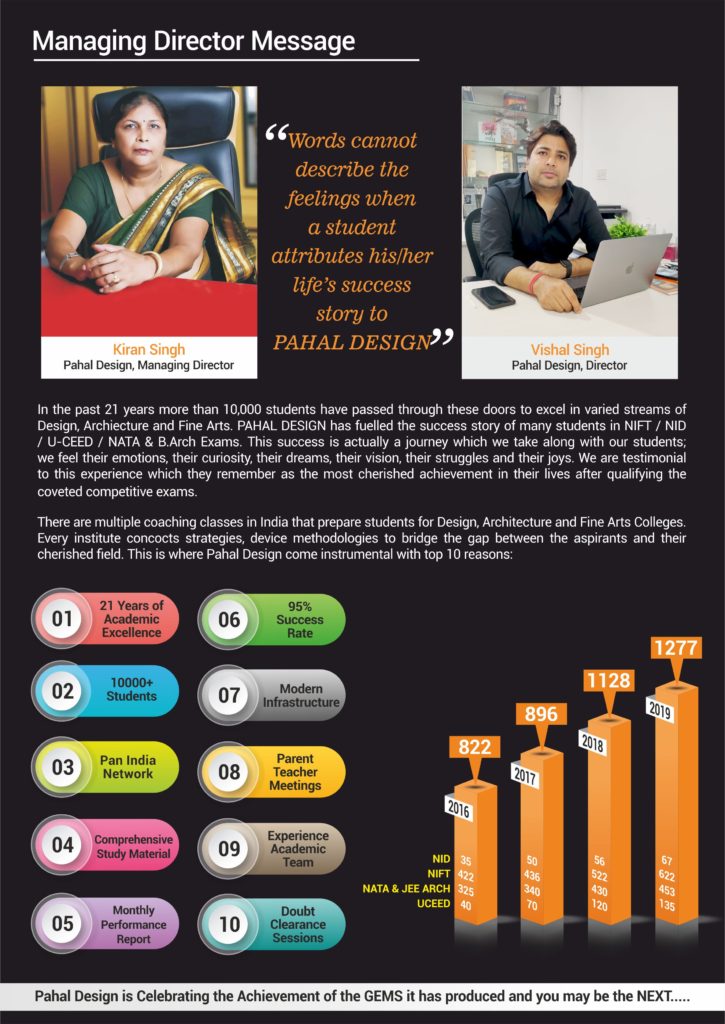
There are many Design Coaching in Jaipur but if we need to find out the best coaching classes, with best learning experience then Pahal Design comes with 22 Years of academic excellence and more than 40 centres across India including all the metros. (New Delhi, Mumbai, Bengaluru, Kolkata, Pune, Ahmedabad, Gurgaon, Jaipur, Lucknow, Dehradun, Chandigarh, Bhopal, Indore, Patna, Ranchi, Kanpur and many more other cities). Now Pahal Design is in Jaipur at Vaishali Nagar for Design, Architecture and Fine Arts Coaching. If any students are looking for Design, Fashion, Architecture and Fine Arts Coaching or any guidance related to Design Colleges then we have Free Guidance for all Design Students.
The design industry in India is growing at a staggering rate of 23 to 25 per cent annually – it’s an indicative of the qualitative change you find in the look and feel of consumer goods. Industry insiders believe that greater spending power and changing needs of consumers are responsible for the boom in the design industry. “People today are spending more money. From the interiors of their flats to the products they buy, all consumers are looking for that extra value-add. There is this new emphasis on vanity. The culture is shifting and design is a reflection of that shift.” With brand positioning and identity the new buzzwords, industries that form the designer’s client base are a lot more aware about design and its importance.

There are some sectors within the industry that have seen a higher growth of interest than others – animation, graphics, apparel, textiles, automotive, product and software interface design to name a few. This interest has also translated into a greater demand for industrial and communication designers.

Currently, India needs 8,000-10,000 designers a year, while overall availability of qualified designers is only 3,000. To make matters worse, only 500 of these 3,000 are said to be practicing designers. There is a reason why your new car is better looking than your last and why your refrigerator seems more functional than the one you had before. 

Design can transform the way we do things, and result in new economic benefits and a better quality of life. The strategic nature of design helps solve problems in ways that are functionally and aesthetically pleasing and make economic sense. Design helps to improve quality and differentiation, offer world class products and services, improve business efficiencies, productivity and margins, increase revenues and achieve higher market share and accelerated growth.

The design industry lags behind other professional services domains in numerical terms when looked at in terms of turnover and number of employees. Architecture, Interior, Animation / New Media, Fashion Design are leading domains within the design industry. Other segments are far behind at present. However with the change in the economic scenario, design domains such as graphic design, industrial design, human computer interaction are growing at a fast clip. The number of design companies is growing as also there is growth in existing companies. There is a good trend of designers opting to start their own setup. Hence most companies existing today are new. The existing companies are consolidating further by adding more services to their portfolio within diverse design disciplines.

India is a large market and at the same unique as well. There is no such thing called as a thumb rule which can describe Indian market or consumers. They vary in cultures, traditions, religions, customers, food, dressing, etc. At the same time the Indian consumer is becoming more demanding and is asserting himself / herself to get his / her aspirations satisfied.

Multinational corporations are focusing on India as a new market for trading their products / services. They understand that successes elsewhere may not necessarily translate in a similar way in India. They will need to understand the market, the sensibilities of the people and respond to them through their offerings. Global corporations will need to work with Indian designers to understand the local market.


To better understand the Indian consumer, to meet the needs and aspirations of this assertive, active, enlightened consumer, Indian businesses and multinational corporations will need to take assistance from Indian designers. This puts a spot light on the design industry as never before.

 
Jaipur

Address:- 2nd Floor, F 18, Gautam Marg, Vaishali Nagar, Jaipur, Rajasthan -302021
Contact Person: Mr. Aman and Mr. Akbar
Contact No: 97721-99911, 0141-6656509
Email: jaipur@pahaldesign.com

About Pahal Design Jaipur Rajasthan

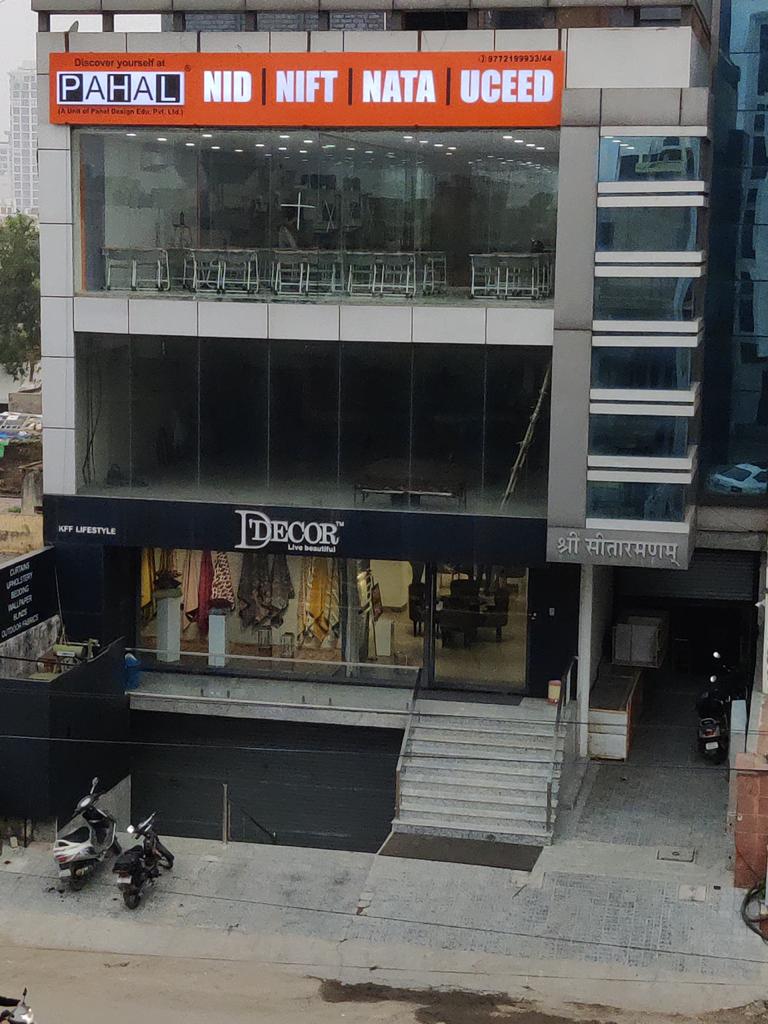
Pahal Design’s 40th Centre & 1st branch in Jaipur located at 2nd Floor F-18, Gautam Marg, Vaishali Nagar, Jaipur, Rajasthan 302021, Jaipur. A walking distance from Amrapali Circle, 22 minutes far from main railway station, 28 minutes far from Jaipur International Airport and 30 minutes’ drive from main bus stand. Kiran Jewellers, D- Decor, DAV Centenary Public School and Digambar Jain temple are the nearest landmarks to reach the centre. The centre offers entrance coaching for all the reputed design colleges in India and overseas. The centre is equipped with highly experienced design educationalists, expert faculty and visiting faculties, preparing and counselling design career enthusiasts for B. Des & M. Des entrance tests and professional career counselling for NID, NIFT, NATA, U/CEED, JEE-Arch and Fine Arts. Get ready to leave your footsteps and make your mark in the world of designing, communication and fashion. We are pleased to inform you that with this new year Pahal Design has added another cap in its feather and the inaugural ceremony at Jaipur Centre was successfully organized at 16th January, 2021.


About Jaipur

The capital of Rajasthan, built proudly by Maharaja Sawai Jai Singh II is famous for its majestic forts, opulent Havelis, beautiful lakes, and dunes. Jaipur is part of the famous Golden Triangle Tourist circuit that includes Delhi and Agra. But Jaipur is not only endowed with wonderful tourist attractions but the city also has an excellent infrastructure to support the tourism. Jaipur has some of India’s best hotels, which compliments the scenic and architectural beauty of the Pink City.
The historic walled city of Jaipur, was founded in 1727 A.D. by the Rajput ruler Sawai Jai Singh of Kacchawah dynasty. The city is roughly divided into nine rectangular sectors with straight roads intersecting only at right angles and is enclosed within massive wall to protect the city in a total area of 709 hectares.

The wall encircles the city and 9 city gates are present to provide the access to the city from various directions. Several iconic monuments and temples are housed within this walled city area with two main North South axes crossing to form 3 main pubic squares (Badi Chaupar, Choti Chaupar and a 3rd one Ramganj Chaupar extending on the eastern side) on the East West axes that define the overall grid iron city plan. It has a total of 12 main bazaar areas across the main axial streets.
The design of the new city was a breath taking departure from the prevalent practices in city development in the sub-continent. Its urban morphology reflected the coming together of cultural elements from eastern and western planning, expressing a culture of a ‘trade and commerce city’ and townscape that is unparalleled anywhere in South Asia.
Envisaged as a trade capital, the main avenues of the city are designed as markets, which remain characteristic bazaars of the city till date. Chaupar, or designed large public squares at the intersection of roads, is another feature that is distinct to Jaipur as are its single to multicourt havelis and haveli temples.
Besides an exemplary planning, its iconic monuments such as the Govind Dev temple, City Palace, Jantar Mantar and Hawa Mahal excel in artistic and architectural craftsmanship of the period. Jaipur is an expression of the

astronomical skills, living traditions, unique urban form and exemplary foresighted city planning of an 18th century city from India.

Jaipur is considered one of the most prolific examples of a planned city, it exemplifies approaches to city planning, sustainability and spatial manifestation of the social fabric through architecture. The lessons that can be learned by understanding this place are deep rooted in its context and are beautiful. Each place has lessons that can teach us about the importance of foresight, planning and mindful use of resources. An effort should be made to make it an inherent part of education and moreover an integral part of design education.
 

The newly prominent architectural buildings of Jaipur are a blend of advanced technology and exquisite design with a touch of traditional art. World Trade Park of Jaipur is a world-class infrastructure designed by renowned architects who have several architectural wonders in his account like the world’s biggest pillar-less rooftop (Sabha Mandap of Govind Devji Temple, which is notified by The Guinness Book of Records), first revolving tower of Rajasthan and many more. The Satsang hall within the Govind Devji’s Temple has a reinforced concrete cement flat roof with a simple soan of 119 ft.
With people from all over the country going to Jaipur for studies, today it has become an education hub also. If you are searching for a good education, then there cannot be a place better than Jaipur. A place where there is no political disturbance, no goons to threaten you here and there, a place to give you a busy life when you need it, a place which would give you the country’s heritage to enjoy any time you need, a place which would give you the mountains and the lakes for a relaxing tour, and the most comfortable evening for studies.
Within the context of formal education, the Art and design as a subject on the curriculum supports personal, social, moral, spiritual, cultural, and creative development, and enables participants to engage with and explore visual, tactile, and other sensory experiences and how to recognize and communicate ideas and meanings. These opportunities enable them to work with traditional and new media so that they develop confidence, competence, imagination, and creativity. Through these opportunities, they learn to appreciate and value images and artifacts across times and cultures, and to understand the contexts in which they were made. A fine arts education—be it in music, theatre, dance, creative writing, visual arts, or art history and visual studies—is not always an easy sell. The social utility and financial feasibility of the arts are often underrated. Innovation and adaptability are essential components of any fine arts education.

Experiences in art, craft, and design enable them to learn how to reflect critically on their own and others’ work. They learn to think and act as artists, makers, and designers, working creatively and intelligently. They develop an appreciation of and engagement in art, craft, and design as critical consumers and audiences and an understanding of its role in the creative and cultural industries that shape and enrich their lives.

There are abundant government and private universities present in Jaipur which focusses on the School of Architecture and design. Arch College of Design & Business. INIFD Jaipur, Indian Institute of Gems and Jewellery Jaipur, Indian Institute of Crafts & Design, IIFA INDIA are some of the best examples. As per the latest update among top colleges, the second-best private institute; Pearl Academy Jaipur for Fashion Design is recognized by India Today for the past three consecutive years. Pearl awards Professional Diploma from Pearl Academy and B. Des. Degree from Rajasthan ILD Skill University (RISU). Sounds exciting? Enroll in Pahal design and prepare for a better future in design and technology. Get the best practical experience with the rich heritage of Jaipur and let us help you to make your dreams come true in this beautiful city.

Pahal Design Jaipur – Vaishali Nagar

Address:- 2nd Floor, F 18, Gautam Marg, Vaishali Nagar, Jaipur, Rajasthan -302021
Contact Person: Mr. Aman and Mr. Akbar
Contact No: 97721-99911, 0141-6656509
Email: jaipur@pahaldesign.com

Pahal Design Books & Study Material is ideal for self-starters who like to study at their own pace. The comprehensive and regularly updated NID, NIFT, NATA, UCEED, CEED, BFA exam books and mocks would prove to be beneficial for all kinds of aspirants.

The comprehensive study material is prepared by most experienced faculties of Pahal Design which focuses on developing advance level skills in student. It intends to provide extensive support in preparation of students for prestigious Design, Architecture and Fine Art exams like NID, NIFT, NATA, JEE B Arch, IIT-UCEED, IIT-CEED, BFA. 

Pahal Study Material Features:

1. Test Series :

A. Monthly Test – The monthly test enables student to track their progress in most efficient way and pay attention to the section required.
B. Mock Test –Its mandatory for all students to attempt mock test after competition of syllabus .The student can book their slot at any of Pahal Design Branch or choose online mode in order to appear in Mock Test Series. Each mock test will give you complete performance analysis, All India Ranking, practice to updated exam pattern and section wise performance report.

2. Doubt clearance & Feedback sessions : Students can attend doubt clearance session with our expert by booking their slot at nearest Pahal design centre or choose online mode for same .

3. Digital Learning Program (DLP) : Access to digital learning platform which has complete learning solution for the students .The Platform will enable students to avail video lectures ,Quiz practice sessions ,any time access to practice sets and tests with more than 5000+ questions .The student will be allotted with unique User Id and Password for their DLP account which they login from Pahal Digital.com or PD app .


4. Expert Team: Each student will get expert guidance for design career and will be assisted to explore their course interest. The team will also analyse and review the student’s performance and help them to improve their performance.

5. Preparation for other Design colleges : Student can get connect to us for the design college counselling or inform us regarding the colleges they are applying for and Pahal Design Team will provide complete guidance according to the updated exam pattern.

The study material is also available for Foundation Batch (2 Years) Program which aims at building strong foundation among Design and Architecture aspirants which is suitable for 10th and 11th appearing students. Study material package focuses on boosting confidence of student for facing National level competition by providing subject wise & topic wise Question Bank based on latest pattern, in addition to previous year question papers and formula booklets.

The content of the study material is deeply researched and developed as per new exam pattern by NID, NIFT, SPA, IDC, IIT, NIT’s and many more. The advance level problems along with each topic are specially designed to give the students an in-depth understanding of the particular subject and prepare them to stay ahead in the competition.

Hauz Khas (Corporate Branch)
 
Address:- G-8, G Block Market, 2nd Floor, Hauz Khas, New Delhi-110016
Contact No: 88-00-22-6864
Contact Person: Ms Karishma Gupta
Email: corporate@pahaldesign.com

CONNECT US


The best coaching institute for NIFT Entrance exam in South Delhi is undoubtedly Pahal Design. They have two centres in South Delhi one is in Hauz Khas and Other is in South Ex. These 2 centres are location at prime location of Delhi which is well connected to metro and Hostel facilities are also available for outstation students. Hauz Khas centre is just 500m for NIFT first and best campus at Hauz Khas. Many renowned markets of Delhi such as Sarojini Nagar Market, Green Park Market, Lajpat Nagar Market, South Extension, Kotla Mubarakpur, M-block Market, etc. and malls such as Ansal Plaza, DLF, MGF Metropolitan, Select Citywalk, Malviya Nagar, etc. are located in South Delhi. The IIT, AIIMS, NIFT, three of the country’s premier institutes in the field of technology, medicine and fashion respectively lie in the Hauz Khas locality of South Delhi. The Indian Institute of Foreign Trade of Delhi is located in the Qutub Institutional Area of South Delhi. Sangam Vihar is also located in South Delhi, which has the highest population in the State. The top Central University Jamia Millia Islamia is situated at Jamia Nagar area of South Delhi. The administrative district had 20% Green Cover, as of 2009. It has several spacious green parks, wildlife sanctuary, biodiversity parks, and green belts. Deer Park and Rose Garden in Hauz Khas, Asola Wildlife Sanctuary close to Delhi’s southern border on the Aravallis foothills are few examples. It has a good mix of concrete and greens. Jahaz Mahal, Zafar Mahal, Tughlaqabad, Hauz Khas Complex, Bijay Mandal, Qutub Minar, Mehrauli Archaeological Park, and the Safdarjung Tomb comprise some of South Delhi’s most scenic heritage sites.

Most of the affluent and upmarket residential areas of South Delhi were established in the early 1960’s. Today, Colonies such as

PAHAL DESIGN

Greater Kailash, Defense Colony, South Extension, Green Park, Neeti Bagh, Gulmohar Park, Hauz Khas, Safdarjung Development Area, Vasant Vihar,Sarvodaya Enclave, Anand Niketan, Jasola and Panchsheel Park are among the most expensive pin codes of New Delhi. All these colonies are categorized in either category ‘A’ or category ‘B’ which highlights the fact that residents of these colonies come under the very affluent and upper-middle-class sections of the society. Newly built builder floors and independent villas sell for as high as INR 10-80 crores in South Delhi. All these colonies are ‘planned colonies’ and therefore have proper connectivity to major roads and metro networks. They all also host their own markets such as Greater Kailash-1, M block Market, Green Park Market, Hauz Khas village area, South Extension Market and Defense Colony Market which are considered to be the poshest markets of Delhi. There are also numerous dedicated recreational areas around these colonies which is a luxury in today’s heavily urbanized and congested New Delhi.

SOUTH DELHI CENTRES:

Hauz Khas (Corporate Branch)

Address:- G-8, G Block Market, 2nd Floor, Hauz Khas, New Delhi-110016
Nearest Metro Station Hauz Khas Gate No-3, Mayfair Garden / RBI Colony
Landmark – Near Punjab National Bank
Contact No: 88-00-22-6864, 011-40106405
Contact Person: Ms Yashika
Email: corporate@pahaldesign.com

South Extension Part – 1

Address:- E-17, Ground Floor, South Extension Part 1, New Delhi – 110049
Landmark: Mcdonald’s Lane, Nearest Metro – South Ex Metro Gate No 2
Contact No : 98994-29749, 011-41350505
Contact Person : Ms. Neha Siddiqui
Email : info@pahaldesign.com


ngg_shortcode_0_placeholder

The National Institute of Fashion Technology is a leader in fashion education with the ability to integrate knowledge, traditional arts, contemporary thought, academic freedom, innovations in design & technology and creative thinking to continuously upgrade its curriculum to address the changing needs of the industry. Its history of more than three decades at the pinnacle of fashion education stands as a testimony to its focus on core values where academic excellence has been nurtured. The institute has stood as a beacon of industry-academia engagement and a key enabler in developing competent professionals.

The National Institute of Fashion Technology (NIFT), set up in 1986 under the Ministry of Textiles, Government of India, is a Statutory Institute governed by the NIFT Act 2006. Bringing in a wide range of aesthetic & intellectual orientations, the early instructors included leading progressive scholars from Fashion Institute of Technology, New York, USA.

Academic inclusiveness has been the key thought in the expansion plans of the institute. NIFT, today, has spread its wings across the length and breadth of the country. Through its 16 professionally managed campuses, National Institute of Fashion Technology provides an excellent environment to its students from different parts of the country to achieve their highest potential through the programmes offered. Since the early years of its inception, the institute has provided a firm foundation in fashion education in the domains of Design, Management and Technology. Since then, NIFT has continued to set and achieve higher academic standards.

NIFT Courses:

  1. B.Des (Bachelor of Design)
  2. M.Des (Master of Design)
  3. B.Ftech (Bachelor of Fashion Technology)
  4. M.Ftech (Master of Fashion Technology)
  5. MFM (Master of Fashion Management)

NIFT Exam Pattern 2020: Creative Ability Test (CAT)

NIFT CAT exam pattern is such that candidates are evaluated on the basis of their intuition skill, power of observation, innovation in the development of a concept as well as design ability of the candidate. One of the most important aspects of NIFT CAT exam is that it tests the creative as well as innovative use of colour and illustration skills of aspirants.

NIFT CAT is a paper-pencil based exam and it is of three hours duration.

NIFT Exam Pattern 2020: General Ability Test (GAT)

Candidates seeking NIFT admissions in BDes programmes offered at NIFT need to appear for GAT exam. This test comprises of the below-mentioned sections:

    • Quantitative Ability
    • Communication Ability
  • English Comprehension
  • Analytical Ability
  • General Knowledge and Current Affairs

The duration of NIFT GAT is 120 minutes for BDes course. While formulating the merit list for BDes course admissions 30% weighatge is allotted to GAT section of NIFT entrance exam.

NIFT CAT Exam Pattern for BDes Admissions

In NIFT exam pattern 2020 for BDes admissions, candidates need to appear for CAT. NIFT CAT exam paper has three questions which candidates need to attempt in three hours duration. In this design entrance exam, candidates are evaluated on the below mentioned parameters:

  • Design ability
  • Intuitive ability
  • Observation skills
  • Concept development skills
  • Creative use of colour
  • Illustration skills

NIFT Exam Pattern for Situation Test

Candidates who have been shortlisted for NIFT BDes admissions on the basis of their written test need to appear for NIFT Situation Test 2020 wherein their “material handling and innovative ability” will be tested.

Here, candidates will be evaluated on “on Space Visualization, Innovative and creative use of given material, composition of elements, colour scheme, construction skill , finesse of the model and overall presentation etc. These parameters will be checked with the write up explaining the concept / idea behind the model constructed. The weightage of the write up is 30%. Since the medium of teaching in NIFT is English, the write-up will be in English language.

  1. What is the marking scheme for NIFT entrance exam? NIFT exam marking scheme varies for CAT and GAT. In NIFT CAT exam, candidates are evaluated out of 100 marks. In GAT exam, aspirants are awarded for one mark for every correct answer and 0.25 marks are deducted for each wrong answer selected by them.


  2. How can I prepare for NIFT CAT? Candidates need to go through the detailed exam pattern as well as syllabus for NIFT CAT and thereafter formulate a preparation strategy. In NIFT CAT exam, aspirants are evaluated on the basis of their power of observation, innovation and design ability. Candidates can go through NIFT Entrance Exam Preparation to have a plan in place when preparing for this design entrance exam.
  3. How can I prepare for NIFT GAT? NIFT GAT comprises of multiple choice questions that aspirants need to solve in order to crack the exam. Questions in NIFT GAT are from subjects such as Quantitative Ability, Communication Ability, English Comprehension, Analytical Ability, General Knowledge and Current Affairs.
  4. Is there any negative marking in NIFT entrance exam? There is no negative marking in NIFT CAT exam. However, for GAT exam, 0.25 marks will be deducted for each wrong answer selected by a candidate. 
  5. What is the syllabus for NIFT exam? National Institute of Fashion Technology does not release any syllabus for NIFT exam. However, candidates can develop an idea of NIFT Entrance Exam Pattern.
  6. How many questions are asked in NIFT CAT? In NIFT CAT, candidates have to attempt three drawing questions.
  7. How many questions are asked in NIFT GAT? The exam pattern for NIFT GAT varies from one course to the other. The total number of questions asked in NIFT GAT are mentioned below:
  • BDes: 100 questions
  • BFTech: 150 questions
  • MDes: 120 questions
  • MFTech: 150 questions
  • MFM: 150 questions

Pahal Design Chandigarh

Address:- SCO No. 54/55, 2nd Floor, Sector 34 A, Chandigarh – 160022
Contact No : 91004-04681
Contact Person : Mr Raja Pratap
Email : chandigarh@pahaldesign.com

ngg_shortcode_2_placeholder 


The National Institute of Fashion Technology is a leader in fashion education with the ability to integrate knowledge, traditional arts, contemporary thought, academic freedom, innovations in design & technology and creative thinking to continuously upgrade its curriculum to address the changing needs of the industry. Its history of more than three decades at the pinnacle of fashion education stands as a testimony to its focus on core values where academic excellence has been nurtured. The institute has stood as a beacon of industry-academia engagement and a key enabler in developing competent professionals.

The National Institute of Fashion Technology (NIFT), set up in 1986 under the Ministry of Textiles, Government of India, is a Statutory Institute governed by the NIFT Act 2006. Bringing in a wide range of aesthetic & intellectual orientations, the early instructors included leading progressive scholars from Fashion Institute of Technology, New York, USA.

Academic inclusiveness has been the key thought in the expansion plans of the institute. NIFT, today, has spread its wings across the length and breadth of the country. Through its 16 professionally managed campuses, National Institute of Fashion Technology provides an excellent environment to its students from different parts of the country to achieve their highest potential through the programmes offered. Since the early years of its inception, the institute has provided a firm foundation in fashion education in the domains of Design, Management and Technology. Since then, NIFT has continued to set and achieve higher academic standards.

NIFT Courses:

  1. B.Des (Bachelor of Design)
  2. M.Des (Master of Design)
  3. B.Ftech (Bachelor of Fashion Technology)
  4. M.Ftech (Master of Fashion Technology)
  5. MFM (Master of Fashion Management)

NIFT Exam Pattern 2020: Creative Ability Test (CAT)

NIFT CAT exam pattern is such that candidates are evaluated on the basis of their intuition skill, power of observation, innovation in the development of a concept as well as design ability of the candidate. One of the most important aspects of NIFT CAT exam is that it tests the creative as well as innovative use of colour and illustration skills of aspirants.

NIFT CAT is a paper-pencil based exam and it is of three hours duration.

NIFT Exam Pattern 2020: General Ability Test (GAT)

Candidates seeking NIFT admissions in BDes programmes offered at NIFT need to appear for GAT exam. This test comprises of the below-mentioned sections:

    • Quantitative Ability
    • Communication Ability
  • English Comprehension
  • Analytical Ability
  • General Knowledge and Current Affairs

The duration of NIFT GAT is 120 minutes for BDes course. While formulating the merit list for BDes course admissions 30% weighatge is allotted to GAT section of NIFT entrance exam.

NIFT CAT Exam Pattern for BDes Admissions

In NIFT exam pattern 2020 for BDes admissions, candidates need to appear for CAT. NIFT CAT exam paper has three questions which candidates need to attempt in three hours duration. In this design entrance exam, candidates are evaluated on the below mentioned parameters:

  • Design ability
  • Intuitive ability
  • Observation skills
  • Concept development skills
  • Creative use of colour
  • Illustration skills

NIFT Exam Pattern for Situation Test

Candidates who have been shortlisted for NIFT BDes admissions on the basis of their written test need to appear for NIFT Situation Test 2020 wherein their “material handling and innovative ability” will be tested.

Here, candidates will be evaluated on “on Space Visualization, Innovative and creative use of given material, composition of elements, colour scheme, construction skill , finesse of the model and overall presentation etc. These parameters will be checked with the write up explaining the concept / idea behind the model constructed. The weightage of the write up is 30%. Since the medium of teaching in NIFT is English, the write-up will be in English language.

  1. What is the marking scheme for NIFT entrance exam? NIFT exam marking scheme varies for CAT and GAT. In NIFT CAT exam, candidates are evaluated out of 100 marks. In GAT exam, aspirants are awarded for one mark for every correct answer and 0.25 marks are deducted for each wrong answer selected by them.
  2. How can I prepare for NIFT CAT? Candidates need to go through the detailed exam pattern as well as syllabus for NIFT CAT and thereafter formulate a preparation strategy. In NIFT CAT exam, aspirants are evaluated on the basis of their power of observation, innovation and design ability. Candidates can go through NIFT Entrance Exam Preparation to have a plan in place when preparing for this design entrance exam.
  3. How can I prepare for NIFT GAT? NIFT GAT comprises of multiple choice questions that aspirants need to solve in order to crack the exam. Questions in NIFT GAT are from subjects such as Quantitative Ability, Communication Ability, English Comprehension, Analytical Ability, General Knowledge and Current Affairs.
  4. Is there any negative marking in NIFT entrance exam? There is no negative marking in NIFT CAT exam. However, for GAT exam, 0.25 marks will be deducted for each wrong answer selected by a candidate. 
  5. What is the syllabus for NIFT exam? National Institute of Fashion Technology does not release any syllabus for NIFT exam. However, candidates can develop an idea of NIFT Entrance Exam Pattern.
  6. How many questions are asked in NIFT CAT? In NIFT CAT, candidates have to attempt three drawing questions.
  7. How many questions are asked in NIFT GAT? The exam pattern for NIFT GAT varies from one course to the other. The total number of questions asked in NIFT GAT are mentioned below:
  • BDes: 100 questions
  • BFTech: 150 questions
  • MDes: 120 questions
  • MFTech: 150 questions
  • MFM: 150 questions

Pahal Design Kolkata

Address:- 307, 3rd Floor, Vardaan Market, Camac Street, Kolkata – 700016
Contact No : 033-46014578, 9830006214
Contact Person : Ms Twinkle Roy
Email : kolkata@pahaldesign.com

ngg_shortcode_3_placeholder 


The National Institute of Fashion Technology is a leader in fashion education with the ability to integrate knowledge, traditional arts, contemporary thought, academic freedom, innovations in design & technology and creative thinking to continuously upgrade its curriculum to address the changing needs of the industry. Its history of more than three decades at the pinnacle of fashion education stands as a testimony to its focus on core values where academic excellence has been nurtured. The institute has stood as a beacon of industry-academia engagement and a key enabler in developing competent professionals.

The National Institute of Fashion Technology (NIFT), set up in 1986 under the Ministry of Textiles, Government of India, is a Statutory Institute governed by the NIFT Act 2006. Bringing in a wide range of aesthetic & intellectual orientations, the early instructors included leading progressive scholars from Fashion Institute of Technology, New York, USA.

Academic inclusiveness has been the key thought in the expansion plans of the institute. NIFT, today, has spread its wings across the length and breadth of the country. Through its 16 professionally managed campuses, National Institute of Fashion Technology provides an excellent environment to its students from different parts of the country to achieve their highest potential through the programmes offered. Since the early years of its inception, the institute has provided a firm foundation in fashion education in the domains of Design, Management and Technology. Since then, NIFT has continued to set and achieve higher academic standards.

NIFT Courses:

  1. B.Des (Bachelor of Design)
  2. M.Des (Master of Design)
  3. B.Ftech (Bachelor of Fashion Technology)
  4. M.Ftech (Master of Fashion Technology)
  5. MFM (Master of Fashion Management)

NIFT Exam Pattern 2020: Creative Ability Test (CAT)

NIFT CAT exam pattern is such that candidates are evaluated on the basis of their intuition skill, power of observation, innovation in the development of a concept as well as design ability of the candidate. One of the most important aspects of NIFT CAT exam is that it tests the creative as well as innovative use of colour and illustration skills of aspirants.

NIFT CAT is a paper-pencil based exam and it is of three hours duration.

NIFT Exam Pattern 2020: General Ability Test (GAT)

Candidates seeking NIFT admissions in BDes programmes offered at NIFT need to appear for GAT exam. This test comprises of the below-mentioned sections:

    • Quantitative Ability
    • Communication Ability
  • English Comprehension
  • Analytical Ability
  • General Knowledge and Current Affairs

The duration of NIFT GAT is 120 minutes for BDes course. While formulating the merit list for BDes course admissions 30% weighatge is allotted to GAT section of NIFT entrance exam.

NIFT CAT Exam Pattern for BDes Admissions

In NIFT exam pattern 2020 for BDes admissions, candidates need to appear for CAT. NIFT CAT exam paper has three questions which candidates need to attempt in three hours duration. In this design entrance exam, candidates are evaluated on the below mentioned parameters:

  • Design ability
  • Intuitive ability
  • Observation skills
  • Concept development skills
  • Creative use of colour
  • Illustration skills

NIFT Exam Pattern for Situation Test

Candidates who have been shortlisted for NIFT BDes admissions on the basis of their written test need to appear for NIFT Situation Test 2020 wherein their “material handling and innovative ability” will be tested.

Here, candidates will be evaluated on “on Space Visualization, Innovative and creative use of given material, composition of elements, colour scheme, construction skill , finesse of the model and overall presentation etc. These parameters will be checked with the write up explaining the concept / idea behind the model constructed. The weightage of the write up is 30%. Since the medium of teaching in NIFT is English, the write-up will be in English language.

  1. What is the marking scheme for NIFT entrance exam? NIFT exam marking scheme varies for CAT and GAT. In NIFT CAT exam, candidates are evaluated out of 100 marks. In GAT exam, aspirants are awarded for one mark for every correct answer and 0.25 marks are deducted for each wrong answer selected by them.
  2. How can I prepare for NIFT CAT? Candidates need to go through the detailed exam pattern as well as syllabus for NIFT CAT and thereafter formulate a preparation strategy. In NIFT CAT exam, aspirants are evaluated on the basis of their power of observation, innovation and design ability. Candidates can go through NIFT Entrance Exam Preparation to have a plan in place when preparing for this design entrance exam.
  3. How can I prepare for NIFT GAT? NIFT GAT comprises of multiple choice questions that aspirants need to solve in order to crack the exam. Questions in NIFT GAT are from subjects such as Quantitative Ability, Communication Ability, English Comprehension, Analytical Ability, General Knowledge and Current Affairs.
  4. Is there any negative marking in NIFT entrance exam? There is no negative marking in NIFT CAT exam. However, for GAT exam, 0.25 marks will be deducted for each wrong answer selected by a candidate. 
  5. What is the syllabus for NIFT exam? National Institute of Fashion Technology does not release any syllabus for NIFT exam. However, candidates can develop an idea of NIFT Entrance Exam Pattern.
  6. How many questions are asked in NIFT CAT? In NIFT CAT, candidates have to attempt three drawing questions.
  7. How many questions are asked in NIFT GAT? The exam pattern for NIFT GAT varies from one course to the other. The total number of questions asked in NIFT GAT are mentioned below:
  • BDes: 100 questions
  • BFTech: 150 questions
  • MDes: 120 questions
  • MFTech: 150 questions
  • MFM: 150 questions

Pahal Design Ranchi

Address:- 2nd Floor, Manjusha Complex, Opposite Shri Bangla Ghari Chandi Mandir,

Hazaribag Road, Lalpur, Ranchi – 834001
Contact No : +91-76777-16770, 0651-2531054
Contact Person : Ms. Shweta
Email : ranchi@pahaldesign.com

ngg_shortcode_4_placeholder 


ABOUT IIAD

Indian Institute of Art and Design in collaboration with Kingston University, London offers new-age design education to its students. The studio-based learning and hands-on Industry experience offers students the knowledge and exposure required to understand how the creative  industries function. Design is an intellectual subject that requires strong creative, visual, logical and critical thinking abilities and keeping that in mind, IIAD ensures a student-teacher ratio of 15:1 so that each student receives equal attention and assistance.

AFFILIATIONS

IIAD offers all its BA (Hons) degree programmes and MA* degree programmes in collaboration with Kingston School of Art, Kingston University, London. The courses at IIAD meet the quality standards and requirements of Kingston University. Both institutions share their resources and best practices for the development of the curriculum and the delivery of the courses. The academic collaboration with Kingston School of Art is the founding stone of the design pedagogy being taught at IIAD. It is known to be a pioneer in art and design education since the 1870s and has helped evolve the Institute’s comprehensive curriculum since inception. To help you understand the nature of this relationship and its benefits to the students, Kingston University has published a document answering queries from students and their families.

Are the degrees offered by IIAD recognised in India?

Yes, the degree offered at IIAD are recognised nationally and internationally. Apart from the degree offered by Kingston University, London, IIAD also offers a B.Voc degree in collaboration with Lingaya’s University which is UGC recognised. The degrees provided by IIAD can help the students in:

  • Applying at international institutes/universities for further education
  • Applying for jobs globally
  • Applying at UGC recognised universities in India for further education
  • Applying for Government jobs in India after completion of their degree programme

FEE AND SCHOLARSHIP

Students who successfully complete the iDAT Entrance Test will be eligible to apply for the Scholarship. The Scholarship form will be made available along with the offer letter.

Cycle – April / May 2020

Announcement Details
Forms Available from   September 2019
Exam Centers and Dates   Online 
Friday 24th April, Saturday 25th April

For Undergraduate programmes : The IIAD Entrance Examination comprises the following parts/rounds based on the programme of interest. For Fashion Design, Communication Design and Interior Architecture & Design Applicants: iDAT – IIAD Design Aptitude Test

  • Part A – Written Test
  • Part B – Studio Simulation

 Part A – Written Test IIAD’s Design Aptitude Test (written) tests the applicants’ logical reasoning, creative thinking and visual aptitude. This is a written exam of 2 hours 30 mins. Students who appear in the written iDAT must also appear for a Studio Simulation at the IIAD campus in New Delhi. Part B – Studio Simulation ‘Studio simulation test’ is a two-hour activity in which a group of 10-15 students are given a brief along with the material. Candidates are required to create a 3D model using that material under the supervision of the faculty. They will be judged on the basis of teamwork, creative thinking, innovation & problem-solving skills.  

For Fashion Business Management Applicants: iMAT – IIAD Management Aptitude Test

  • Part A – Written Test
  • Part B – Personal Interview

IIAD’s Management Aptitude Test (iMAT) tests the applicants’ language, logical reasoning and analytical thinking. This is a written exam of 2 hours. Students who appear in written iMAT must also appear for a Personal Interview at the IIAD campus in New Delhi.   For Postgraduate programmes : The IIAD Entrance Examination comprises the following parts/rounds based on programme of interest.   For Fashion Design iDAT – IIAD Design Aptitude Test


  • Part A – Written Test
  • Part B – Personal Interview

iDAT is IIAD’s Design Aptitude Test which will test applicants’ logical reasoning, creative thinking and visual aptitude. This is a written exam of 2 hours 30 mins. Students who appear in the written iDAT must also appear for a Personal Interview at the IIAD campus in New Delhi.   For Fashion Business Management Applicants: iMAT – IIAD Management Aptitude Test

  • Part A – Written Test
  • Part B – Personal Interview

iMAT is IIAD’s Management Aptitude Test which will test applicants’ language, logical reasoning and analytical thinking. This is a written exam of 2 hours. Students who appear in written iMAT must also appear for a Personal Interview at the IIAD campus in New Delhi. The Sample Papers can be obtained upon successful completion of the Application Form.

B.A. (Hons.) Communication Design

The BA Communication Design programme (validated by Kingston University) is delivered through a mix of project work, group work, lectures, seminars and assignments. The program offers a common introductory experience during the first year of specialisation, followed by two years of selected and more specialised study driven by interests and preferences. The programme concludes with a Major Design Project in the last semester of the final year, this is an amalgamation of the specialisation and is defined by student’s own path as a future designer.

B.A. (Hons.) Interior and Architecture Design

At the intersection of architecture, interior and experience design, the Interior Architecture and Design programme provides a multi-disciplinary approach to transforming existing spaces and places.  In increasingly Urban Environments, the emphasis on the design and working of a building, inside out, has gained tremendous importance. The programme focuses on examining existing structures and transforming their interior through relevant design interventions and renovations that give existing buildings a new life.  

Unlike courses in interior design and decoration, the Interior Architecture programme focuses on spatial design and detailing, adaptive reuse and retrofitting as well as architectural addition and refurbishment.  

The programme addresses a wide range of spaces, from domestic to retail, institutional to  commercial and set/production design to issues of conservation. Whether designing a structure, situation or event, the interior architect responds to how society interacts with, and inhabits space.

B.A. (Hons.) Fashion Design

Fashion Design as a discipline has evolved from being a whimsical, wearer-led, phenomenon to an industry where designers and labels establish and guide customer preferences. A formal degree in Fashion Designing is ideal for students with a penchant for the creative fields and a desire to explore their artistic and technical skills in in an industry valued north of $3 trillion globally. The programme will help students explore their creative identity and refine it further as they unpack the myriad layers of the discipline. Fashion Design being a practical discipline demands rigorous hands-on exposure with a mature awareness of the complexities of the world of Fashion. Students graduating from the programme will be able to use design thinking and creative problem-solving strategies to create appealing, sustainable and responsible fashion for a rapidly evolving industry.

TRANSFER TO IIAD

IIAD accepts applications for transfer to IIAD for the design programme (in either Fashion Design, Communication Design or Interior Architecture & Design) from students who have successfully completed previous year(s) of their design degree/diploma programme from a nationally or internationally recognized Design Institute.

Schedule a free counselling session WhatsApp WhatsApp Enquiry