SEAT Matrix 2025

Factors Influencing Cutoffs:

Several elements impact the determination of NIFT cutoffs each year:

Seat Intake: The total number of seats available for a particular program at a campus.

Number of Applicants: Higher competition can lead to higher cutoffs.

Program Popularity: More sought-after courses may have stricter cutoffs.

Difficulty Level of Entrance Exam: Challenging exams might result in lower scores, affecting rank distributions.

Accessing Official Cutoffs:

Candidates are advised to regularly check the official NIFT website for the most accurate and updated cutoff information. The cutoffs are typically released after the declaration of results and are available in the form of opening and closing ranks for each program and campus.

Conclusion:

Aspiring NIFT candidates should aim for high scores to secure favorable ranks, increasing their chances of admission into desired programs and campuses. Staying informed about previous years’ trends and understanding the factors influencing cutoffs can provide valuable insights during preparation.

  1. Cut off Merit Ranks-2024

  2. Cut off Merit Ranks – 2023

  3. Cut off Merit Ranks-2022

  4. Cut off Merit Ranks-2021

  5. Cut off Merit Ranks-2020

Set up in 1986, NIFT is the pioneering institute of fashion education in the country and has been in the vanguard of providing professional human resource to the textile and apparel industry. It was made a statutory institute in 2006 by an Act of the Indian Parliament with the President of India as ‘Visitor’ and has full fledged campuses all across the country. Over the years NIFT has also been working as a knowledge service provider to the Union and State governments in the area of design development and positioning of handlooms and handicrafts.

The Degrees awarded by the Institute are recognised worldwide. The Institute confers Degrees to the graduates in the Convocation Ceremony marking the occasion.

NIFT had entered into a strategic alliance with Fashion Institute of Technology (FIT), New York, USA. The partnership encompasses a landmark achievement and first of its kind at NIFT. This new international dimension allows select meritorious students from NIFT, the unique opportunity to obtain a Dual Degree from both NIFT and FIT. Students from NIFT undertake two years study at the home institute intercepted by one year of study at FIT. Thereafter, the students resume their studies at NIFT to obtain the Dual Degree from both the institutes. 44 students have been selected by FIT, USA for undertaking the one year AAS programme as part of dual degree from August 2023 to June 2024.

Hauz Khas (Corporate Office)
Address:- G-13, Ground Floor, Hauz Khas, New Delhi-110016
Nearest Metro Station Hauz Khas Gate No-3, Mayfair Garden / RBI Colony
Landmark:
Opposite Joups
Contact No: 8800-22-6864
Contact Person: Karishma Gupta
Email: corporate@pahaldesign.com

Commonly Asked Questions in NID M.Des. Interview

 
1. Personal & Academic Background
 
•Tell us about yourself.
•Why do you want to pursue M.Des. at NID?
•Why did you choose this specific discipline?
•Walk us through your academic and professional journey so far.
•How has your background (educational/work experience) prepared you for this course?
•Why are you shifting from [your previous field] to this design discipline? (If applicable)
 
2. Portfolio & Work Review
 
•Walk us through your portfolio.
•What is your favorite project in your portfolio and why?
•How did you approach this project? What was your design process?
•What was the biggest challenge you faced in any project, and how did you solve it?
•If you had to redo one of your projects, what would you change?
•Which software, tools, and techniques do you use in your work?
•How do you ensure that your design is user-centric?
 
3. Design Thinking & Problem-Solving
 
•Define design in your own words.
•What is your understanding of design thinking?
•Can you describe a real-world problem and propose a design-based solution?
•How would you redesign a common object like a chair, ATM machine, or traffic signal?
•How do you incorporate sustainability in your designs?
•If given a tight deadline, how do you prioritize tasks?
•What inspires you as a designer?
 
4. Design Awareness & Industry Knowledge
 
•Who are your favorite designers or design studios, and why?
•Name a recent design innovation that impressed you.
•What are the current trends in your chosen design discipline?
•How do you think design can impact society?
•Which brands or companies do you admire for their design, and why?
 
5. Course & Career Goals
 
•Why did you choose NID over other design schools?
•Where do you see yourself after completing your M.Des.?
•Do you want to work in the industry, freelance, or pursue academia?
•How does this course align with your career goals?
•Are you open to interdisciplinary collaborations?
 
6. Situational & Hypothetical Questions
 
•If you had unlimited resources, what design problem would you solve?
•Suppose your design is criticized by a client or professor; how would you handle it?
•If given a team project where team members disagree, how would you manage the situation?
•If you were given ₹10 lakh to start a design-based business, what would you do?
 
7. General Knowledge & Creativity Challenges
 
•How would you explain design to a 5-year-old?
•If you had to design a product for the blind, what factors would you consider?
•Think of a random word (e.g., “circle”) and create a design concept around it.
•How would you use storytelling in design?

NID M.Des Result 2025-26

NID M.Des DAT Mains Schedule 2025-26

Master of Design Handbook 2025-26

Hauz Khas (Corporate Office)
Address:- G-13, Ground Floor, Hauz Khas, New Delhi-110016
Nearest Metro Station Hauz Khas Gate No-3, Mayfair Garden / RBI Colony
Landmark:
Opposite Joups
Contact No: 8800-22-6864
Contact Person: Karishma Gupta
Email: corporate@pahaldesign.com


The National Institute of Fashion Technology (NIFT) is recognized as the premier institute for fashion education that continuously evolves itself to keep abreast to the changing market trends. Set up in 1986, NIFT is the pioneering institute of fashion education in India and has been at the vanguard of providing professional human resources to the textile, apparel, and design industries through its 19 campuses. NIFT was made a statutory institute in 2006 by an Act of the Indian Parliament with the President of India as ‘Visitor’. The emphasis has been to train students to derive from the core strength of art and culture and apply it to the modern and dynamic world of fashion.

At NIFT, we are proud of the dynamic and motivated students who are mentored and supported to take on the challenges and opportunities that await them in the industry. The graduates of NIFT understand the nuances of fashion business spanning art, craft, technology, and strategy and have acquired the skill sets that will make them adapt to the growing needs of the industry.

Graduates of NIFT have been provided cutting-edge understanding through exposure to emerging challenges, developments, techniques, technology, and practices from all over the world. During their programme at NIFT, the students undergo a metamorphosis, unfolding their potential, developing skills, and stimulating intellectual growth. Their latent potential is honed by committed and skilled faculty drawn from academia and industry. We are aware of the fact that the fashion and design industries want professionals with multi-skill sets, and we have trained our students to match the requirements.

The campus placements provide a platform for graduating students from various disciplines of the two-year postgraduate and four-year undergraduate programmes to realize their professional dreams and ambitions and thus request the keen and sustained participation of employer organizations. NIFT graduates carry the energy, creativity, skill, technical know-how, and legacy of their predecessors to merge as valuable assets to the organizations that they are inducted into.

Industry Engagement

The new curriculum of NIFT attempts to give the student a rich repertoire of experience and understanding that will hopefully inculcate a desire and a capability for lifelong learning and will stand him or her in good stead in these disruptive times of change. Industry engagement is envisaged as a learning process that, by providing exposure to the students in a real-life working environment as part of an academic curriculum, helps them to develop and enhance academic, personal, and professional competencies coupled with a deeper understanding of the ethics and values that distinguish a good professional. A significant part of the engagement programme is based on the regulated exposure of the students to the industry environment as part of the course curriculum under the guidance of both academia and industry.

The revised curriculum structure of NIFT, which is arrived at through deliberations, workshops, and interactions involving internal experts, eminent academicians, industrialists, and alumni, is robust with enhanced industry engagement through

Interaction with industry leaders and alumni in the classroom
Sponsored classroom projects
Industry visits and craft sensitization
Exposure to exhibitions and fairs
Internships
Joint research endeavours
Hands-on, practical learning experience in an industry environment to be transacted within the curriculum structure. Critical to this new perspective would be the planning of Industry Engagements and scheduling them in coordination with the industries as per the requirement to transact the new curriculum in the UG & PG Programmes offered by NIFT and its campuses.

Placement Process at NIFT

The National Institute of Fashion Technology has a centralized placement process. Companies can employ students from any campus or course of the institute through two routes which are facilitated by the institute:

Pre-Placement Offers (PPO)
Companies can extend a pre-placement offer to students before the on-campus placement, which is considered as a job offer. These offers may be made on the basis of internships, training, or projects undertaken by the students at the said company. In order to provide a fair opportunity to all students, companies may inform NIFT of such offers by filling up the details in the CMS with the link provided to the industry mentor by NIFT. This would help us ensure students offered PPO are not allowed to participate in the further placement process.

On-Campus Placement (Phase 1)
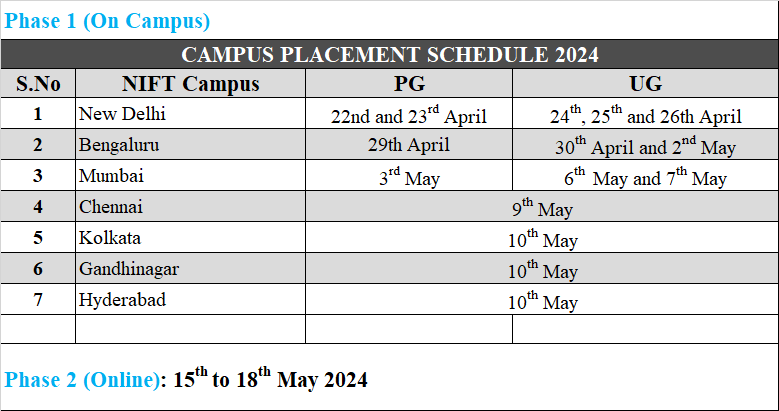
Companies can register for campus placements, the schedule of which is given for 2024. Upon being given a confirmed time and date, they may come to the campus for the placement procedure.

Off Campus Placement (Phase 2)
After the completion of on-campus placement, NIFT would facilitate off-campus placement in an online mode for those registered companies that could not be taken on board for the On-Campus Placement.

Eligibility Criteria for Firms for Campus Placements

A company registered under the Companies Act of 1956/2013 or a multinational company or global firm having or not having its operations in India, conducting business in the fashion, or allied sector dealing in the design, manufacturing, or distribution.

The phase 2 (online) of NIFT Delhi placement process will be held from May 15 to May 18, 2024. Meanwhile, NIFT placements do take place every year. NIFT Delhi placements brochure 2024 is available on the official website. According to students’ reviews, the placement rate recorded during BDes placements 2024 and in recent past was 99%. Further, the highest, average and lowest package offered during NIFT Delhi BDes placements 2024 stood at INR 12 LPA, INR 7 LPA and INR 4 LPA, respectively.

Earlier, according to unofficial sources, the NIFT Delhi highest package offered during placements 2022 stood in-between INR 12 LPA and INR 15 LPA. Further, the NIFT salary package offered during NIFT Delhi UG and PG placements 2022 stood at INR 4.50 LPA and INR 5.70 LPA, respectively. According to other online sources, NIFT Delhi students bag decent internships during the academic years wherein the stipend paid range from INR 5,000 to INR 7,000 per month.

NIFT Placement Brochure 2024

Particulars Placement Statistics (2023)
UG average package INR 4.50 LPA
PG average package INR 5.70 LPA

NIFT (B.Des)

4,000.00

Total Booklets

  1.  Quantitative Ability – 7 Booklets
  2.  Verbal & Analytical Ability – 4 Booklets
  3.  Communication Ability & English Comprehension – 2 Booklets
  4. General Knowledge and Current Affairs – Monthly
  5. Creative Booklet – 5 (1 Booklet in Hard Copy and 4 Booklets on LMS )
  6. Online Portal Access – 24 x 7 
  7. NIFT B.Des Previous Year Question Papers – The last 5 years’ original exam papers will be available over LMS.
  8. 5 Mock Tests as per the new Exam Pattern will be available over LMS.
  9. Monthly Tests will be available over LMS.
  10. NIFT Guide Book. 

Key Features of DLP by Pahal Design

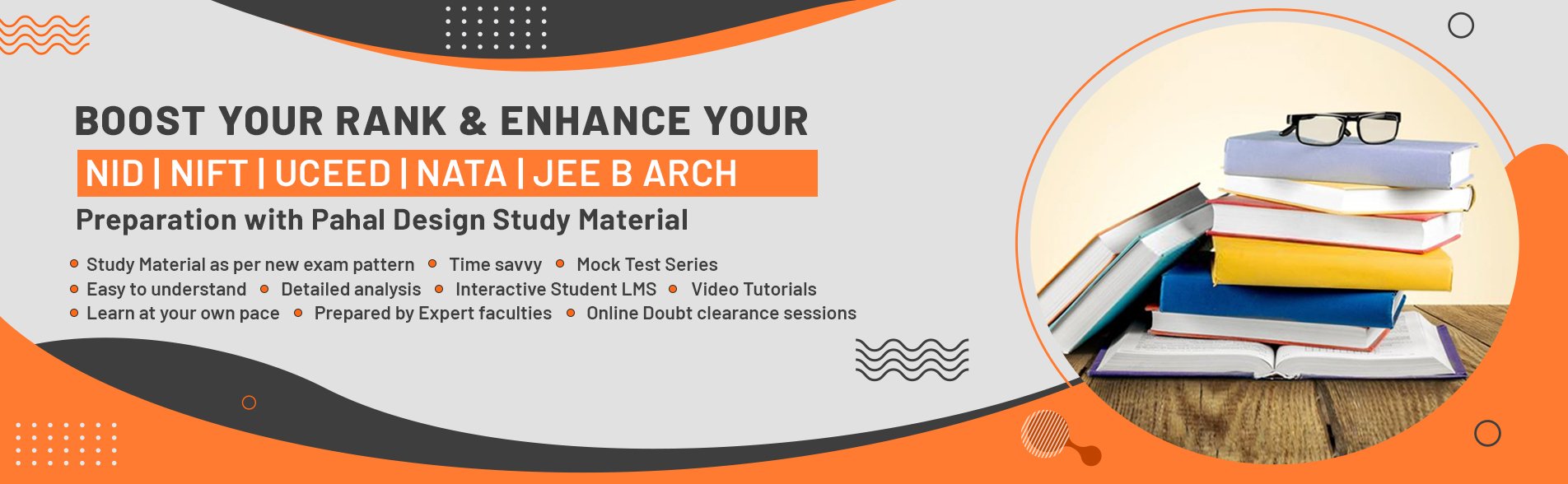
  1. Study Material as per new exam pattern
  2. Detailed analysis
  3. Prepared by Expert faculties
  4. Easy to understand
  5. Time savvy
  6. Interactive student LMS
  7. Learn at your own pace
  8. Mock Test Series

S.N. Course Subjects Study Materials Description
1. NIFT (B.Des)  Quantitative Ability Booklet – 1 Booklet – 2 Booklet – 3 Booklet – 4 Booklet – 5 Booklet – 6 Booklet – 7 Quantitative Ability 7 booklets have various categories that deal with all important topics with concept, explanation, practice exercises, and Model Test Papers. It has important tips and tricks which facilitate students to increase the solving speed in a superior way.
  Verbal & Analytical Ability Booklet – 1 Booklet – 2 Booklet – 3 Booklet – 4 These 4 booklets include all topics of analytical reasoning which help students to identify key information, apply logic and find patterns.
Communication Ability & English Comprehension Booklet – 1 Booklet – 2 This section is very important for NIFT B.des exam. Booklet 1 & 2 will cover all the topics with intensive practice exercises.
General Knowledge and Current Affairs Monthly Wise The GK and CA are made by experts on latest NIFT exam pattern. Monthly booklet will be shared with the students which will have all important events, facts and happenings in the country and across the globe. It also has exclusive series of fashion and business news. Available on LMS.
  Creative Workbook – 1 Workbook – 2 Workbook – 3 Workbook – 4 Workbook – 5 Workbooks 1 and 3 will be available in hard copy. workbooks 2, 4 and 5 will be available over LMS.
NIFT B.Des Previous Year Question Papers   The last 5 years original exam papers will be available over LMS.

2. Test Series (A) Monthly Test: The monthly test enables students to track their progress in most efficient way and pay attention to the section required. (B) Mock Test: It’s mandatory for all students to attempt mock test after competition of syllabus. The student can appear the mock test online. Each mock test will give you complete performance analysis, All India Ranking, practice to updated exam pattern, and section-wise performance report.

3. Doubt clearance & Feedback sessions: Students can attend doubt clearance sessions with our expert by booking their slot at nearest Pahal design centre or choose online mode for same.

4. Digital Learning Program (DLP): Access to digital learning platform which has complete learning solution for the students . The Platform will enable students to avail video lectures , Quiz practice sessions, any time access to practice sets and tests with more than 3000+ questions. The student will be allotted with unique User Id and Password for their DLP account which they login from pahal.design/login/index.php.

5. Expert Team: Each student will get expert guidance for design career and will be assisted to explore their course interest. The team will also analyse and review the student’s performance and help them to improve their performance.

6. Preparation for other colleges: Students can get connect to us for the design college counseling or inform us regarding the colleges they are applying for and Pahal Design Team will provide complete guidance according to the updated exam pattern.

7. Situation Test Kit: The Pahal Design study material includes the preparation for the Nift second phase as well. Once student gets the result for NIFT first-round exam, the Situation Test kit gets delivered at his/her doorstep.

Features of Situation Test Kit
Situation Test  Kit * Situation Test Hand Book * Video for step-by-step preparation * Access to LIVE classes *Access to classroom sessions. * E-book on creative write-up guidance * Last 15 years of exam papers * Material kit * Practice Set * Mock Test * Feedback and doubt clearance session.

Pahal Design offers Special Batch for NIFT MFM students. Every year more than 100 students selected for top NIFT Campuses of India like Delhi, Mumbai, Bengaluru, Kolkata, Gandhinagar, Hyderabad and many more. We have weekdays and weekends Batch available for the students. For working professionals we have Evening Online Batch where they can take their classes while doing job. 

MFM Course Highlights:

1. Live & Interactive sessions with systematic syllabus completion.

2. Learning Access Portal for Online Practice of Questions

3. Mock Test Papers

4. Study Material based on the latest exam pattern

5. Dedicated Doubt Clearing sessions

Deepening Specializations (DS)

Deepening specialization subjects are meant to allow the students to specialize in a specific area leading
to a particular pathway.

The areas for deepening specialization are Marketing and Retailing, Entrepreneurship and International Business. The student can choose any one area for in-depth study throughout the course.

DS 1 : Marketing and Retailing

The specialization provides an opportunity to gain in-depth understanding of Marketing, Merchandising, Brand Management, Customer Experience Management, Retail operations, Omni- channel Retail, E commerce etc.

DS 2 : Entrepreneurship

The DS-Entrepreneurship would equip the students with the skills to Innovate, generate ideas, conduct feasibility studies, and , understanding ways and means to turn good ideas into reality, so that ground work to set up enterprises is understood.

DS 3 : International Business

The International Business as a deepening specialization aims to provide a understanding of the size and nature of global business, EXIM documentation, export marketing and export merchandising.

All these specialization would help the student to focus and perform at higher levels in international trade.

Career Pathways

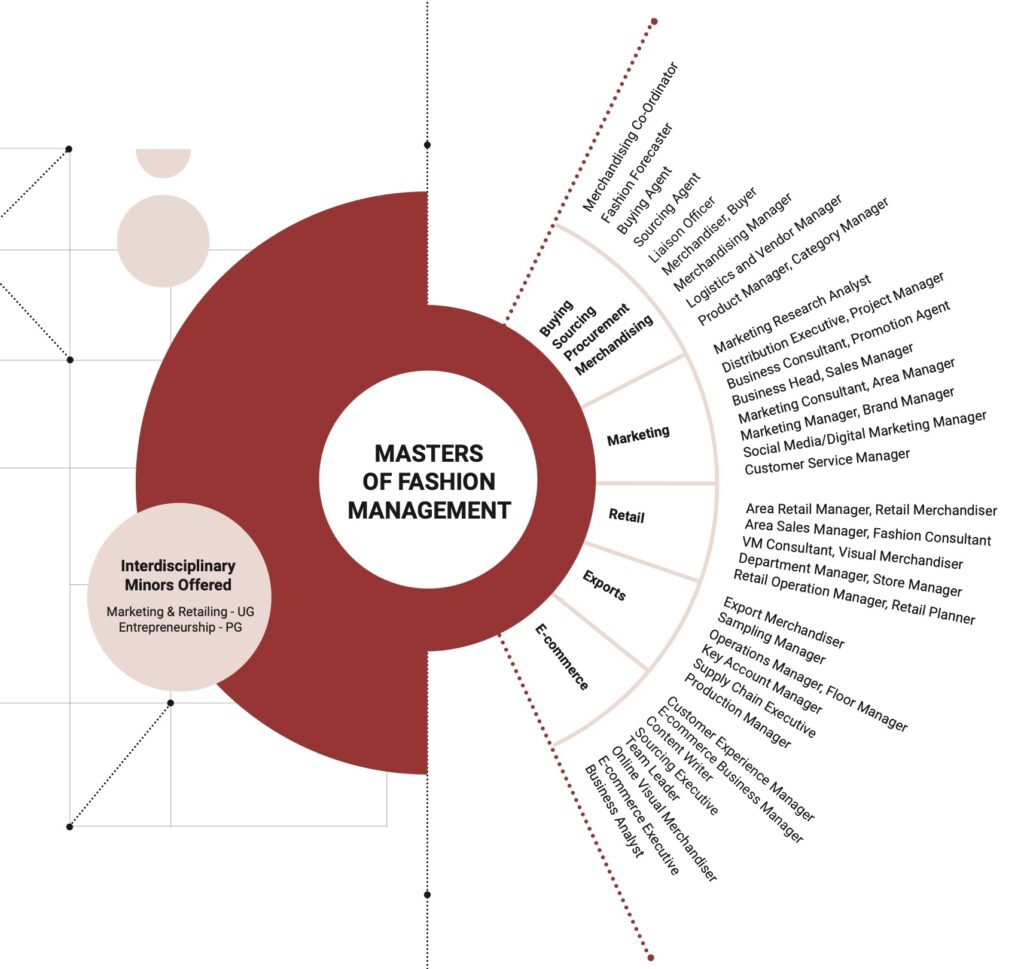
The Marketing & Retailing specialization covers the subjects like customer experience management and retail operations, Omni channel planning and buying, E commerce, marketing & IMC, and social media marketing. This would lead to careers as Retail buyer, retail planner, store manager, visual merchandiser, retail trainer, mall manager, retail consultant, brand executive, social media analyst, social media marketer, content marketing, event manager, E-commerce merchandiser, marketing and sales professional, luxury store manager.

The MFM department’s International business specialization covers the subjects like global fashion business, export merchandising and EXIM documentation, global marketing and costing and profitability. This would lead to careers as export merchandiser, buying house merchandiser, sourcing manager, logistics manager, global business development manager, sampling merchandisers, compliance officer, vendor management executive.

Entrepreneurship specialization covers the subjects like Entrepreneurship business models and success stories, business idea generation and feasibility testing with live projects, family business management, business plan, laws and integrated project. This would lead to careers as entrepreneur, social entrepreneur, NGOs, academician, cluster manager/ marketer, Consultant for rural marketers.

  1. Tell me about yourself?
  2. Why do you think we should give you admission in our college/What special quality do you possess that we should consider you for our college?
  3. What are your greatest strengths?
  4. What is your greatest weakness?
  5. What are your career goals, and how do you plan to achieve them?
  6. Where do you see yourself 5 years down the line?
  7. What are your hobbies and interests?
  8. Who is your role model/Who inspires you?
  9. What does fashion mean to you? Is it important? Why is it important?
  10. What fashion designer’s design? What is fashion design?
  11. Why did you decide to choose fashion design as a career?
  12. How would you relate past and present fashion trends?
  13. How would you describe your personal style?
  14. What are your expectations from this design course?
  15. According to you, who is the most stylish celebrity?
  16. Name some of your favourite fashion writers, stylists, photographers etc.
  17. Describe something that excites you about the fashion Industry?
  18. Are you passionate about something apart from fashion?
  19. How do you stay up to date with fashion?
  20. Should fashionable clothes be allowed in colleges or should there be uniform clothing for all?
  21. What Fashion Means To You? Is It Crucial For You? If Yes, Then Justify.
  22. Why Do You Want to Enter the Fashion Industry as A Professional?
  23. How Would You Describe Your Style?

24. What Are Your Expectations From This Specific Course?

25. Why Do You Think That You Are The Most Suited Candidate For College Admission/ What Quality You Embody That We Should Consider Your Admission In Our Esteemed College?


May Cycle

• Examination Dates – 22nd May 2021, Mode of Exam – Online
• Personal Interview – 26th & 27th May 2021
• Results – 2nd June 2021
• Last date to apply – 16th May 2021
• Last date to apply for Who’s Next Scholarship: 19th May 2021

Procedure & Guidelines

Candidates applying online are required to apply through the Admissions 2021 Portal (ADMISSIONS 2021) on the official home page of Pearl Website www.pearlacademy.com

Candidates appearing in their final examinations can also apply provisionally.

Candidates can apply through the Online mode using either Debit/Credit Card/Net Banking

Application fee is to be paid using Credit Card / Debit Card / Net banking Please keep your Credit Card / Debit Card ready with you before applying.

Candidates are required to Register Online using a Valid e-mail ID before applying. This email ID should be valid for at least next 1 year.

Candidates applying online are required to apply through the Admissions 2021 Portal (ADMISSIONS 2021) on the official home page of Pearl Website

  • Candidates appearing in their final examinations can also apply provisionally.
  • Candidates can apply through the Online mode using either Debit/Credit Card/Net Banking.
  • Application fee is to be paid using Credit Card / Debit Card / Net banking. Please keep your Credit Card / Debit Card/ ready with you before applying.
  • Candidates are required to Register Online using a Valid e-mail ID & Mobile number before applying.

Candidates are advised to keep the following ready with them before applying online:

  • Credit / Debit Card/Net Banking/.
  • Scanned copy of passport size photograph [The photograph must be a recent passport size color picture, preferably in white background. Photographs with Caps, hats and dark glasses are not acceptable. The image should be in .jpg format only. Size of file should not be more than 1 mb].
  • Details of educational qualifications (marks / grade / year of passing etc.)

Payment Guidelines

  • Fill up the registration form with basic details
  • Verify the OTP which will be sent on registered OTP
  • After validating OTP, An email activation link will be sent in your registered email id
  • After clicking on “Activation Key”, student will get a page to make to pay the online application form charges.
  • Submit application fee charges by selecting Credit Card / Debit Card/Net banking options.
  • After successful payment of Rs. 1500/-, an auto confirmation email & SMS will be sent on your registered email Id /Mobile No containing the follow:-
    a) confirmation of successful Registration & Payment
    b) Your online application form no.
    c) Instructions to fill the complete the application form for further process
  • After receiving the payment submission confirmation email, click on given URL to fill the incomplete form
  • Update the required application form
  • Click on “Click here for final submit” to submit the filled application
  • After completion of your Online Application SAVE your Online Application and take a print out. • An auto-generated confirmation mail will be sent on your Email ID after the complete form submission:
  • https://admissions.pearlacademy.com/studentportal/studentloginnew.aspx
  • Enter User id & Password
    • for online form submission – email id will be your User ID & password created by you
    • for Offline form submission – Email ID will be your User ID & Password will be sharing on your email id, once form will be submitted at our end.
  • Candidates applying online are required to apply through the Admissions 2021 or apply now on the official home page of Pearl Website
    • Candidates appearing in their final examinations can also apply provisionally.
    • Candidates can apply through the Online mode using either Debit/Credit Card/Net Banking/.
    • Application fee is to be paid using Credit Card / Debit Card / Net banking. Please keep your Credit Card / Debit Card / with you before applying.
    • Candidates are required to Register Online using a Valid e-mail ID & Mobile number before applying.

General Instructions

  • Pearl Academy is a unit of “Creative Arts Education Society”, a society registered under the Societies Registration Act, 1860, New Delhi.
  • Candidates applying online are required to apply through the Admissions 2021 Portal (ADMISSIONS – 2021) on the official home page of Pearl Website (www.pearlacademy.com). Please read the Guidelines for Applying carefully before applying.
  • Candidates can apply through the Online mode using either Debit/Credit Card or Demand Draft.
  • Application fee of Rs. 1500/- is to be paid using Credit Card / Debit Card / Demand Draft. Please keep your Credit Card / Debit Card / ready with you before applying.
  • Candidates are required to Register Online using a Valid e-mail ID before applying.
  • Candidates can also apply through Offline mode by purchasing a hard copy of Application form the Pearl Academy campuses
  • Candidates appearing in their final examinations can also apply provisionally.
  • Pearl Academy (“Academy”) reserves the right to cancel a course before or after its commencement by giving a notice, at any time due to any internal technical or administrative reasons or due to insufficient strength of the course. If Academy cancels a course, you will be eligible for a full refund of the course fee. Academy may also offer a transfer to another course as an alternative, subject to payment or refund of any difference in course fees.Academy will process any refund due as soon as possible and, in any case, within 45 days of notice of cancellation. The refund will be made using the same method of payment that you originally used to make your course booking unless otherwise expressly agreed.

    Academy will make all reasonable efforts to deliver the course as outlined on Academy’s site and in any brochure or published material. However, Academy reserve the right to:

    1. Alter the timetable, location or presenters specified for a course; and
    2. Make reasonable amendments to the content and syllabus of a course, when necessary.

    Academy reserve the right to cancel your course booking in Academy’s absolute discretion, and refund all fees paid by you, irrespective of whether the course itself is to proceed, without any further liability on our part.

    Academy also reserves the right to exclude you from any course before or after its commencement of course, if in Academy’s absolute discretion Academy consider that you are impeding the provision of the course or other of Academy’s activities, or your presence is bringing or threatening to bring the Academy or any part of it or its subsidiaries into disrepute. In these circumstances, Academy will refund all fees paid by you but will have no further liability to you in respect of such termination or exclusion.

  • Pearl Academy reserves the right to cancel / add / change any entrance test center(s) due to administrative reasons. Other centers may also be added and such information, as well as the exact location of the centers, will be notified later.
  • Admit cards for Written Test & Personal Interviews for both admission cycles will be available 4 days before the Written Test. Candidates are required to download Admit Cards from Pearl Website only. Please check Pearl website regularly for updates.
  • For any further details contact 9821-651-399 

Set up in 1986, NIFT is the pioneering institute of fashion education in the country and has been in the vanguard of providing professional human resource to the textile and apparel industry. It was made a statutory institute in 2006 by an Act of the Indian Parliament with the President of India as ‘Visitor’ and has full-fledged campuses all across the country. Over the years NIFT has also been working as a knowledge service provider to the Union and State governments in the area of design development and positioning of handlooms and handicrafts.

Curriculum

Programme Structure

NIFT has adopted a format of Majors, Deepening Specialisations, Minors and General Electives. Inter disciplinary Minors provide individuated pathways that would permit students to acquire interdisciplinary skillsets and opt for a set of subjects that complement studies in one’s major or explore an unrelated area of intellectual interest. General Electives have been offered to the students to help them enhance their personality and develop interests in specific areas like Personality Development, Communication Skills, Critical Thinking Skills, Professional Ethics etc. The Craft Cluster Initiative has been integrated into the curriculum. Increased Industry interaction for students through classroom projects, internships and part transaction in Industry Environment is the focus of the restructured curriculum.

The contact hours have been recalibrated to 25 hours per week, giving increased time for studio practice and self–study to the students. Standardisation of credits across all programmes and all semesters has been undertaken.

New and emerging areas across disciplines integrated into the curriculum:

    1. a) Artificial Intelligence
    1. d) Advanced Apparel Manufacturing Management
      b) Internet of Things

      c) Designing Ergonomic Environment
    1. e) Big Data and Business Analytics
    1. f) Fashion Thinking
    1. g) User Experience, Sensory Design
    1. h) Augmented Reality, Virtual Experience design
    1. i) Head Gear Design
    1. j) CAD 3D & Contemporary Manufacturing
    1. k) Couture Jewellery
    1. l) Travel & Outdoor Gear Design
    1. m) Design for Society
    1. n) Smart Jewellery
    1. o) Smart Textiles
    1. p) Active Sportswear, Bespoke Menswear, Wearable Technology
    1. q) Shapewear & Seamless Garments on Computerized Knitting
    1. r) Optitex for Virtual Prototyping
    1. s) Surface Embellishment: Digital Embroidery, Laser, 3D Printing
    1. t) Design Strategy

NIFT PARTNERSHIP AND ASSOCIATION

NIFT – Fashion Institute of Technology (FIT), New York, USA strategic partnership provides a unique opportunity to select meritorious NIFT students to obtain Dual Degree from both NIFT and FIT. Students from NIFT undertake two years study at the home Institute intercepted by one year of study at FIT. Thereafter, the students resume their studies at NIFT to obtain the Dual Degree from both the institutes.

Some of the key institutes with whom NIFT has an association are Queensland University of Technology, Australia; De Montfort University, UK; Glasgow School of Arts, UK; Swiss Textile College, Switzerland; ENSAIT, France; NABA, Italy; ESMOD, Germany; Saxion University of Applied Sciences, Netherlands; Amsterdam Fashion Institute, Netherlands; Bunka Gauken University, Japan; University of Northampton, UK; Politechnico di Milano, Italy; KEA – Copenhagen School of Design and Technology, Denmark; North Carolina State University, USA; The Savannah College of Art and Design (SCAD), USA and many more. NIFT is also a member of the prestigious International Foundation for Fashion Technology Institutes (IFFTI) and Cumulus, an international body representing design institutes of the world.

AHMEDABAD (Drive-in-Road)
Address:- 9, 1st Floor, Sunrise Centre-II, Sunrise Park, Bodakdev,
Ahmedabad, Gujarat-380015
Landmark: Off Drive-in-Road
Contact No: 78029-49620, 079-40398630
Contact Person: Ms Manisha Malkani
Email: ahmedabad@pahaldesign.com

Graphic designers create visual concepts, using computer software or by hand, to communicate ideas that inspire, inform, and captivate consumers. They develop the overall layout and production design for applications such as advertisements, brochures, magazines, and reports.

Duties

Graphic designers typically do the following:

  • Meet with clients or the art director to determine the scope of a project
  • Use digital illustration, photo editing software, and layout software to create designs
  • Create visual elements such as logos, original images, and illustrations to help deliver a message
  • Design layouts, including selection of colors, images, and typefaces
  • Present design concepts to clients or art directors
  • Incorporate changes recommended by clients or art directors into final designs
  • Review designs for errors before printing or publishing them

Graphic designers, also referred to as graphic artists or communication designers, combine art and technology to communicate ideas through images and the layout of websites and printed pages. They may use a variety of design elements to achieve artistic or decorative effects.

Graphic designers work with both text and images. They often select the type, font, size, color, and line length of headlines, headings, and text. Graphic designers also decide how images and text will go together in print or on a webpage, including how much space each will have. When using text in layouts, graphic designers collaborate with writers, who choose the words and decide whether the words will be put into paragraphs, lists, or tables. Through the use of images, text, and color, graphic designers may transform data into visual graphics and diagrams to make complex ideas more accessible.

Graphic design is important to market and sell products, and it is a critical component of brochures and logos. Therefore, graphic designers often work closely with people in advertising and promotions, public relations, and marketing.

Frequently, designers specialize in a particular category or type of client. For example, some designers create the graphics used on product packaging, and others may work on the visual designs used on book jackets.

Graphic designers need to keep up to date with software and computer technologies in order to remain competitive.

Some individuals with a background in graphic design become postsecondary teachers and teach in design schools, colleges, and universities.

Some graphic designers specialize in experiential graphic design. These designers work with architects, industrial designers, landscape architects, and interior designers to create interactive design environments, such as museum exhibitions, public arts exhibits, and retail spaces.

Education for Graphic Designers
A bachelor’s degree in graphic design or a related field is usually required. However, individuals with a bachelor’s degree in another field may pursue technical training in graphic design to meet most hiring qualifications.

The National Association of Schools of Art and Design accredits about 350 postsecondary colleges, universities, and independent institutes with programs in art and design. Most programs include courses in studio art, principles of design, computerized design, commercial graphics production, printing techniques, and website design. In addition, students should consider courses in writing, marketing, and business, all of which are useful in helping designers work effectively on project teams.

High school students interested in graphic design should take basic art and design courses in high school, if the courses are available. Many bachelor’s degree programs require students to complete a year of basic art and design courses before being admitted to a formal degree program. Some schools require applicants to submit sketches and other examples of their artistic ability.

Many programs provide students with the opportunity to build a professional portfolio of their designs. For many artists, including graphic designers, developing a portfolio—a collection of completed works that demonstrates their styles and abilities—is essential because employers rely heavily on a designer’s portfolio in deciding whether to hire the individual.

Graphic designers must keep up with new and updated computer graphics and design software, either on their own or through formal software training programs. Professional associations that specialize in graphic design, such as AIGA, offer courses intended to keep the skills of their members up to date.

Other Experience for Graphic Designers
Graphic designers often gain their initial experience through internships. Internships provide aspiring graphic designers an opportunity to work with designers and to experience the design process from concept to completion, in some cases while completing a design program.

Licenses, Certifications, and Registrations for Graphic Designers
Certification programs are generally available through software product vendors. Certification in graphic design software can demonstrate a level of competence and may provide a jobseeker with a competitive advantage.

Advancement for Graphic Designers
Experienced graphic designers may advance to chief designer, art director, or other supervisory positions.

Important Qualities for Graphic Designers
Analytical skills. Graphic designers must be able to look at their work from the point of view of their consumers and examine how the designs they develop will be perceived by consumers to ensure they convey the client’s desired message.

Artistic ability. Graphic designers must be able to create designs that are artistically interesting and appealing to clients and consumers. They produce rough illustrations of design ideas, either by hand sketching or by using computer programs.

Communication skills. Graphic designers must communicate with clients, customers, and other designers to ensure that their designs accurately reflect the desired message and effectively express information.

Computer skills. Most graphic designers use specialized graphic design software to prepare their designs.

Creativity. Graphic designers must be able to think of new approaches to communicating ideas to consumers. They develop unique designs that convey a certain message on behalf of their clients.

Time-management skills. Graphic designers often work on multiple projects at the same time, each with a different deadline.

Art Directors

Art directors are responsible for the visual style and images in magazines, newspapers, product packaging, and movie and television productions. They create the overall design of a project and direct others who develop artwork and layouts.

Craft and Fine Artists

Craft and fine artists use a variety of materials and techniques to create art for sale and exhibition. Craft artists create handmade objects, such as pottery, glassware, textiles, and other objects that are designed to be functional. Fine artists, including painters, sculptors, and illustrators, create original works of art for their aesthetic value, rather than for a functional one.

Desktop Publishers

Desktop publishers use computer software to design page layouts for newspapers, books, brochures, and other items that are printed or published online.

Drafters

Drafters use software to convert the designs of engineers and architects into technical drawings. Most workers specialize in architectural, civil, electrical, or mechanical drafting and use technical drawings to help design everything from microchips to skyscrapers.

Industrial Designers

Industrial designers develop the concepts for manufactured products, such as cars, home appliances, and toys. They combine art, business, and engineering to make products that people use every day. Industrial designers consider the function, aesthetics, production costs, and usability of products when developing new product concepts.

Multimedia Artists and Animators

Multimedia artists and animators create animation and visual effects for television, movies, video games, and other forms of media.

Technical Writers

Technical writers, also called technical communicators, prepare instruction manuals, how-to guides, journal articles, and other supporting documents to communicate complex and technical information more easily. They also develop, gather, and disseminate technical information through an organization’s communications channels.

Web Developers

Web developers design and create websites. They are responsible for the look of the site. They are also responsible for the site’s technical aspects, such as its performance and capacity, which are measures of a website’s speed and how much traffic the site can handle. In addition, web developers may create content for the site.

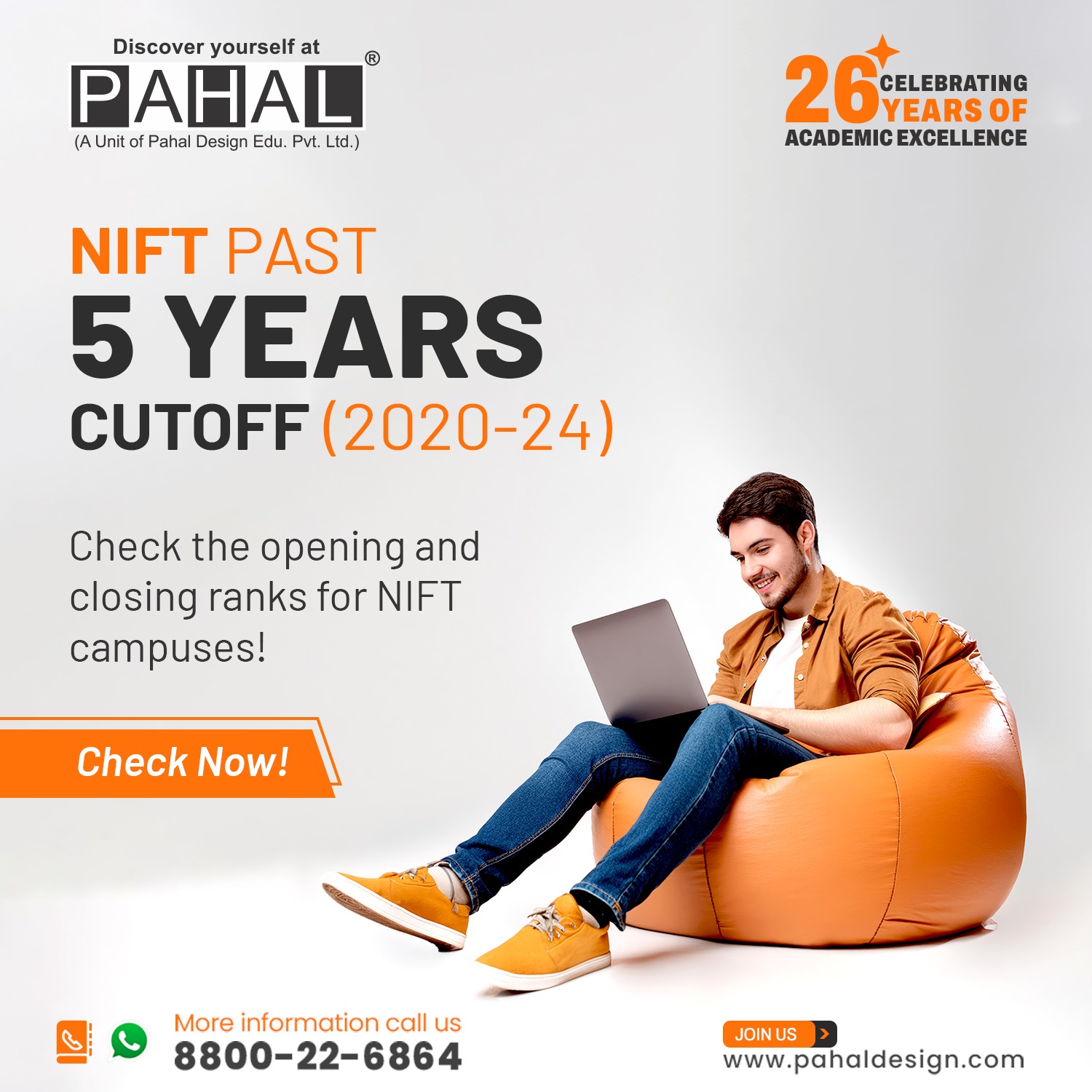
*Admission information* for the academic year *2021* :


*Unitedworld Institute of Design (UID)* is one of the premier Design institutes of India. A constituent college of Karnavati University, we aim to create globally sought after professionals who can exhibit
their creativity and trigger novel trends.
UID’S pursuit for excellence has made its name gleam with
an extraordinary record of success in a short span.

_*Option # 1 ::*_

*Undergraduate Programs at Offer:*

UG (B. Design)
1) Product Design
2) Automobile and Transportation Design
3) Interaction Design
4) Fashion Design
5) Lifestyle Accessory Design
6) Visual Communication (Graphics)
7) Animation and Motion Graphics
8) Interior & Furniture Design

_*Fee Structure*_ :
Tuition fee of Rs. 2,25,000/- Per Semester * 8 Semesters
Total Fees = Rs 18.00 Lakhs

_*Option # 2 ::*_

*B.Design- Global Design Program*
Duration: It is a 4 Years full-time-degree course comprising of 8 semesters of 6 months each

_*Fee Structure-*_ Tuition fee = Rs. 3,50,000/- Per Semester * 8 Semesters
Total Fees = Rs 28.00 Lakhs

*Degree- B. Design

Course Breakup:

*Semester 1-*_ at UID Ahmedabad, India
*Semester 2_* – at UID Ahmedabad, India
*Semester 3-*_ at Swinburne University, Melbourne, Australia
*Semester 4-*_ at UID Ahmedabad, India
*Semester 5-*_ at Naba, Milan, Italy
*Semester 6-*_ at UID Ahmedabad, India
*Semester 7-*_ at Nottingham Trent University, United Kingdom
*Semester 8-*_ at UID Ahmedabad, India

_*Option # 3 ::*_

*INTEGRATION MASTER OF DESIGN (5 YEARS) PROGRAMME*
Duration: It is a 5 Years full-time-degree course comprising 10 semesters of 6 months duration each.
Programme Highlights:
Two qualifications in one i.e. B. Design and M. Design. Unique and differentiated graduate profile

_*Fee Structure*_ :
Tuition fee = Rs. 2,25,000/- Per Semester * 10 Semesters
Total Fees = Rs. 22.50 Lakhs

_*Option # 4 ::*_

*Post Graduate Program* :

_*PG (M. Design)*_
1) Industrial Design
2) Visual Experiential Design
3) Interior and Experience Design
4) Fashion Design
5) Fashion Styling and Communication
6) Textile and Knitwear Design

_*Fee Structure*_ :
Tuition fee = Rs. 2,00,000/- Per Semester * 4 Semesters
Total Fees = Rs. 8,00,000/-

In case of further information you can reach our Admission Team at *9821-651-399 | 9910-60-9749

Join Exclusive Crash Course Batch at Pahal Design. Starting from 15th April onwards….

Schedule a free counselling session WhatsApp WhatsApp Enquiry