If you’re dreaming of getting into top design colleges like IIT Bombay, IIT Delhi, IIT Guwahati, or IIT Hyderabad, then cracking UCEED (Undergraduate Common Entrance Examination for Design) is your first step!

UCEED 2026 will test not just your drawing skills, but also how you think, observe, imagine, and connect ideas with the world around you. The exam has two parts – Part A and Part B, and understanding the syllabus deeply will help you prepare smartly.

UCEED (2010-2025) Original Exam papers

Part A – Design and Analytical Thinking

Part A focuses on your observation, reasoning, and creativity through objective-type questions. It’s about how you see, analyze, and interpret the world — skills that every great designer needs.

🔹 1. Visualization and Spatial Reasoning

You’ll be tested on how well you can visualize and mentally manipulate 2D shapes and 3D objects. Imagine folding paper, rotating cubes, or understanding the geometry behind everyday objects.

🔹 2. Practical and Scientific Knowledge

Design and science go hand-in-hand. This section checks your understanding of basic scientific principles and how things work in real life — from levers to light to everyday gadgets.

🔹 3. Observation and Design Sensitivity

Great designers notice what others miss. This part tests your ability to observe minute details, identify patterns, and think critically about form, function, and context.

🔹 4. Environment and Society

Design isn’t just about aesthetics — it’s about solving real-world problems. Be ready to answer questions on environmental issues, culture, and how design impacts society.

🔹 5. Analytical and Logical Reasoning

Here, your reasoning and problem-solving skills take the spotlight. Expect puzzles, data interpretation, and logic-based questions that test your qualitative and quantitative thinking.

🔹 6. Language and Comprehension

You’ll need to understand and interpret Standard English texts — passages, conversations, or descriptions — to assess your comprehension and interpretive skills.

🔹 7. Creativity

This is where your imagination shines! You’ll face questions that test your ability to think out of the box, use analogies, and connect ideas through symbols, metaphors, and visual logic.

Part B – Drawing and Design Aptitude

Part B is hands-on. It tests your ability to sketch, visualize, and communicate ideas through drawing.

🔸 1. Drawing Skills

You’ll need to draw products, people, or scenes accurately with attention to proportion, perspective, and line quality. Composition, light, and shading also matter — because your drawing should tell a story.

🔸 2. Design Aptitude

This section measures how you apply creativity to real-life challenges. It’s about design thinking, empathy, and practical innovation — solving problems visually and meaningfully.

ngg_shortcode_0_placeholder

FAQ’s

What is the structure of the UCEED exam and what topics does it cover?

The UCEED exam is divided into two parts, Part A and Part B. Part A focuses on design and analytical thinking, testing visualization, scientific knowledge, observation, environment, reasoning, language comprehension, and creativity. Part B emphasizes drawing skills and design aptitude, assessing the ability to sketch, visualize, and communicate ideas visually.

How should I prepare for Part A of the UCEED exam to enhance my chances of success?

Preparation for Part A should include practicing visualization and spatial reasoning exercises, understanding basic scientific principles, improving observation skills, studying environmental and societal issues, enhancing logical reasoning abilities, strengthening language comprehension, and fostering creativity through various problem-solving activities.

What skills are assessed in Part B of the UCEED exam, and how can I improve my performance in this section?

Part B evaluates your drawing skills and design aptitude. To improve performance, practice sketching products, people, and scenes with attention to proportion, perspective, and shading. Additionally, develop your ability to think creatively, approach design challenges with empathy, and communicate ideas clearly through visual means.

Are there any specific requirements or instructions regarding the use of a scribe during the UCEED exam?

Yes, a scribe is allowed to assist candidates in reading questions or entering answers as per the candidate’s instructions. However, the scribe is not permitted to explain the questions or suggest solutions, ensuring that the exam remains fair and based on the candidate’s own abilities.

Will there be any spot round of counselling or admissions for UCEED candidates?

There are no spot admission rounds for IITs after the counseling process. However, IIITDM Jabalpur may conduct a spot round of admissions at the institutional level if there are remaining vacant seats after the main counseling process.


If you have any doubts then feel free to connect us at 8800-22-6864

Pahal Design Centres 


Admissions to the Bachelor of Design (BDes) programmes at IIT Bombay, IIT Delhi, IIT Guwahati, IIT Hyderabad, IIT Indore, IIT Roorkee and IIITDM Jabalpur are done through the Undergraduate Common Entrance Examination for Design (UCEED). Students who have passed Class XII (or equivalent) in 2025, or appearing in 2026, in ANY STREAM (Science, Commerce, or Arts & Humanities) are eligible to appear for UCEED 2026.

Important Dates

Activity Date
   
Start date for Online Registration October 01, 2025, 01:00 pm
Last date for Online Registration with regular fee October 31, 2025
Last date for Online Registration with late fee November 07, 2025, 5:00 pm
Start date for Admit Card downloading January 02, 2026, 01:00 pm
Last date for rectification of discrepancies in Admit card January 08, 2026, 05:00 pm
UCEED 2025: date and time of exam January 18, 2026 (Sunday)
09:00 am to 12:00 noon
Release of Draft Answer Key and candidates’ response for Part-A January 20, 2026
Last date for uploading comments (if any)
on the Draft Answer Key in the candidate’s portal
January 22, 2026, 05:00 pm
Release of Final Answer Key for Part-A January 28, 2026, 05:00 pm
Announcement of cut-off marks for Part-A February 05, 2026
Declaration of results March 06, 2026
Start date for Score Card downloading March 10, 2026
Application Process for BDes Programme starts Admission Schedule »
Last date for Score Card downloading July 31, 2026

Note:

  • Any request for change in the examination date and time will not be considered.
  • The dates for the seat allotment rounds are tentative. The change in date(s) (if any) will be posted on the official website (www.uceed.iitb.ac.in).

Syllabus

UCEED 2026 will have two parts.

Part-A will have questions from the following topics:

  • Visualization and spatial reasoning: Ability to visualise and transform 2D shapes and 3D objects and their spatial relationships.
  • Practical and scientific knowledge: Know-how of scientific principles and everyday objects.
  • Observation and design sensitivity: The capacity to detect concealed properties in daily life and think critically about them. Attention to detail, classification, analysis, inference and prediction.
  • Environment and society: General awareness of environmental, social and cultural connections with design.
  • Analytical and logical reasoning: Ability to analyse qualitative and quantitative information.
  • Language: Proficiency in reading and comprehending Standard English.
  • Creativity: Grasp of verbal and non-verbal analogies, metaphors, signs and symbols.

Part-B will have questions on the following topics:

  • Drawing: Ability to draw products, people or scenes in proportion with good line quality, composition, proportion, perspective and shading.
  • Design aptitude: Capability to practically and appropriately respond to problems/situations with ingenuity and empathy.


UCEED 2025 will be conducted by the Indian Institute of Technology Bombay under the guidance of the UCEED-CEED Implementation Committee 2025 (henceforth referred to as the UCI Committee).

UCEED 2025 is open to all nationals (Indian/Foreign). Candidates seeking admission to the Bachelor’s Degree programme in Design (BDes) at Indian Institute of Technology Bombay (IITB), Indian Institute of Technology Delhi (IITD), Indian Institute of Technology Guwahati (IITG), Indian Institute of Technology Hyderabad (IITH), Indian Institute of Technology Roorkee (IITR) and Indian Institute of Information Technology Design and Manufacturing Jabalpur (IIITDMJ), must appear for UCEED 2025. UCEED 2025 score is valid only for admission to the programmes in the academic year 2025-2026.

SCHEDULE OF UCEED 2025

UCEED is a test centre-based examination and has two parts: Part-A is computer-based and Part-B contains questions related to sketching that needs to be attempted on the provided sheet. It is compulsory for the candidates to attempt both the parts in the given time.

The total time for the examination (that includes both Part-A and Part-B) is THREE hours and it will be held as per the following schedule:

Date

January 19, 2025 (Sunday)

Time

09:00 am to 12:00 noon

UCEED Brochure 2025

Important Dates

Activity Date
   
Start date for Online Registration October 01, 2024, 01:00 pm
Last date for Online Registration with regular fee October 31, 2024
Last date for Online Registration with late fee November 08, 2024, 5:00 pm
November 18, 2024, 5:00 pm
Start date for Admit Card downloading January 03, 2025, 01:00 pm
Last date for rectification of discrepancies in Admit card January 09, 2025, 05:00 pm
UCEED 2025: date and time of exam January 19, 2025 (Sunday)
09:00 am to 12:00 noon
Release of Draft Answer Key and candidates’ response for Part-A January 21, 2025
Last date for uploading comments (if any)
on the Draft Answer Key in the candidate’s portal
January 23, 2025, 05:00 pm
Release of Final Answer Key for Part-A January 29, 2025, 05:00 pm
Announcement of cut-off marks for Part-A February 06, 2025
Declaration of results March 07, 2025
Start date for Score Card downloading March 10, 2025
Application Process for BDes Programme starts Admission Schedule »
Last date for Score Card downloading June 11, 2025
 
Hauz Khas (Corporate Office)
 
Address:- G-13, Ground Floor, Hauz Khas, New Delhi-110016
Nearest Metro Station Hauz Khas Gate No-3, Mayfair Garden / RBI Colony
Landmark:
Opposite Joups
Contact No: 8800-22-6864
Contact Person: Karishma Gupta
Email: corporate@pahaldesign.com

ABOUT NID
National Institute of Design is internationally acclaimed as one of the finest educational and research institutions for Industrial, Communication, Textile and IT Integrated (Experiential) Design. It is an autonomous institution under the aegis of the Ministry of Commerce and Industry, Government of India. NID has been declared ‘Institution of National Importance’ by the Act of Parliament, by virtue of the National Institute of Design Act 2014.

Bachelor of Design (B.Des.)
The four-year-long Bachelor of Design programme is offered only at NID Ahmedabad in the following areas of specialization: Faculty of Industrial Design, Faculty of Communication Design, Faculty of Textile, Apparel, Lifestyle & Accessory Design and Ceramic & Glass Design.

NID ELIGIBILITY CRITERIA

 Eligibility Criteria

Bachelor of Design (B.Des.)

 All candidates applying for the B.Des. must fulfil the eligibility criteria of both age and educational qualification as under.

Age Limit:

■ For Indian Nationals in General Category and General EWS Category: Only those candidates born on or after 1 July 2003 are eligible to apply for admission.

■ For Indian Nationals in Reserved Category (Other Backward Class-Non Creamy Layer (OBC-NCL), Scheduled Caste (SC), Scheduled Tribe (ST): Only those candidates born on or after 1 July 2000 are eligible to apply for admission.

■ For Indian Nationals in PwD Reserved Category: Only those candidates born on or after 1 July 1998 are eligible to apply for admission.

■ For Foreign Nationals in Overseas (Supernumerary) Category: Only those candidates born on or after 1 July 2003 are eligible to apply for admission.

Educational Qualification:

Applications for academic year 2024-25 are open to candidates who have passed or will appear for higher secondary (10+2) qualifying examinations in the academic year 2023-24 in any stream (Science, Arts, Commerce, Humanities etc.) from any recognized board of education such as CBSE, IB, ICSE or equivalent. Admission to all programmes at NID is on the basis of the candidates’ performance in two stages of the Design Aptitude Test (DAT). The objective of these exams is to assess the knowledge, skills and behavioural qualities of candidates.

DESIGN APTITUDE TESTS

Stage 1: Design Aptitude Test (DAT) Prelims

 Design Aptitude Test (DAT) Prelims will be conducted at various test centres across India (Refer Section 7.3 of this Admissions Handbook). Candidates should note that appearing for the DAT Prelims or being shortlisted for the second stage of the admission process does NOT guarantee automatic entitlement to admission.

Stage 2: Design Aptitude Test (DAT) Mains

Candidates shortlisted after the DAT Prelims will be invited to appear for the Stage 2 DAT Mains exam. Exact details of the Test Centre will be announced later in the DAT Mains Admit Card.

Pahal Design IIT UCEED | NID Course 2025-26 :

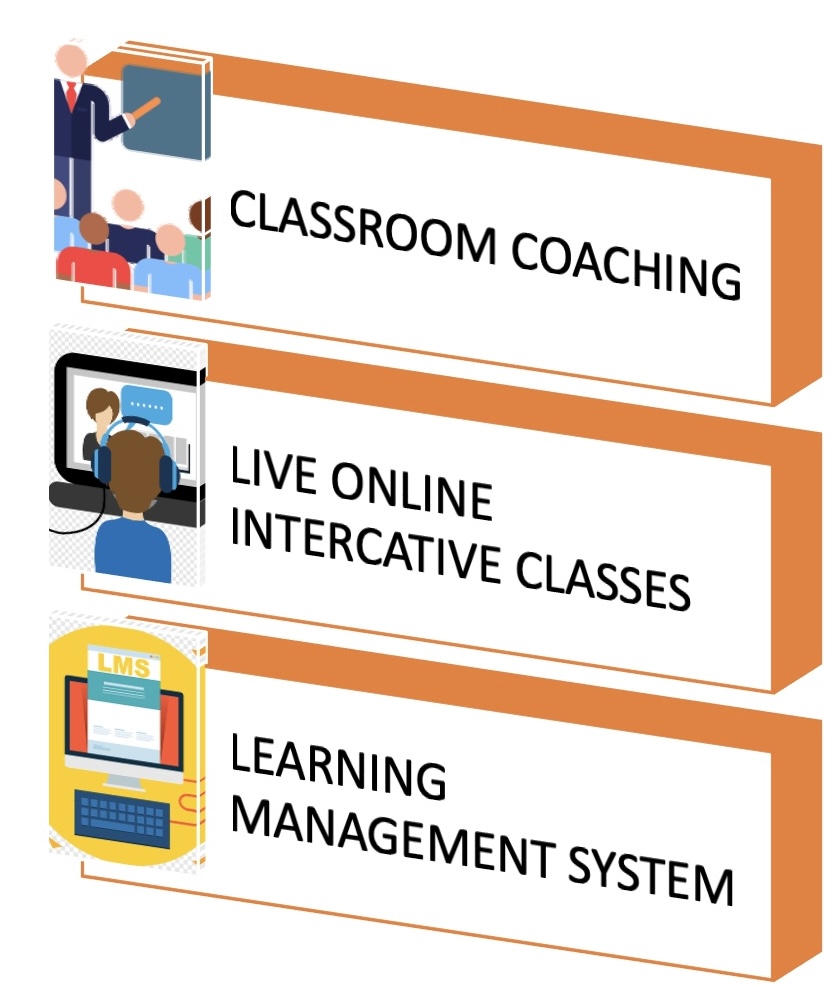
  1. Classroom Coaching : Pahal Design is offering Classroom coaching at 30 Centres across India.

https://pahaldesign.com/contact-us/

  1. Live Online Intercative Classes : If you want Online Classes then this is available with full study material.
  2. Learning Management System : The students can solve assignments, Quizzes, UCEED | NID Exam papers, assignments using their ipad, Tablet or Laptop anytime anywhere.
  3. Full Study Material – IIT UCEED | NID Study Material is available at pahaldlp.com
Hauz Khas (Corporate Office)
Address:- G-13,Ground Floor, Hauz Khas, New Delhi-110016
Nearest Metro Station Hauz Khas Gate No-3, Mayfair Garden / RBI Colony
Landmark:
Near Nirula’s
Contact No: 8800-22-6864
Contact Person: Karishma Gupta
Email: corporate@pahaldesign.com
 
SOUTH DELHI
South Extension

Address:- E-13, Ground Floor, South Extension Part 1, New Delhi – 110049
Landmark: Mcdonald’s Lane, Nearest Metro – South Ex Metro Gate No 2
Contact No: 8800-22-6864
Contact Person : Karishma Gupta
Email: corporate@pahaldesign.com

EAST DELHI
Preet Vihar

Address:- F-16, 1st Floor, Preet Vihar, 
(Nearby Metro – Preet Vihar, Lift No 3 ), New Delhi – 110092
Contact No: 93540-52529
Contact Person: Mr. Prashant Verma
Email: corporate@pahaldesign.com

NORTHWEST DELHI
Pitampura

Address:- 3rd Floor, 368, Kohat Enclave, Pitampura, New Delhi – 110034
Near Kohat Enclave Metro Station Gate 3, Above Yes Bank
Contact No: 90311-70312
Contact Person: Mr. Dev Budhani
Email: corporate@pahaldesign.com

WEST DELHI
Janakpuri

Address:- 2nd Floor, S-4/63A, Shivaji Marg, New Mahavir Nagar, Janakpuri, New Delhi – 110018
Opposite – Metro Pillar No. 552, Landmark – Janakpuri East Metro Station
Contact Person: Mr. Dev Budhani
Contact No: 90311-70312
Email: corporate@pahaldesign.com

DELHI NCR
Gurugram

Address:- M-44, Ground Floor, Old DLF Colony,
Sec-14 Market, Gurugram-122001
Landmark – Opposite Ganpati Honda
Contact Person: Karishma Gupta
Contact No: 8800-22-6864
Email: corporate@pahaldesign.com

DELHI NCR
NOIDA

Address:- C-29, Ground Floor, Sector 2, Noida
(Nearby Metro – Noida Sector 15 Metro Station ), UP – 201301
Contact No: 93540-52529
Contact Person: Mr. Prashant Verma
Email: corporate@pahaldesign.com


Admissions to the Bachelor of Design (BDes) programmes at IIT Bombay, IIT Delhi, IIT Guwahati, IIT Hyderabad, IIT Roorkee and IIITDM Jabalpur are done through the Undergraduate Common Entrance Exam for Design (UCEED). Many institutes also recognize the UCEED Score Card for admissions to their BDes program. Only those students who have passed Class XII (or equivalent) in 2023 in all subjects or are appearing in 2024 in ANY STREAM (Science, Commerce, or Arts & Humanities) for the first time are eligible to appear for the UCEED 2024. UCEED 2024 score is valid only for admission to the programmes in the academic year 2024-2025.
The BDes programme in IDC emphasises skill-based components in the fundamentals of design in the first two years. In the third year, the students have a choice of a large number of elective courses that provide an opportunity to specialize in the various areas of design that IDC is known for. The potential for design lies in solving real-world problems. A series of design projects (one in each semester), often enriched through field trips and real-world experiences, enables students to engage with design issues and develop an understanding of design methodology. In the last two semesters of the BDes programme, the students do semester-long degree projects that demonstrate the abilities that they have acquired.

UCEED is a test centre-based examination and has two parts: Part-A is computer-based and Part-B contains question related to sketching that needs to be attempted on the provided sheet. It is compulsory for the candidates to attempt both the parts in the given time.

The total time for the examination (that includes both Part-A and Part-B) is THREE hours.

UCEED 2024 PARTICIPATING INSTITUTES

  • Indian Institute of Technology Bombay (IITB),
  • Indian Institute of Technology Delhi (IITD),
  • Indian Institute of Technology Guwahati (IITG),
  • Indian Institute of Technology Hyderabad (IITH),
  • Indian Institute of Technology Roorkee (IITR)
  • Indian Institute of Information Technology Design and Manufacturing Jabalpur (IIITDMJ)

IIT – UCEED SYLLABUS

UCEED 2024 will have two parts.
Part-A will have questions on the following topics:

  • Visualization and spatial reasoning: Ability to visualise and transform 2D shapes and 3D objects and their spatial relationships.
  • Practical and scientific knowledge: Know-how of scientific principles and everyday objects.
  • Observation and design sensitivity: The capacity to detect concealed properties in daily life and think critically about them. Attention to detail, classification, analysis, inference and prediction.
  • Environment and society: General awareness of environmental, social and cultural connections with design.
  • Analytical and logical reasoning: Ability to analyse qualitative and quantitative information.
  • Language: Proficiency in reading and comprehending Standard English.
  • Creativity: Grasp of verbal and non-verbal analogies, metaphors, signs and symbols. Part-B will have questions on the following topics:

Drawing: Ability to draw products, people or scenes in proportion with good line quality, composition, proportion, perspective and shading.

Design aptitude: Capability to practically and appropriately respond to problems/situations with ingenuity and empathy.

UCEED 2015-24 Original Last 10 Years Exam Papers


Indira Nagar[Bengaluru Head Office]

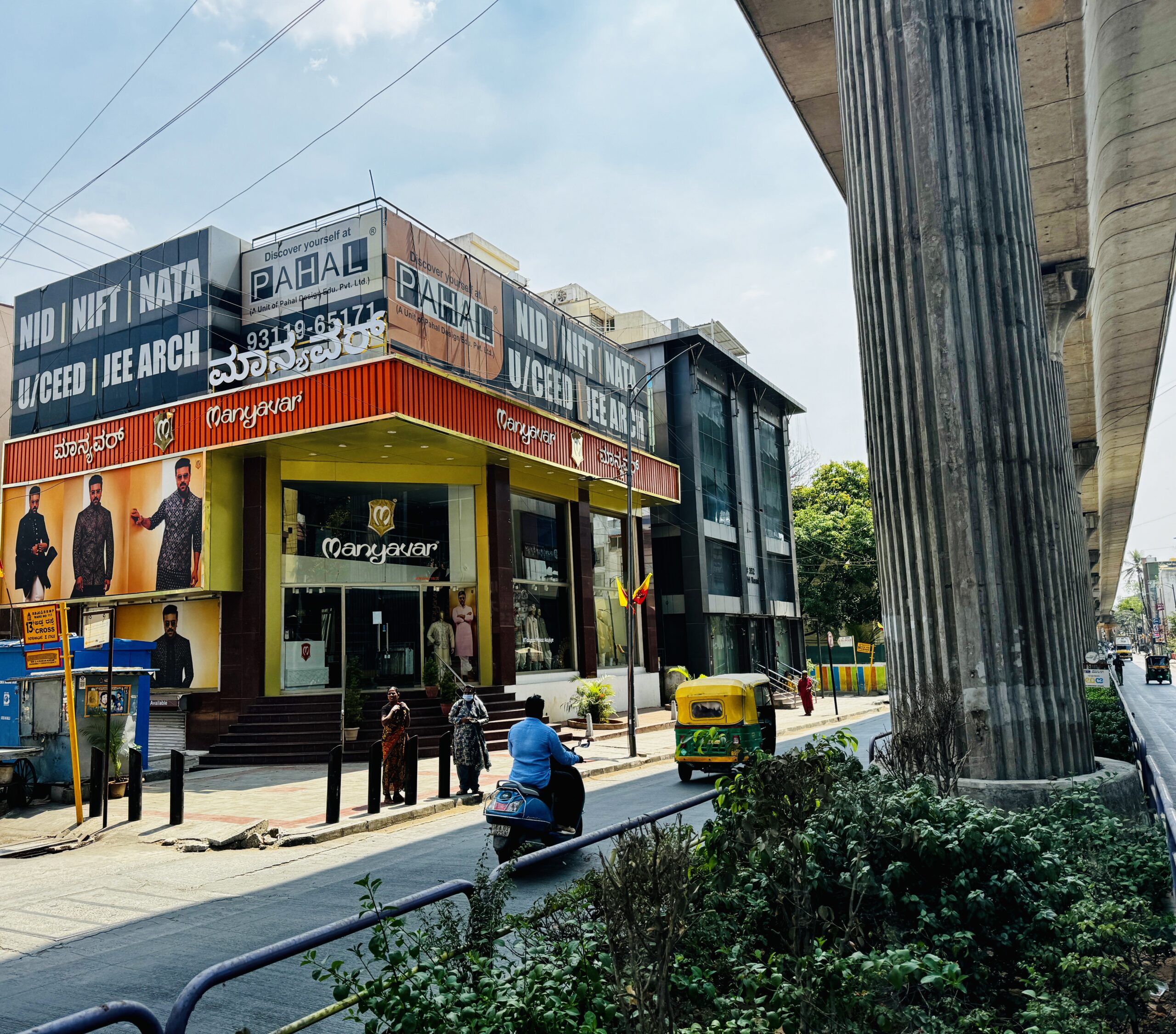
Address:- 1st Floor, 393, Chinmaya Mission Hospital Rd, near HDFC bank,2nd Stage, Binnamangala, Hoysala Nagar, Indiranagar, Bengaluru – 560038, Above Manyavar
Contact No: 9821-651-399
Contact Person: Ms.Etisha
Email: corporate@pahaldesign.com


Pahal Design has been training and mentoring students for more than 25 years in Design and Architecture, like NID, NIFT, NATA, UCEED, JEE Paper 2, BFA. With 7 centres in Delhi, no students is too far from Pahal Design Centre, each of which is located at just walking distance from the metro. Pahal Design offering Weekdays and Weekends Batch for the students. We have Classroom Coaching, Online Live Coaching and Study material available for the students. The batch size of the classes conducted here is kept small so that each student receives individual attention by the faculty and all their doubts are resolved before the exam. 

National Institute of Design is internationally acclaimed as one of the finest educational and research institutions for Industrial, Communication, Textile and IT Integrated (Experiential) Design. It is an autonomous institution under the aegis of the Ministry of Commerce and Industry, Government of India. NID has been declared ‘Institution of National Importance’ by the Act of Parliament, by virtue of the National Institute of Design Act 2014.

Pahal Design IIT UCEED | NID Course 2024 :

  1. Classroom Coaching : Pahal Design is offering Classroom coaching at 30 Centres across India.

https://pahaldesign.com/contact-us/

  1. Live Online Intercative Classes : If you want Online Classes then this is available with full study material.
  2. Learning Management System : The students can solve assignments, Quizzes, UCEED | NID Exam papers, assignments using their ipad, Tablet or Laptop anytime anywhere.
  3. Full Study Material – IIT UCEED | NID Study Material is available at pahaldlp.com
WEST DELHI
Janakpuri

Address:- 2nd Floor, S-4/63A, Shivaji Marg, New Mahavir Nagar, Janakpuri, New Delhi – 110018
Opposite – Metro Pillar No. 552, Landmark – Janakpuri East Metro Station
Contact Person: Mr. Dev Budhani
Contact No: 90311-70312
Email: corporate@pahaldesign.com


UCEED 2024 will be conducted by the Indian Institute of Technology Bombay under the guidance of the UCEED-CEED Implementation Committee 2024 (henceforth referred to as the UCI Committee).
UCEED 2024 is open to all nationals (Indian/Foreign). Candidates seeking admission to the Bachelor’s Degree programme in Design (BDes) at Indian Institute of Technology Bombay (IITB), Indian Institute of Technology Delhi (IITD), Indian Institute of Technology Guwahati (IITG), Indian Institute of Technology Hyderabad (IITH), Indian Institute of Technology Roorkee (IITR) and Indian Institute of Information Technology Design and Manufacturing Jabalpur (IIITDMJ), must appear for UCEED 2024.

Pahal Design Bangalore is offering weekdays and weekends batch. Students can join Classroom Coaching and Online Coaching.

Syllabus

UCEED 2024 will have two parts.

Part-A will have questions from the following topics:

  • Visualization and spatial reasoning: Ability to visualise and transform 2D shapes and 3D objects and their spatial relationships.
  • Practical and scientific knowledge: Know-how of scientific principles and everyday objects.
  • Observation and design sensitivity: The capacity to detect concealed properties in daily life and think critically about them. Attention to detail, classification, analysis, inference and prediction.
  • Environment and society: General awareness of environmental, social and cultural connections with design.
  • Analytical and logical reasoning: Ability to analyse qualitative and quantitative information.
  • Language: Proficiency in reading and comprehending Standard English.
  • Creativity: Grasp of verbal and non-verbal analogies, metaphors, signs and symbols.

Part-B will have questions on the following topics:

  • Drawing: Ability to draw products, people or scenes in proportion with good line quality, composition, proportion, perspective and shading.
  • Design aptitude: Capability to practically and appropriately respond to problems/situations with ingenuity and empathy.

UCEED 2024 will be held only in the following 27 cities in India:

Ahmedabad, Bengaluru, Bhopal, Bhubaneswar, Chandigarh, Chennai, Coimbatore, Dehradun, Delhi, Ernakulam, Guwahati, Hyderabad, Jaipur, Kolkata, Kozhikode, Lucknow, Mumbai, Mysuru, Nagpur, Noida, Panaji, Patna, Pune, Raipur, Thiruvananthapuram, Thrissur, and Visakhapatnam.

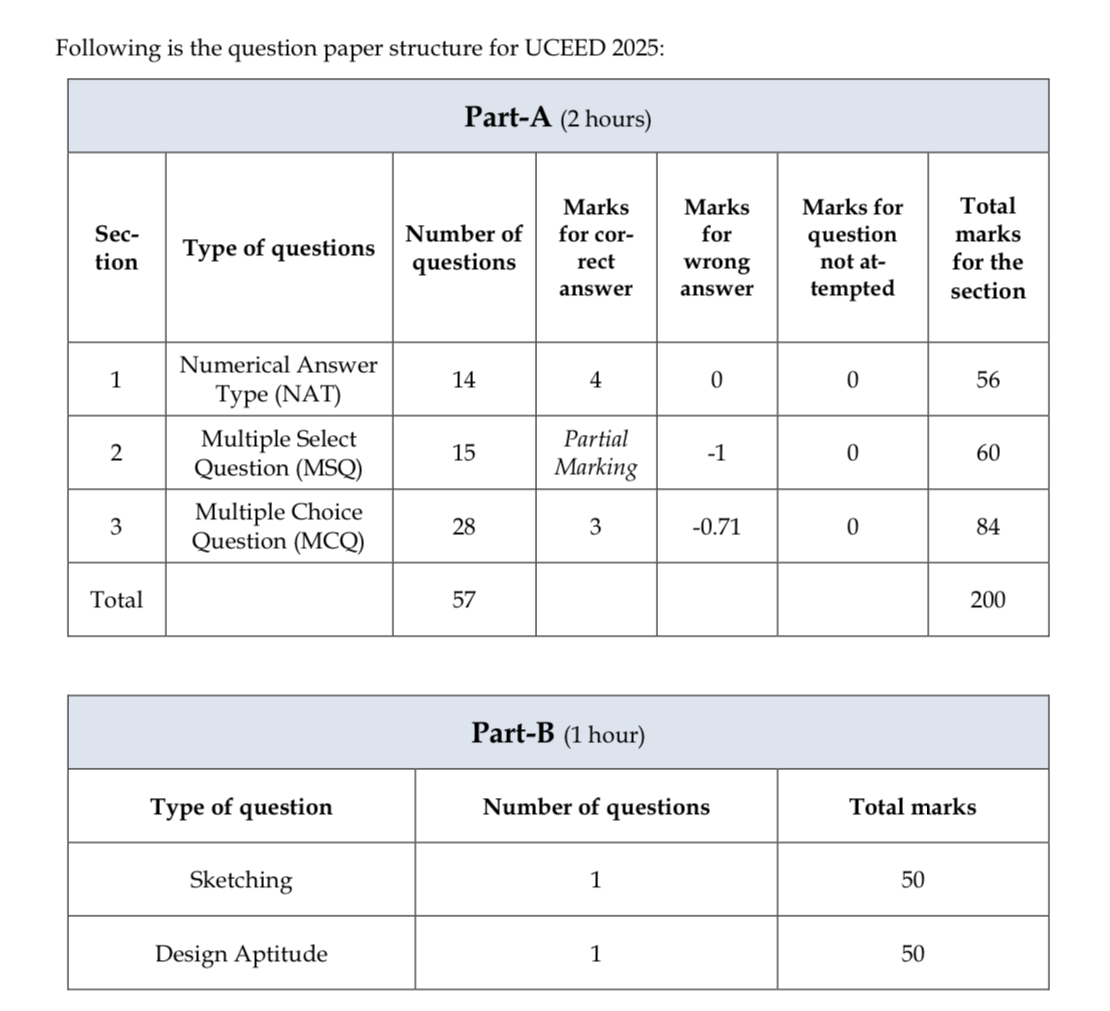
Question Paper Structure for UCEED 2024

  • There will be ONE question paper of total THREE hours duration.
  • The question paper will be in English only.
  • The question paper will carry a total of 300 marks.
  • The question paper will consist of two parts: Part-A and Part-B. It is compulsory to attempt questions from both the parts.
  • Utmost care is taken to prepare an error free question paper. However, if an error is detected in the question paper, the UCI Committee shall take an appropriate decision after the examination, which shall be final.

Details of the two parts of the question paper are given below:

Part-A (Total marks: 200; Maximum time: 2 hours)

  • This part will be administered through a computer-based test.
  • This part will consist of three sections.

Section 1:NAT (Numerical Answer Type): 14 questions (4 marks each; no negative marks).
For these questions, the answer is a number that needs to be entered using a virtual keyboard on the computer screen. No choices will be shown for these questions.

Section 2: MSQ (Multiple Select Question): 15 questions.
Each MSQ may have one or more than one correct choice(s) out of the four given. The following is the marking scheme:

Full Marks: + 4

    • If only (all) the correct option(s) is(are) chosen and NONE of the incorrect options is chosen.

Partial Marks: + 3

    • If all the four options are correct but ONLY three options are chosen and NONE of the incorrect options is chosen.

Partial Marks: + 2

    • If three or more options are correct but ONLY two options are chosen, both of which are correct and NONE of the incorrect options is chosen.

Partial Marks: + 1

    • If two or more options are correct but ONLY one option is chosen and it is a correct option and NONE of the incorrect options is chosen

Zero Marks: 0

    • If none of the options is chosen (i.e., the question is unanswered).

Negative Marks: -1

    • In all other cases.

Section 3: MCQ (Multiple Choice Question): 28 questions (3 marks each for the correct answer; 0.71 negative marks for incorrect answers). Each MCQ will have four choices, out of which only one is the correct answer..

Part-B (Total marks: 100; Maximum time: 1 hour)

  • Part-B consists of TWO questions to test the candidates’ drawing skills and design aptitude. This will require subjective evaluation. The questions in Part-B will be displayed on the computer screen, and the answer must be written/drawn in the answer book provided by the invigilator. In the case of PwD candidates availing the use of a scribe, assistance in attempting Part-B is not permitted, as the question is aimed at evaluating their drawing skill.
  • Part-B answer booklets will be collected at the end of the examination.
  • Part-B question is mandatory.
  • The entire paper (Part-A and Part-B) must be finished within the stipulated time for each part.
KARNATAKA
 
Indira Nagar – Bengaluru Head Office

Address:- 1st Floor, 393, Chinmaya Mission Hospital Rd, near HDFC bank,2nd Stage, Binnamangala, Hoysala Nagar, Indiranagar, Bengaluru – 560038, Above Manyavar
Contact No: 9821-651-399
Contact Person: Ms. Purva
Email: corporate@pahaldesign.com

Online Counselling


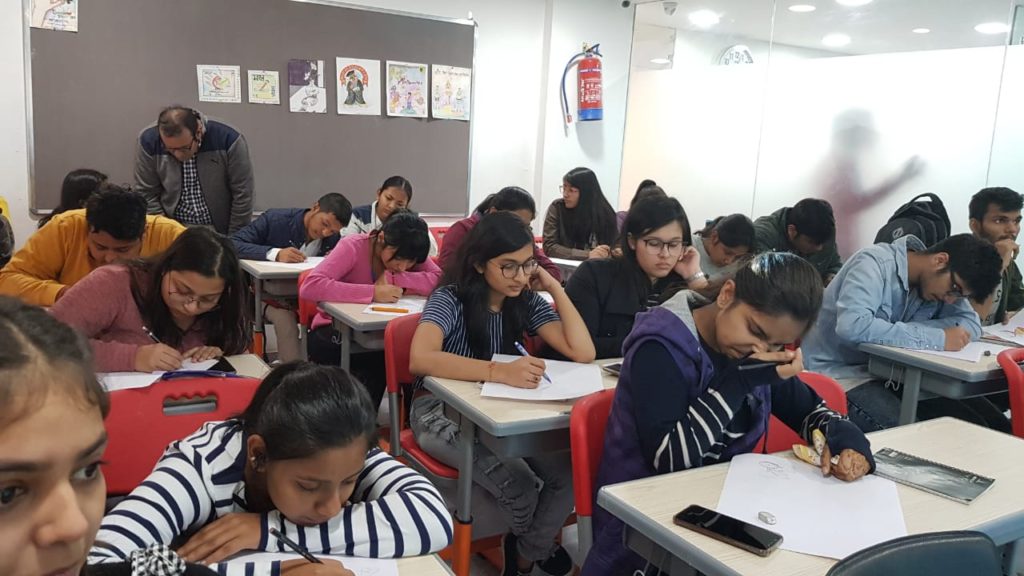
Graphic designers create visual concepts, using computer software or by hand, to communicate ideas that inspire, inform, and captivate consumers. They develop the overall layout and production design for applications such as advertisements, brochures, magazines, and reports.
Duties

Graphic designers typically do the following:

  • Meet with clients or the art director to determine the scope of a project
  • Use digital illustration, photo editing software, and layout software to create designs
  • Create visual elements such as logos, original images, and illustrations to help deliver a message
  • Design layouts, including selection of colors, images, and typefaces
  • Present design concepts to clients or art directors
  • Incorporate changes recommended by clients or art directors into final designs
  • Review designs for errors before printing or publishing them

Graphic designers, also referred to as graphic artists or communication designers, combine art and technology to communicate ideas through images and the layout of websites and printed pages. They may use a variety of design elements to achieve artistic or decorative effects.

Graphic designers work with both text and images. They often select the type, font, size, color, and line length of headlines, headings, and text. Graphic designers also decide how images and text will go together in print or on a webpage, including how much space each will have. When using text in layouts, graphic designers collaborate with writers, who choose the words and decide whether the words will be put into paragraphs, lists, or tables. Through the use of images, text, and color, graphic designers may transform data into visual graphics and diagrams to make complex ideas more accessible.

Graphic design is important to market and sell products, and it is a critical component of brochures and logos. Therefore, graphic designers often work closely with people in advertising and promotions, public relations, and marketing.

Frequently, designers specialize in a particular category or type of client. For example, some designers create the graphics used on product packaging, and others may work on the visual designs used on book jackets.

Graphic designers need to keep up to date with software and computer technologies in order to remain competitive.

Some individuals with a background in graphic design become postsecondary teachers and teach in design schools, colleges, and universities.

Some graphic designers specialize in experiential graphic design. These designers work with architects, industrial designers, landscape architects, and interior designers to create interactive design environments, such as museum exhibitions, public arts exhibits, and retail spaces.

Education for Graphic Designers
A bachelor’s degree in graphic design or a related field is usually required. However, individuals with a bachelor’s degree in another field may pursue technical training in graphic design to meet most hiring qualifications.

The National Association of Schools of Art and Design accredits about 350 postsecondary colleges, universities, and independent institutes with programs in art and design. Most programs include courses in studio art, principles of design, computerized design, commercial graphics production, printing techniques, and website design. In addition, students should consider courses in writing, marketing, and business, all of which are useful in helping designers work effectively on project teams.

High school students interested in graphic design should take basic art and design courses in high school, if the courses are available. Many bachelor’s degree programs require students to complete a year of basic art and design courses before being admitted to a formal degree program. Some schools require applicants to submit sketches and other examples of their artistic ability.

Many programs provide students with the opportunity to build a professional portfolio of their designs. For many artists, including graphic designers, developing a portfolio—a collection of completed works that demonstrates their styles and abilities—is essential because employers rely heavily on a designer’s portfolio in deciding whether to hire the individual.

Graphic designers must keep up with new and updated computer graphics and design software, either on their own or through formal software training programs. Professional associations that specialize in graphic design, such as AIGA, offer courses intended to keep the skills of their members up to date.

Other Experience for Graphic Designers
Graphic designers often gain their initial experience through internships. Internships provide aspiring graphic designers an opportunity to work with designers and to experience the design process from concept to completion, in some cases while completing a design program.

Licenses, Certifications, and Registrations for Graphic Designers
Certification programs are generally available through software product vendors. Certification in graphic design software can demonstrate a level of competence and may provide a jobseeker with a competitive advantage.

Advancement for Graphic Designers
Experienced graphic designers may advance to chief designer, art director, or other supervisory positions.

Important Qualities for Graphic Designers
Analytical skills. Graphic designers must be able to look at their work from the point of view of their consumers and examine how the designs they develop will be perceived by consumers to ensure they convey the client’s desired message.

Artistic ability. Graphic designers must be able to create designs that are artistically interesting and appealing to clients and consumers. They produce rough illustrations of design ideas, either by hand sketching or by using computer programs.

Communication skills. Graphic designers must communicate with clients, customers, and other designers to ensure that their designs accurately reflect the desired message and effectively express information.

Computer skills. Most graphic designers use specialized graphic design software to prepare their designs.

Creativity. Graphic designers must be able to think of new approaches to communicating ideas to consumers. They develop unique designs that convey a certain message on behalf of their clients.

Time-management skills. Graphic designers often work on multiple projects at the same time, each with a different deadline.

Art Directors

Art directors are responsible for the visual style and images in magazines, newspapers, product packaging, and movie and television productions. They create the overall design of a project and direct others who develop artwork and layouts.

Craft and Fine Artists

Craft and fine artists use a variety of materials and techniques to create art for sale and exhibition. Craft artists create handmade objects, such as pottery, glassware, textiles, and other objects that are designed to be functional. Fine artists, including painters, sculptors, and illustrators, create original works of art for their aesthetic value, rather than for a functional one.

Desktop Publishers

Desktop publishers use computer software to design page layouts for newspapers, books, brochures, and other items that are printed or published online.

Drafters

Drafters use software to convert the designs of engineers and architects into technical drawings. Most workers specialize in architectural, civil, electrical, or mechanical drafting and use technical drawings to help design everything from microchips to skyscrapers.

Industrial Designers

Industrial designers develop the concepts for manufactured products, such as cars, home appliances, and toys. They combine art, business, and engineering to make products that people use every day. Industrial designers consider the function, aesthetics, production costs, and usability of products when developing new product concepts.

Multimedia Artists and Animators

Multimedia artists and animators create animation and visual effects for television, movies, video games, and other forms of media.

Technical Writers

Technical writers, also called technical communicators, prepare instruction manuals, how-to guides, journal articles, and other supporting documents to communicate complex and technical information more easily. They also develop, gather, and disseminate technical information through an organization’s communications channels.

Web Developers

Web developers design and create websites. They are responsible for the look of the site. They are also responsible for the site’s technical aspects, such as its performance and capacity, which are measures of a website’s speed and how much traffic the site can handle. In addition, web developers may create content for the site.

1. Draw a scenery showing you attending online class while showing your sibling is distracting you with reference to the figure ( it was a door slightly opening ) – 15 Marks
2. We had to make a comic strip of knots and crosses being characters from the game tic tax toe in 6 stages with dialogues – 6 Marks
3. there was a picture of a black sphere in the desert with clouds and we had to make a short story of it in 3 stages without adding any elements or changing the setting. 9 Marks
4. Anti bullying poster making . 15 Marks
5. Instruction manual on how to make a cup of tea. 15 Marks

NMD-
1). Choose 3 options from list of old media to new media and depict transition through visual narration the transition.
I choose, Book->Ebooks, Music-> Spotify, journalism->blogs

2). Design a robot for bank to help consumers with token generation, queries etc in 3 frame.

3). Draw a dynamic logo for a mobile phone Company.

4). Design a transmedia campaign for Consumer Rights Awareness

FVC-
1). Write a dialogue b/w you and your fren formulating your argument on Three Farm laws
2). Depict a scene visually through words of a student stuck in traffic at junction while getting late for exam
3). Write a story on a person stuck in house alone in lockdown, and how insecurities/fears are rising

Product design-

1st question design a product for storage of vaccines to have temperature of 2-5°.

2nd draw a poster for vaccination
3rd draw a composition of you taking a selfie with your smart phone ,
4th Show a story board of conversation between charger and phone.
5th design an AU electronic product to help and assist old people
There was one more question which I can’t recall right now..

Interaction Design –

1) Draw a headphone showing volume change and song change feature,.

2) poster design on healthy lifestyle during pandemic

3) content of above to be shown in SMS, Public space etc

4) draw a headphone in the same design language as that of a Radio shown in figure

5) Design a lamp for millennials and receive it’s features


There are many Design Coaching in Jaipur but if we need to find out the best coaching classes, with best learning experience then Pahal Design comes with 22 Years of academic excellence and more than 40 centres across India including all the metros. (New Delhi, Mumbai, Bengaluru, Kolkata, Pune, Ahmedabad, Gurgaon, Jaipur, Lucknow, Dehradun, Chandigarh, Bhopal, Indore, Patna, Ranchi, Kanpur and many more other cities). Now Pahal Design is in Jaipur at Vaishali Nagar for Design, Architecture and Fine Arts Coaching. If any students are looking for Design, Fashion, Architecture and Fine Arts Coaching or any guidance related to Design Colleges then we have Free Guidance for all Design Students.
The design industry in India is growing at a staggering rate of 23 to 25 per cent annually – it’s an indicative of the qualitative change you find in the look and feel of consumer goods. Industry insiders believe that greater spending power and changing needs of consumers are responsible for the boom in the design industry. “People today are spending more money. From the interiors of their flats to the products they buy, all consumers are looking for that extra value-add. There is this new emphasis on vanity. The culture is shifting and design is a reflection of that shift.” With brand positioning and identity the new buzzwords, industries that form the designer’s client base are a lot more aware about design and its importance.

There are some sectors within the industry that have seen a higher growth of interest than others – animation, graphics, apparel, textiles, automotive, product and software interface design to name a few. This interest has also translated into a greater demand for industrial and communication designers.

Currently, India needs 8,000-10,000 designers a year, while overall availability of qualified designers is only 3,000. To make matters worse, only 500 of these 3,000 are said to be practicing designers. There is a reason why your new car is better looking than your last and why your refrigerator seems more functional than the one you had before. 

Design can transform the way we do things, and result in new economic benefits and a better quality of life. The strategic nature of design helps solve problems in ways that are functionally and aesthetically pleasing and make economic sense. Design helps to improve quality and differentiation, offer world class products and services, improve business efficiencies, productivity and margins, increase revenues and achieve higher market share and accelerated growth.

The design industry lags behind other professional services domains in numerical terms when looked at in terms of turnover and number of employees. Architecture, Interior, Animation / New Media, Fashion Design are leading domains within the design industry. Other segments are far behind at present. However with the change in the economic scenario, design domains such as graphic design, industrial design, human computer interaction are growing at a fast clip. The number of design companies is growing as also there is growth in existing companies. There is a good trend of designers opting to start their own setup. Hence most companies existing today are new. The existing companies are consolidating further by adding more services to their portfolio within diverse design disciplines.

India is a large market and at the same unique as well. There is no such thing called as a thumb rule which can describe Indian market or consumers. They vary in cultures, traditions, religions, customers, food, dressing, etc. At the same time the Indian consumer is becoming more demanding and is asserting himself / herself to get his / her aspirations satisfied.

Multinational corporations are focusing on India as a new market for trading their products / services. They understand that successes elsewhere may not necessarily translate in a similar way in India. They will need to understand the market, the sensibilities of the people and respond to them through their offerings. Global corporations will need to work with Indian designers to understand the local market.



To better understand the Indian consumer, to meet the needs and aspirations of this assertive, active, enlightened consumer, Indian businesses and multinational corporations will need to take assistance from Indian designers. This puts a spot light on the design industry as never before.

 
Jaipur

Address:- 2nd Floor, F 18, Gautam Marg, Vaishali Nagar, Jaipur, Rajasthan -302021
Contact Person: Mr. Aman and Mr. Akbar
Contact No: 97721-99911, 0141-6656509
Email: jaipur@pahaldesign.com

Schedule a free counselling session WhatsApp WhatsApp Enquiry