 NATA is an aptitude test that assesses a candidate’s innate ability through a variety of testing formats and cannot be taught, learnt or induced. NATA measures the aptitude of the applicant for specific field of study i.e. Architecture, through assessment of cognitive skills, visual perception and aesthetic sensitivity tests, logical reasoning and critical thinking ability, etc., besides the learning that the candidate has acquired over the past few years and is related to the specific field of study.
Architecture as social commentary holds a mirror to society, reflecting its glory and challenges. From stylistic evolution to radical visions, architecture not only responds to society but actively helps to shape it. Architecture plays a significant role in shaping cultural identity and also acts as a medium to express creativity. Buildings and structures act as symbols of a community’s values, beliefs; heritage and their design reflect the unique identity of the place.
Architecture is a noble profession which deals with the well-being of human beings and Society. Its routes are as ancient as the civilization. Popularly defined as combination of Arts and Technology, it ensures creation of built environment ensuring health, hygiene, safety and happiness of the occupants as well as visitors.
The career of an Architect is very promising and satisfying, being a ‘Professional’, one is capable of starting the practice, in the modern terms ‘start-up’ at the earlier stage of life with minimal investment. Hence, Architects are popularly known as ‘Job Givers’ rather than ‘Job Seekers’.
As aptly described by Hon’ble Prime Minister, Shri Narendra Modi Ji, this is the ‘Amrit Kal’of Indian Civilisation and in the days to come, we would be the biggest service providers of the world. The construction and infrastructure activities across India are at its peak and the Architects have to positively contribute to the development of Nation as never before. The Council is making all efforts to ensure that the Architectural Education and Profession in the country meets the challenges posed by globalisation, scarcity of natural resources and energy along with threat posed by natural and man-made disasters.
NATA is the first step towards this glorious career and those who wish to join Architecture profession will have to qualify NATA, a test especially designed to assess the aptitude of the candidate towards architecture profession.
SCHDEULE OF EXAMINATION
The candidates can appear for a maximum of 3 attempts in NATA 2024 in one academic year. The best score out of all the attempts shall be considered for the declaration of results. The score of NATA Test would be valid for a period of 2 academic years. Examination shall be valid for a period of 2 academic years.
Examination shall be conducted on all weekends starting from April to July. 2024 in two sessions, subject to a number of candidates registered for the session. The candidates need to indicate their preference for session & city of examination while registering at NATA portal www.nata.in. The session during which the candidate will take the test as well as the Test Centres, shall be allotted by the Council, as far as possible, on the basis of cities and sessions preferred by the candidate in the application form. However, the decision of the Council in allotting the Test Centre and session to candidates shall be final.
The Tests shall be conducted as per the schedule as given below:
| Date & Time of Examination | |
| NATA 2024 Examination commencing from: | 06-04-2024 onwards |
| Session 1: 10.00 am. to 1.00 pm
(180 mins/3.0 hours) |
Session 2: 1.30 pm to 4.30 pm
(180mins/3.0 hours) |
NATA Coaching SYLLABUS 2025
The medium of Aptitude test shall be in English and Hindi. The aptitude of the candidate will be assessed using some or all of the following:
PART-A
Drawing and Composition Test
This is one and a half-hour (90 minutes) – 80 Marks Test where the candidate has to attempt three questions. The content of the PART A Test is as follows:
- Al – Composition and Colour -25 Marks: Creating suitable compositions for various situations and colouring them appropriately. Re-arranging various shapes in a visually appealing manner and colouring it suitably.
- A2 -Sketching & Composition (Black and White)-25 Marks: Ability to draw, visualize, depict a situation, involving buildings / its components, people, environment, products with an understanding of scale, proportions, textures, shades, and shadow, etc.
- A3 – 3D Composition-30 Marks: Creating interesting 3D composition for the given situation using the provided kit.
PART-B
This is one and a half-hours (90 minutes), 120 Marks Test where the candidate has to appear for an online test. It shall have two type of Questions viz., B1 – 30 Questions of 2 Marks and B2 – 15 Questions of 4 Marks from the following topics:
- Visual Reasoning Ability to understand and reconstruct 2D and 3D composition, knowledge about its composition, and technical concepts.
- Logical Derivation Ability to decode a situation, composition, and context and generate meaning. Understanding the minute information hidden in a particular situation and drawing conclusions.
- K., Architecture & Design General awareness of architecture and design, current issues, recent episodes, etc., Knowledge about important buildings, historical progression, innovation in materials, and construction technology.
- Language Interpretation Ability to correctly & logically generate the meaning of words, and sentences, and understand about English grammar.
- Design Sensitivity Ability to observe record and analyse, people, space, products,
- Critical thinking, reasoning, and ability to identify subtle communications.
- Design Thinking Ability to understand semantics, metaphors, problem identification and definition, and analysis of a given situation.
- Numerical Ability Basic Mathematics and its association with creative thinking. To unfold a
- space with the use of geometry.
Appearing in second or third test is not mandatory and is purely at the discretion of the applicants. Candidates can register themselves for one test or maximum of three Tests in one academic year by filling in the application form appropriately.
Qualifying Criteria
The Qualifying Marks for the NATA 2024 would be based on the following Rules:
- A minimum of 20 marks must be secured in PART A
- A minimum of 30 marks must be secured in PART B
- Overall qualifying marks for NATA 2024 shall be 70 marks out of 200 as aggregate of Part A and Part B.
JEE PAPER – 2 SYLLABUS
Part – I MATHEMATICS
UNIT 1: SETS, RELATIONS, AND FUNCTIONS:
UNIT 2: COMPLEX NUMBERS AND QUADRATIC EQUATIONS:
UNIT3: MATRICES AND DETERMINANTS:
UNIT 4: PERMUTATIONS AND COMBINATIONS:
UNIT 5: BINOMIAL THEOREM AND ITS SIMPLE APPLICATIONS:
UNIT 6: SEQUENCE AND SERIES:
UNIT 7: LIMIT, CONTINUITY, AND DIFFERENTIABILITY:
UNIT 8: INTEGRAL CALCULAS:
UNIT 9: DIFFRENTIAL EQUATIONS
UNIT 10: CO-ORDINATE GEOMETRY
- Straight line
- Circle, conic sections
UNIT 11: THREE-DIMENSIONAL GEOMETRY
UNIT 12: VECTOR ALGEBRA
UNIT 13: STATISTICS AND PROBABILITY
UNIT 14: TRIGONOMETRY
Part –II APTITUDE TEST
UNIT – 1 Awareness of persons. Buildings, Materials.
Objects, Texture related to Architecture and Build-environment, Visualizing three- dimensional objects from two-dimensional drawings. Visualizing. Different sides of three- dimensional objects. Analytical Reasoning Mental Ability (Visual. Numerical and Verbal)
UNIT – 2 Three dimensional- perception: Understanding and appreciation of scale and proportions of objects, building forms and elements, colour texture harmony and contrast Design and drawing of geometrical or abstract shapes and patterns in pencil. Transformation of forms both 2D and 3D union, subtraction rotation, development of surfaces and volumes, Generation of plans, elevations, and 3D views of objects, creating two-dimensional and three-dimensional compositions using given shapes and forms.
Part – III DRAWING TEST
Sketching of scenes and activities from memory of urban scape (public space, market, festivals, street scenes, monuments, recreational spaces, etc.). landscape (riverfronts. Jungle. Gardens, trees. Plants, etc.) and rural life.
To be conducted in a Drawing sheet.
Note: Candidates are advised to bring pencils. Own geometry box set, crasets and colour pencils, and crayons for the Drawing Test
| Particulars | Details |
| Mode of exam | Mathematics, Aptitude Test and Planning questions in online mode Drawing test A-4 drawing sheet (offline mode) |
| Duration of exam | 3 hours
3.5 hours for candidates who chose both B.Arch and B.Plan 4 hours for candidates with benchmark disabilities having physical limitations to write |
| Total subjects | Mathematics, General Aptitude, and Drawing skills/Planning |
| Total number of questions | 82 for B.Arch (Mathematics 30, Aptitude 50, and Drawing 2)
105 for B.Planning (Mathematics 30, Aptitude 50, and Planning 25) |
| Nature of Questions | Maths and Aptitude questions will be objective type and numerical value while the drawing section will have questions to test the drawing and sketching skills of the candidate |
| Marking Scheme | Every correct response will be awarded 4 marks; for each incorrect response, 1 mark will be deducted. Marking will not be done for unattempt questions. |
| JEE Main paper 2 total marks | Total of 400 Marks |
| Medium of paper | English or Hindi (Candidates from Gujarat, Daman & Diu, and Dadra and Nagar Haveli can choose Gujarati as well) |
JEE Main Paper 2 Syllabus Planning Part III
| Unit | Topics |
| 1 | GENERAL AWARENESS-
General knowledge questions and knowledge about prominent cities, development issues, government programs, etc. |
| 2 | SOCIAL SCIENCES-
The idea of nationalism, nationalism in India, the pre-modern world, 19th -century global economy, colonialism, and colonial cities, industrialization, resources, and development, types of resources, agriculture, water, mineral resources, industries, national economy; Human Settlements Power-sharing, federalism, political parties, democracy, the constitution of India Economic development- economic sectors, globalization, the concept of development, poverty; Population structure, social exclusion, and inequality, urbanization, rural development, colonial cities, |
| 3 | THINKING SKILLS Comprehension (unseen passage); map reading skills, scale, distance, direction, area, etc.;critical reasoning; understanding of charts, graphs, and tables; basic concepts of statistics and quantitative reasoning |
IMPORTANT LINKS
- Why Architecture? | A Film by Council of Architecture
- NATA 2024 Registration
- NATA Score accepting Colleges
- NATA Exam Papers 2024
| NATA
ENTRANCE EXAM COACHING FOR THE YEAR 2024/2025 |
Pahal Design NATA Course 2025-26 :
- Classroom Coaching : Pahal Design is offering Classroom coaching at 30 Centres across India.
https://pahaldesign.com/contact-us/
- Live Online Intercative Classes : If you want Online Classes then this is available with ffull study material.
- Learning Management System : The students can solve assignments, Quizzes, NATA Exam papers, assignments using their ipad, Tablet or Laptop anytime anywhere.
- Full Study Material – NATA Study Material is available at pahaldlp.com
Nearest Metro Station Hauz Khas Gate No-3, Mayfair Garden / RBI Colony
Landmark: Near Nirula’s
Contact No: 8800-22-6864
Contact Person: Karishma Gupta
Email: corporate@pahaldesign.com
Address:- E-13, Ground Floor, South Extension Part 1, New Delhi – 110049
Landmark: Mcdonald’s Lane, Nearest Metro – South Ex Metro Gate No 2
Contact No: 8800-22-6864
Contact Person : Karishma Gupta
Email: corporate@pahaldesign.com
Address:- F-16, 1st Floor, Preet Vihar,
(Nearby Metro – Preet Vihar, Lift No 3 ), New Delhi – 110092
Contact No: 93540-52529
Contact Person: Mr. Prashant Verma
Email: corporate@pahaldesign.com
Address:- 3rd Floor, 368, Kohat Enclave, Pitampura, New Delhi – 110034
Near Kohat Enclave Metro Station Gate 3, Above Yes Bank
Contact No: 90311-70312
Contact Person: Mr. Dev Budhani
Email: corporate@pahaldesign.com
Address:- 2nd Floor, S-4/63A, Shivaji Marg, New Mahavir Nagar, Janakpuri, New Delhi – 110018
Opposite – Metro Pillar No. 552, Landmark – Janakpuri East Metro Station
Contact Person: Mr. Dev Budhani
Contact No: 90311-70312
Email: corporate@pahaldesign.com
Address:- M-44, Ground Floor, Old DLF Colony,
Sec-14 Market, Gurugram-122001
Landmark – Opposite Ganpati Honda
Contact Person: Karishma Gupta
Contact No: 8800-22-6864
Email: corporate@pahaldesign.com
Address:- C-29, Ground Floor, Sector 2, Noida
(Nearby Metro – Noida Sector 15 Metro Station ), UP – 201301
Contact No: 93540-52529
Contact Person: Mr. Prashant Verma
Email: corporate@pahaldesign.com
 Architecture is a multifaceted profession that combines creativity, engineering, and management to create functional and aesthetically pleasant spaces and Architects are responsible for designing buildings, considering factors like safety, functionality, sustainability, culture, and the two most essential one’s time and money. They need to work holistically to get the desired results. Architecture is not just about designing, but also knowing how to run a business, and how to create a social impact. It requires a strong foundation in both art and business, making it a dynamic and rewarding profession. The field is diverse having various options to choose from as a career in architecture such as interior designing, content writing, graphic designing, Municipal jobs, and more, making it a highly desirable profession.

 Dear Students,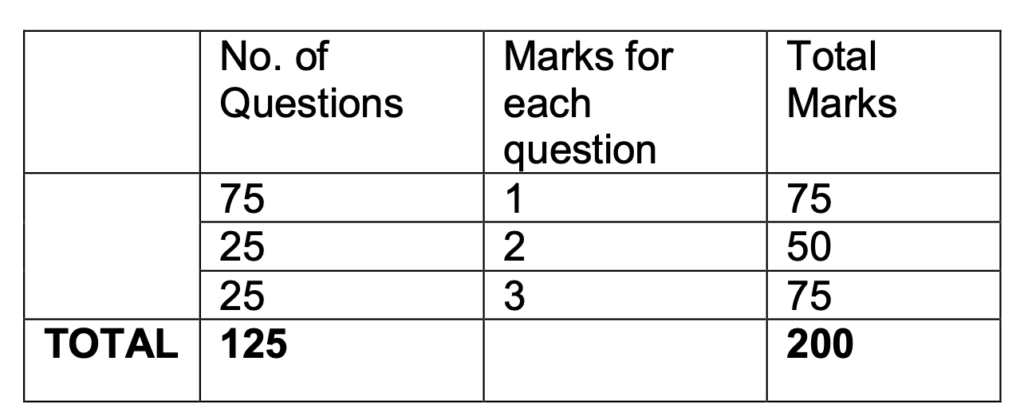

 FREQUENTLY ASKED QUESTIONS
 6. Will the test fee be refunded for any valid reason?


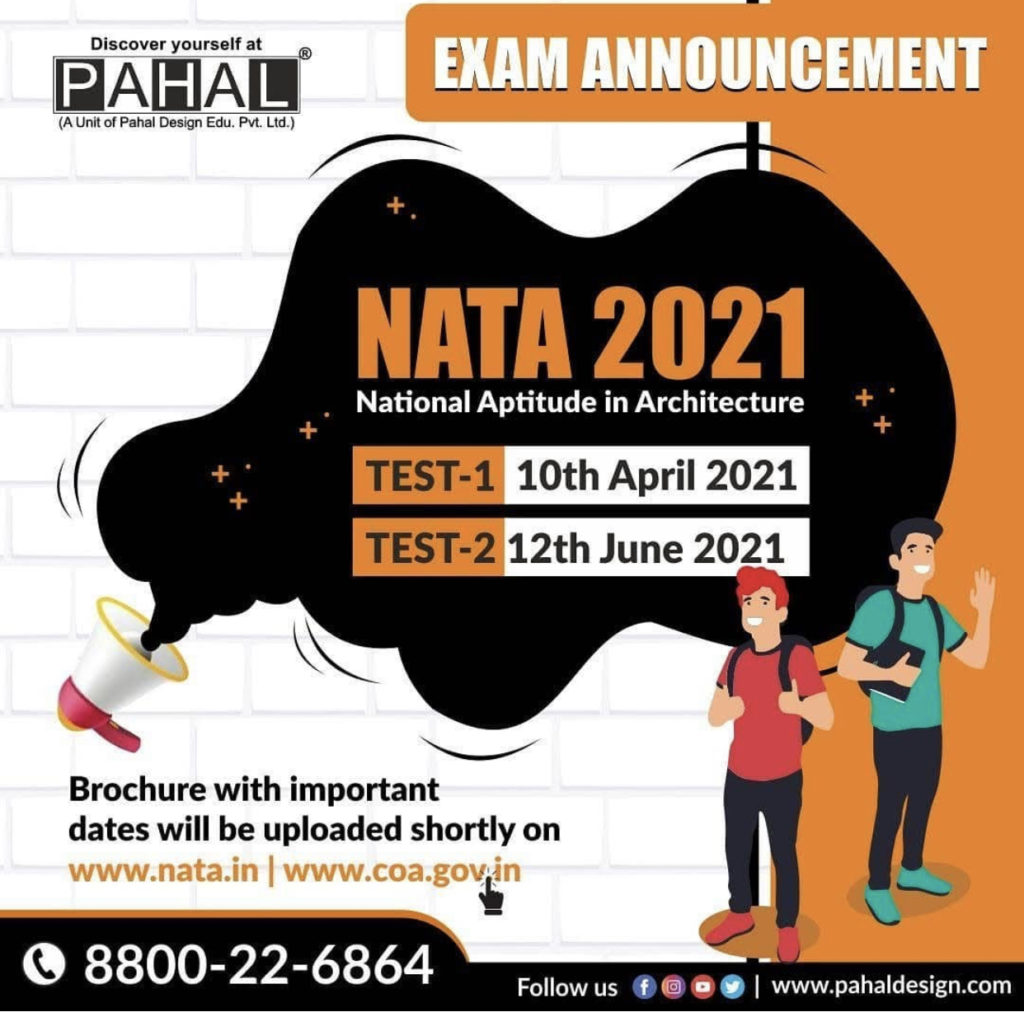
 About NATA 2021
 Outline of Aptitude Test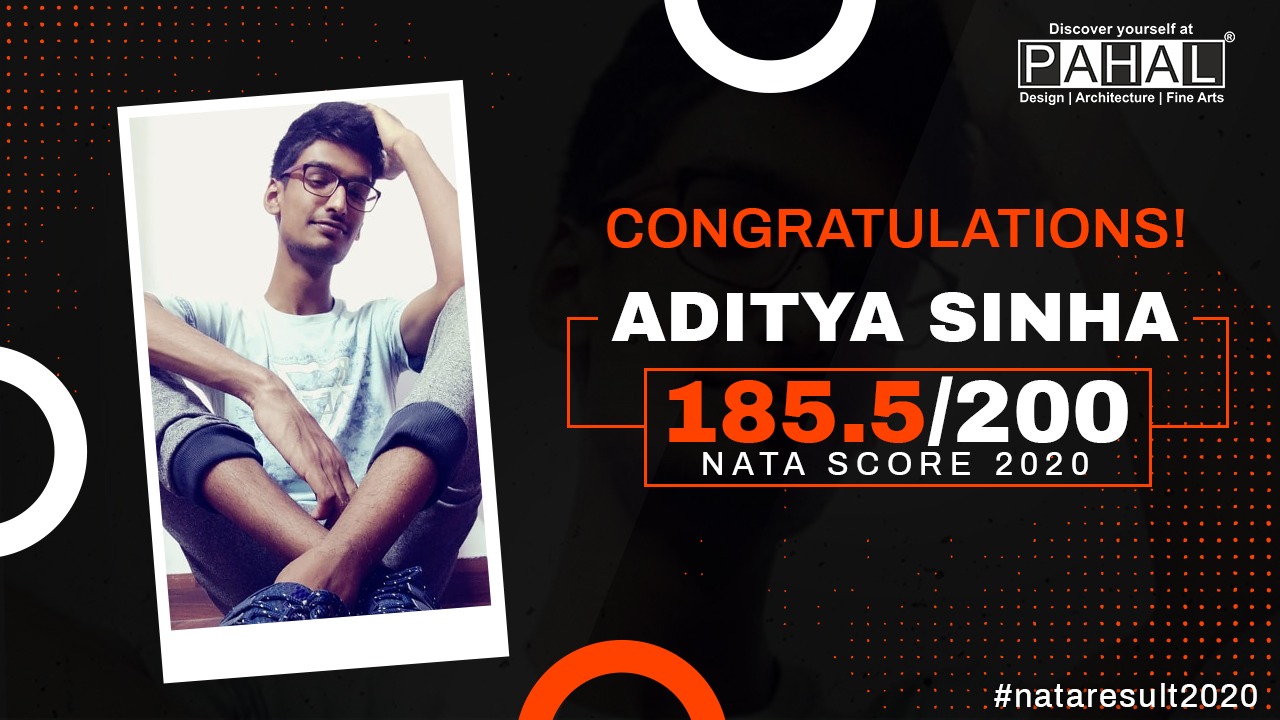
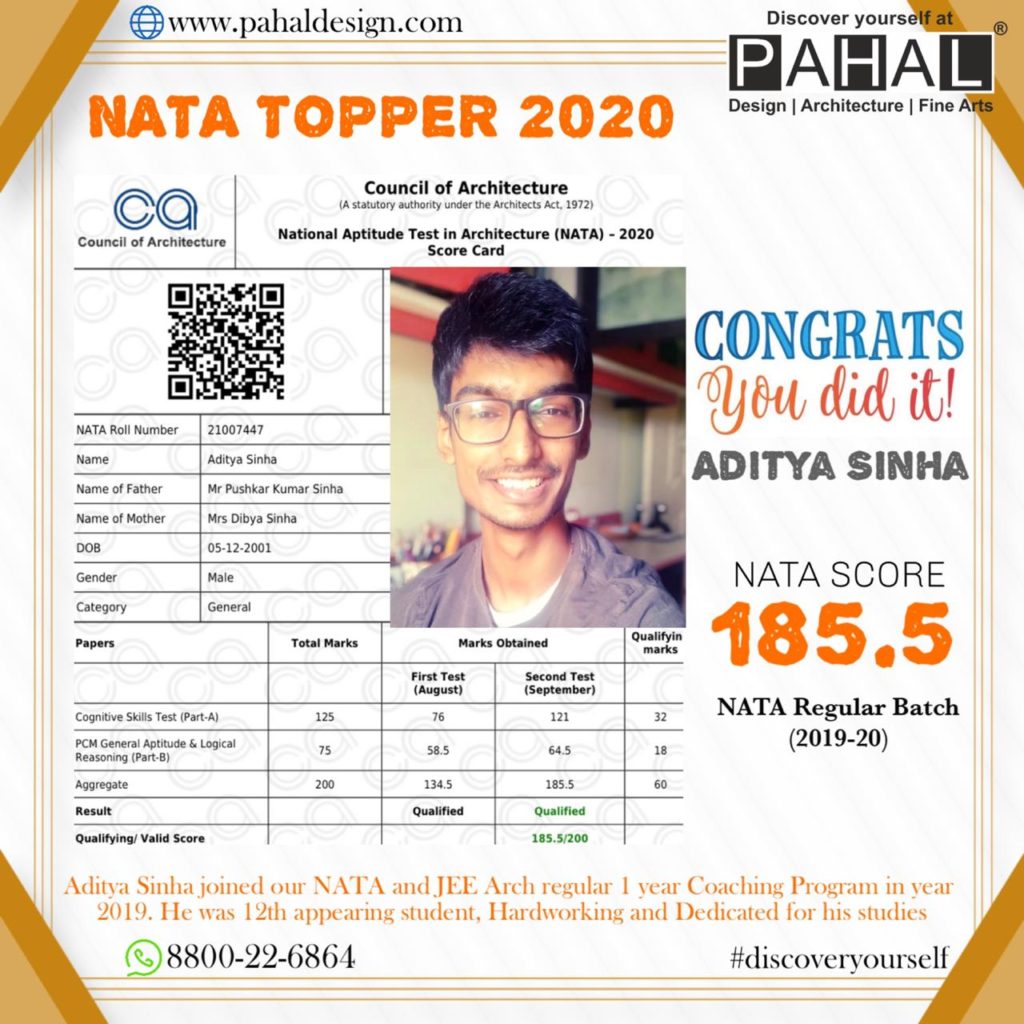
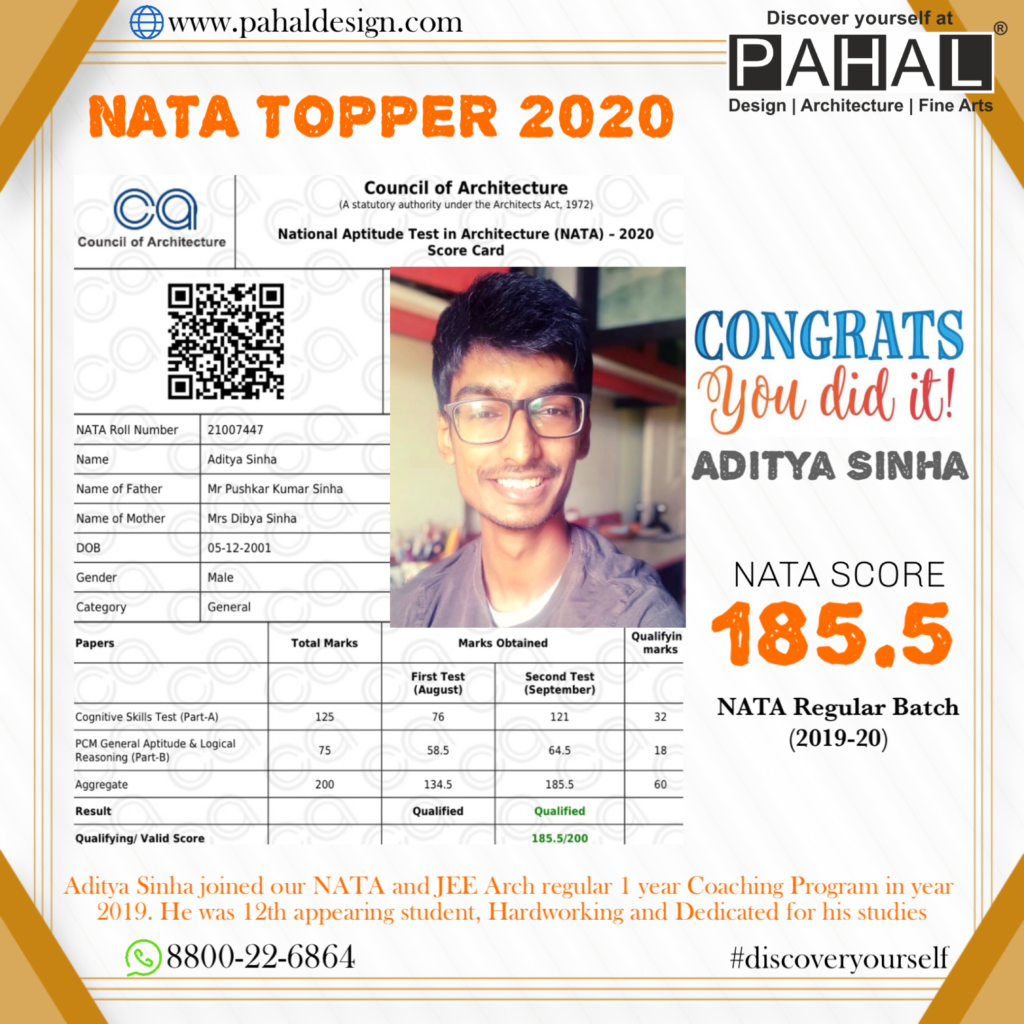 Aditya Sinha, the all India topper of (NATA) 2020 entrance test, believed in the simple philosophy of ‘Be inspired; nothing is impossible’ to achieve this feat. Depending on rigorous efforts, the NATA topper from Delhi shares that he focused on enhancing his analytical skills and practised sketching as much as possible and worked on Architecture Aptitude.
 National Aptitude Test in Architecture (NATA) is being conducted by COA since 2006, in terms of the provisions of CoA (Minimum Standards of Architectural Education) Regulations, 1983, published in the Gazette of India. It is implied that a separate aptitude test in Architecture should be conducted and such test should not be combined with the tests for admissions to Engineering, Pharmacy, Medicine and other disciplines. Being the competent authority for fixing the norms and standards for architectural institutions, COA has the necessary expertise to hold a Common Aptitude Test in Architecture, at national level to provide a single window system for appearing in aptitude test and to facilitate institutions, students and public at large for admission to First year of 5 year B.Arch. Degree Course at all recognized Institutions all over country. The purpose of conducting NATA is to provide a single scheme of examination for holding aptitude test and to facilitate prospective students all over the country to apply for admissions in architecture seats in institutions spread across the country and to avoid appearing in multiple aptitude tests. However, the actual admissions shall be carried out only by the concerned competent authorities of the respective states/institutions based on valid NATA score. The NATA also ensures that the eligibility criteria for admission to five-year Bachelor of Architecture (B.Arch.) degree course, as prescribed by CoA and duly approved by the Central Government, are strictly adhered to and followed all over the country in Architectural Institutions.
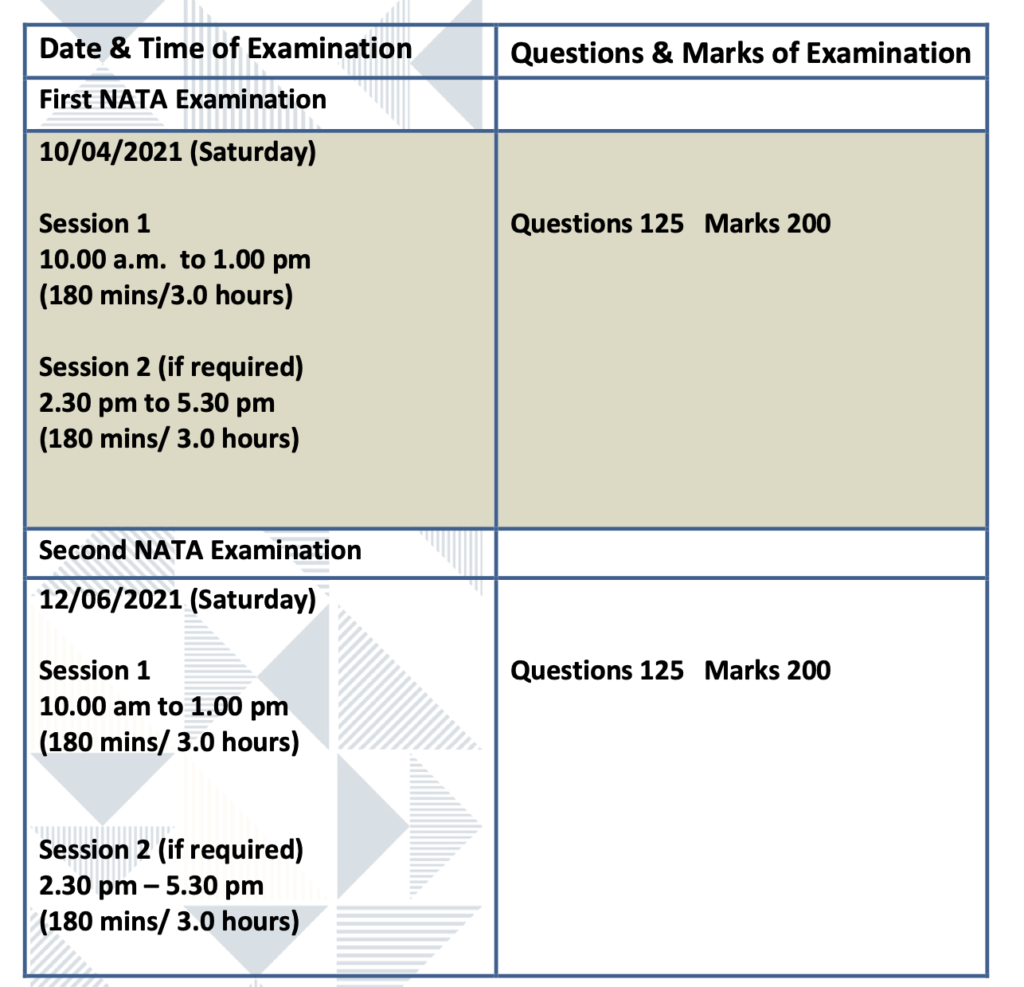
 With the objective of attracting a greater number of bright aspirants for studying Architecture and practicing the same as a profession in future, Council like every year will be conducting NATA-2020 for admission to B.Arch. in the academic session 2020-2021. NATA-2020 shall be conducted twice a year, thus giving opportunity to those students who miss out the first test due to some reason or other or wish to improve upon their NATA score in the first test by re-appearing the second test. Both the first and second test will be conducted on different dates as totally computer-based examinations all over the country.