Do Architecture Entrance need coaching guidance?
Ever since you thought about becoming an architect, you either joined a coaching class or saw your friends depending on Google to crack JEE Paper 2 or NATA. You were told by experts that coaching is the solution to making your way into an architecture career. There are several students who have left their homes and took a hostel or small rooms and their only schedule consists of coaching classes. Did you stop and wonder whether you can top or crack an architecture entrance exam without a coaching?
To answer this, you will have to be 100% honest with yourself. Let us start with a few questions.
-
Are you in class 11 or 12 or a dropper?
 A dropper, or in other words one who completed class 12 last year or before that, and is solely preparing for architecture entrance exam, is advised to join a coaching class. The main reason behind this is to improve morale strength, get quick revision, be able to understand tough sections (the ones in which you face problems) from a good teacher at coaching and to get a reality check about your preparation for architecture entrance.
If you are in class 11, then you will really have to think. A lot depends on how much efforts you are ready to put into architecture entrance exam preparations (which are among the toughest exams) from DAY 1. Joining a good coaching class which guides you in the right direction, and helps you understand the topics being taught in architecture, will straight away help. However, it is not a do or die situation straight away to join a coaching class. You can take a few days to look into the study material and see whether you need help or not and decide.
If you are in class 12, then you are already in a good position to decide. Ask yourself this question:
2. How well you know about architecture entrance examination or its exam syllabus?
 Architecture entrance exams syllabus is not only wide but somehow not being touched throughout out our daily lives. Both of the entrance exams will ask you about basic of architecture but still if you do not have that vision or particular knowledge about architecture it might be an alarming situation. It is a much-debated topic on why a student at all needs coaching for architecture entrance exam when several materials are available online or its bit easy to crack architecture entrance respective to engineering or medical entrances.
Out of 3 sections in an entrance exam, drawing and architecture aptitude is somehow most score able yet need to get trained subject, which somehow, you’ll be getting from coaching only. However, all that matters for the student is to analyse whether or not he or she needs extra help to understand any topic or subject.
-
How well did you perform in class 12?
If you did excellently (read extremely above average), then you are already in the right direction. With the help of right study material, solving of mock tests, you are good to go. You may refer to coaching classes study material for extra practice!
On the other hand, if you think that you left a big scope for improvement in your performance and in critical thinking, then maybe you should join a JEE Paper 2 preparation or a NATA preparation coaching.
4. Are you good at time management?
 It is a tough question to ask an architecture aspirant. You are young and have hardly been introduced to the concept of time management, there have been people older and in positions of immense responsibility who have shuddered at the thought of having to manage time with numerous tasks at hand. Still, this question is important.
When you join a coaching class for architecture entrance exam preparation, you commit at least 5-6 hours to it; this includes usual 3-4 hours of classes, 1 hour of travel and 1 hour to recover from travel fatigue. In the case of many, if the coaching centre is far away then a larger portion time is wasted in travel. Those who take weekend classes, spend almost the entire day there for two days a week. Like all other entrance examinations, architecture entrance too is of 3 hours but questions asked in the exams are lot lengthy and being tough to solve in the given time limit. Good Coaching will definitely help you to come out of this fear and will not prepare you for exam but will also help you to learn the techniques of time management during the pressure and stress of exam.
For any entrance exam, apart from right coaching self-studies are critical. You need to devote at least 3-4 hours every day for that. So, can you manage time for coaching, school, and self-studies? If yes, only then must you join a coaching centre.
Apart from the above points, there are several other factors too. It is up to you to decide whether or not to join a coaching class. Make sure that you follow some smart exams techniques so that you come out with flying colours.
To answer the question we started with, YES, you can top architecture entrance exam without coaching but by joining the right coaching your chances to top architecture entrance will boost definitely. If you understand the topics and have an acumen for solving problems, then you will race ahead to the top with or without coaching.
For any further details contact 8800-22-6864 / 93540-52529

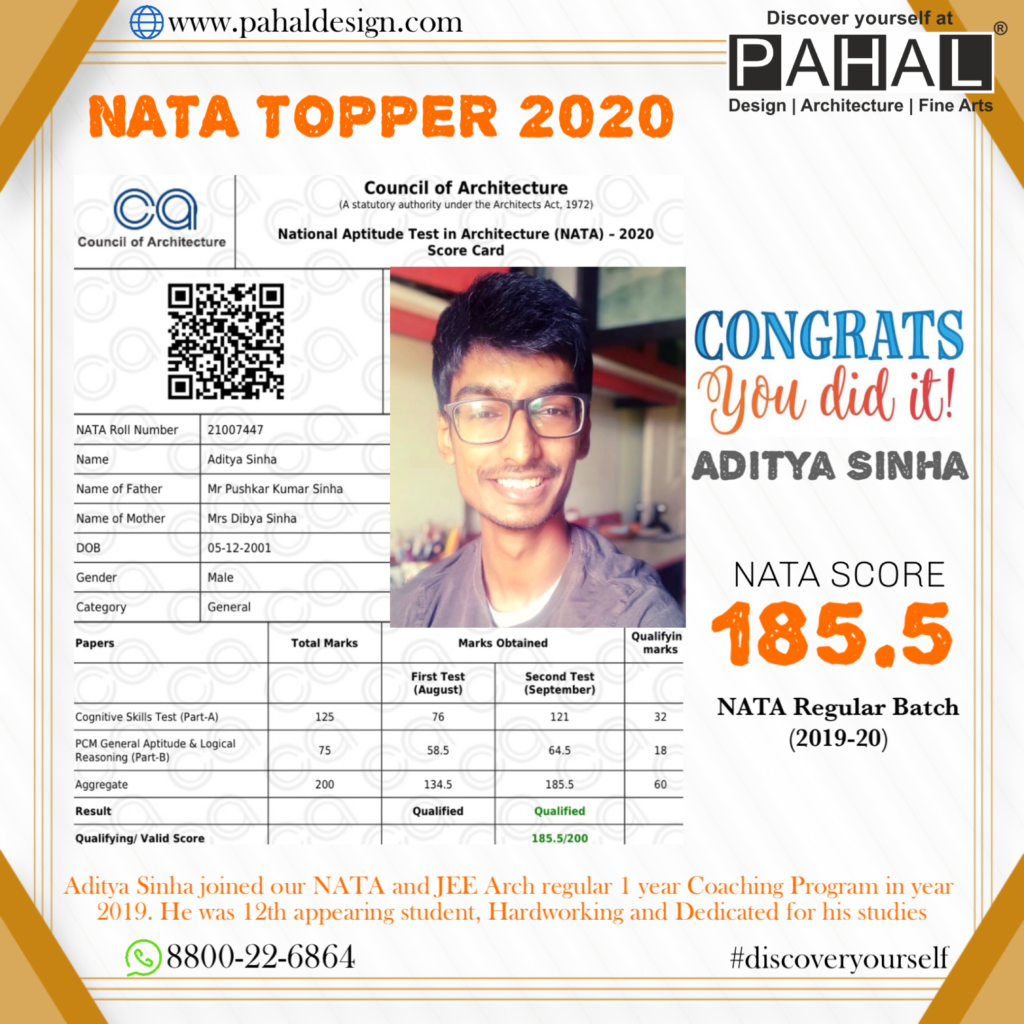 Aditya Sinha, the all India topper of (NATA) 2020 entrance test, believed in the simple philosophy of ‘Be inspired; nothing is impossible’ to achieve this feat. Depending on rigorous efforts, the NATA topper from Delhi shares that he focused on enhancing his analytical skills and practised sketching as much as possible and worked on Architecture Aptitude.
 In view of the prevalent situation in the country arising out of pandemic Corona Virus (COVID-19), the competent authority of the Council of Architecture has decided to postpone the ensuing First Test of NATA 2020 examination scheduled for August 01, 2020.
 interpretation and perception to test graphical similarities and other properties; Ability to understand spatial relationship between objects, and to visualize images and scenarios; Tests for cognitive ability: perception, attention, recognition, memory etc.”


 NATA measures the aptitude of the applicant for specific field of study, i.e. Architecture. The test makes an assessment of drawing and observation skills, sense of proportion, aesthetic sensitivity, Physics, Chemistry and Mathematics at 10+2 level and critical thinking ability that have been acquired by the candidate over the past few years and are related to the specific field of study.