Student Type: Class 12

Institute: Pahal Design

Exam Date: 21 December 2025 (Prelims)

Study Duration: 6 months (Oct 2025 – Mar 2026)

Perfect, thank you 🙌

You’re a Class 12 student with Pahal Design coaching (12 hrs/week), strong in Creative Thinking, and want to improve Time Management — and you’d like Weekly Mock Tests included.

Here’s your 6-Month Structured NID DAT (B.Des) 2026 Prelims Plan – Oct 2025 to Mar 2026

🗓️ MONTH 1: OCTOBER 2025 — FOUNDATION & CONSISTENCY

Goal: Strengthen sketching discipline + basics of design aptitude

Weekly Focus:

Week 1: Line quality, proportion, shading, basic objects (cups, bottles, furniture) Week 2: Human figures, gesture drawing, basic anatomy Week 3: Perspective (1-point, 2-point), indoor/outdoor spaces Week 4: Observation exercises — draw from life (daily 15–20 min)

Theory + Aptitude:

Daily 15–20 min GK (design, art, culture, logos, current affairs) 2 reasoning exercises (pattern, analogy, visual puzzles) each week

Mock Test: 1 every Sunday (2 hours)

→ Focus on completing all questions within time.

Creative Challenge: “Everyday Object, New Use” — redesign an object with a new function.

🗓️ MONTH 2: NOVEMBER 2025 — IDEA DEVELOPMENT & SPEED

Goal: Improve idea generation + learn to draw fast & clean

Weekly Focus:

Week 1: Storyboard sketches – create 4-frame visual stories Week 2: Product sketching – draw 10 everyday products in 30 mins Week 3: Scene composition – perspective + storytelling Week 4: Design thinking prompts (“How to reduce waste?”, “Redesign a classroom”)

Theory + Aptitude:

Logical reasoning: sequences, odd-one-out, spatial reasoning Visual GK: identify famous designs, logos, products

Mock Test: Every Sunday (3 hours full-length)

→ Target 90+% completion within time.

Creative Challenge: “Festival Reimagined” – redesign a festival logo/poster.

🗓️ MONTH 3: DECEMBER 2025 — EXAM SIMULATION PHASE

Goal: Full Prelims simulation, build confidence before exam

Weekly Focus:

2 full-length mocks per week Time practice: sketch completion in < 15 min per question Daily warm-up: 10-min object sketch + 1 creative idea prompt

Theory + Aptitude:

Quick revision: reasoning, GK (art movements, NID facts, design pioneers) Review all mock tests and note recurring mistakes

Mock Test:

Sunday = Full 3-hour DAT Prelims simulation Wednesday = Sectional speed test (Creative / Aptitude)

Creative Challenge: “Design for a Social Cause” – poster or visual concept.

🗓️ MONTH 4: JANUARY 2026 — FOUNDATION REVISIT + MAINS PREP START

Goal: Revisit weak areas + start early exposure to Studio Test-type activities

Weekly Focus:

Perspective + proportion refresh Quick idea thumbnails (draw 5 ideas for 1 topic) Basic model-making concepts (paper, clay, wire exercises)

Mock Test: 1 full paper weekly + 1 quick 60-min challenge midweek

Creative Challenge: “Redesign your school bag / workspace.”

🗓️ MONTH 5: FEBRUARY 2026 — ADVANCED IDEATION + MASTERY

Goal: Expand imagination and improve clarity in presentation

Weekly Focus:

Week 1: Product + environment combos Week 2: Comic strip storytelling Week 3: Unusual combinations (e.g., “Tree + Phone” design challenge) Week 4: Personal portfolio sketches

Theory + Aptitude:

Solve 1 reasoning set daily Design awareness flashcards (NID, NIFT, Indian crafts, famous logos)

Mock Test: 2 per week (alternate days)

Creative Challenge: “Nature + Technology” concept illustration.

🗓️ MONTH 6: MARCH 2026 — FINE-TUNING & MAINS BRIDGE

Goal: Maintain speed, polish creativity, and transition to Mains prep

Weekly Focus:

Time trials: finish full papers in 2.5 hours Focused improvement on weak areas from mock analysis Brainstorming drills (idea web, mind mapping)

Mock Test: Every Sunday (with peer or mentor review)

Creative Challenge: “Future Living” – visualize city life in 2050.

For any details call 8800-22-6864

On the 2nd of January 2022, NID (National Institute of Design)Exam 2022 successfully conducted NID DAT Prelims in pen and paper mode across 23 test cities in the country. National institute of Design conducts its entrance exam in two phases; DAT Prelims & DAT Mains. NID DAT Prelims is the first examination of the two phase entrance process.

Students from across the country aspiring to study and build a career in the field of design appear for NID DAT exam every year. Candidates who qualify NID DAT secure admission in Bachelor of Design (B.Des), Graduate Diploma Program in Design (GDPD) & Master of Design (M.Des) courses offered by National Institute of Design.

Approximately 15000 students appeared for NID DAT Prelims 2022 across the country. Even though the candidate count of 2022 is 25-30% less than the number of candidates who appeared in NID DAT Prelims 2021, the dedication and enthusiasm of the students was clearly visible across all test centres in the country.

NID DAT Prelims for B.Des is a 3 hour examination of 100 marks comprising multiple choice questions (G.K, Logical Reasoning, and English) and creative section whereas NID DAT Prelims for M.Des is a 2 hr 30 minutes examination with a 30 minute common design aptitude section and a 2 hour discipline specific creative section. If the candidate has chosen 2 disciplines, then the exam duration is increased to 4 hours 30 mins.

Question 1a simple picture of tap was given and we had to design it for 3 different types of people in 3 different boxes, one for each.
a) a six year old 
b) an artist
c) impaired eye person
 
Question 2- story boarding 
A fisherman is sitting near the shore/sea and a kingfisher bird is there too. They both are having an intense conversation and it ends with 
Kingfisher- ” at last, you’re a human being”*
Make the story and give it a title, write the story in the given box and illustrate the story in the 3 boxes given.
 
Question 3 – all the parts of a cycle were given (even the vvvvv little ones, way too many parts were there in different angles).
Draw a proper cycle using all the parts.
 
Question 4 – perspective question
A room was given with alot of details and a person was looking at his friend peeping from the window. We had to draw what the friend of the person would see. The whole composition was given in one point perspective.

There are 5 major faculty/streams at NID for students to choose from –

  1. Faculty of Communication Design
    (Animation Design, Film & Video communication, Graphic Design, Photography Design)
  2. Faculty of Industrial Design
    (Ceramic & Glass Design, Furniture & Interior Design, Product Design, Toy & Game Design, Transportation & Automobile Design, Universal Design)
  3. Faculty of Inter-Disciplinary Design Studies
    (Design for retail experience, Strategic Design Management)
  4. Faculty of Information technology Integrated programmes
    (Digital Game Design, Information Design, Interaction Design, New Media Design)
  5. Faculty of Textile, Apparel, Lifestyle and Accessory Design
    (Apparel Design, Lifestyle accessory Design & Textile Design)

Students who appeared for DAT Prelims 2022, found the difficulty level of the examination to be moderate. The B.Des question paper had 27 multiple choice questions from static G.K, English and non verbal reasoning of 40 marks. The creative section carried 60 marks covering 4 questions of frames, observation and assembly, story boarding and perspective.

When interviewed by our counselors at Pahal Design, many students were ecstatic after attempting the examination and were extremely thankful to the faculties for their guidance. Maximum students found time management an essential component to deliver their best during the examination and were very grateful for the consecutive mock tests which helped them take a feel of the examination beforehand.

NID DAT is a tough examination; hence students need constant practice and guidance from faculties at every step of their preparation. The students who will qualify NID DAT Prelims will proceed for NID DAT Mains.

NID DAT Mains for B.Des/GDPD/M.Des is the studio test of 100 marks. It includes doodling concept, 3D Modeling, Clay Modeling, Wire moulding, Psychometric test, Audio Visual test, Interview and portfolio round. The final score of the candidate is calculated on the basis of both their DAT Prelims (30% weightage) and DAT mains score (70% weightage).

Bachelor of Design (B.Des) is offered at NID Ahmedabad (Gujarat), NID Vijayawada (Andhra Pradesh), NID Kurukshetra (Haryana), NID Bhopal (Madhya Pradesh) & NID Jorhat (Assam) with a total intake of 425 seats.

Masters of Design (M.Des) is offered at NID Bangalore (Karnataka), NID Ahmedabad & NID Gandhinagar (Gujarat) with a total intake of 347 seats.

Online Counselling Request

Graphic designers create visual concepts, using computer software or by hand, to communicate ideas that inspire, inform, and captivate consumers. They develop the overall layout and production design for applications such as advertisements, brochures, magazines, and reports.

Duties

Graphic designers typically do the following:

  • Meet with clients or the art director to determine the scope of a project
  • Use digital illustration, photo editing software, and layout software to create designs
  • Create visual elements such as logos, original images, and illustrations to help deliver a message
  • Design layouts, including selection of colors, images, and typefaces
  • Present design concepts to clients or art directors
  • Incorporate changes recommended by clients or art directors into final designs
  • Review designs for errors before printing or publishing them

Graphic designers, also referred to as graphic artists or communication designers, combine art and technology to communicate ideas through images and the layout of websites and printed pages. They may use a variety of design elements to achieve artistic or decorative effects.

Graphic designers work with both text and images. They often select the type, font, size, color, and line length of headlines, headings, and text. Graphic designers also decide how images and text will go together in print or on a webpage, including how much space each will have. When using text in layouts, graphic designers collaborate with writers, who choose the words and decide whether the words will be put into paragraphs, lists, or tables. Through the use of images, text, and color, graphic designers may transform data into visual graphics and diagrams to make complex ideas more accessible.

Graphic design is important to market and sell products, and it is a critical component of brochures and logos. Therefore, graphic designers often work closely with people in advertising and promotions, public relations, and marketing.

Frequently, designers specialize in a particular category or type of client. For example, some designers create the graphics used on product packaging, and others may work on the visual designs used on book jackets.

Graphic designers need to keep up to date with software and computer technologies in order to remain competitive.

Some individuals with a background in graphic design become postsecondary teachers and teach in design schools, colleges, and universities.

Some graphic designers specialize in experiential graphic design. These designers work with architects, industrial designers, landscape architects, and interior designers to create interactive design environments, such as museum exhibitions, public arts exhibits, and retail spaces.

Education for Graphic Designers
A bachelor’s degree in graphic design or a related field is usually required. However, individuals with a bachelor’s degree in another field may pursue technical training in graphic design to meet most hiring qualifications.

The National Association of Schools of Art and Design accredits about 350 postsecondary colleges, universities, and independent institutes with programs in art and design. Most programs include courses in studio art, principles of design, computerized design, commercial graphics production, printing techniques, and website design. In addition, students should consider courses in writing, marketing, and business, all of which are useful in helping designers work effectively on project teams.

High school students interested in graphic design should take basic art and design courses in high school, if the courses are available. Many bachelor’s degree programs require students to complete a year of basic art and design courses before being admitted to a formal degree program. Some schools require applicants to submit sketches and other examples of their artistic ability.

Many programs provide students with the opportunity to build a professional portfolio of their designs. For many artists, including graphic designers, developing a portfolio—a collection of completed works that demonstrates their styles and abilities—is essential because employers rely heavily on a designer’s portfolio in deciding whether to hire the individual.

Graphic designers must keep up with new and updated computer graphics and design software, either on their own or through formal software training programs. Professional associations that specialize in graphic design, such as AIGA, offer courses intended to keep the skills of their members up to date.

Other Experience for Graphic Designers
Graphic designers often gain their initial experience through internships. Internships provide aspiring graphic designers an opportunity to work with designers and to experience the design process from concept to completion, in some cases while completing a design program.

Licenses, Certifications, and Registrations for Graphic Designers
Certification programs are generally available through software product vendors. Certification in graphic design software can demonstrate a level of competence and may provide a jobseeker with a competitive advantage.

Advancement for Graphic Designers
Experienced graphic designers may advance to chief designer, art director, or other supervisory positions.

Important Qualities for Graphic Designers
Analytical skills. Graphic designers must be able to look at their work from the point of view of their consumers and examine how the designs they develop will be perceived by consumers to ensure they convey the client’s desired message.

Artistic ability. Graphic designers must be able to create designs that are artistically interesting and appealing to clients and consumers. They produce rough illustrations of design ideas, either by hand sketching or by using computer programs.

Communication skills. Graphic designers must communicate with clients, customers, and other designers to ensure that their designs accurately reflect the desired message and effectively express information.

Computer skills. Most graphic designers use specialized graphic design software to prepare their designs.

Creativity. Graphic designers must be able to think of new approaches to communicating ideas to consumers. They develop unique designs that convey a certain message on behalf of their clients.

Time-management skills. Graphic designers often work on multiple projects at the same time, each with a different deadline.

Art Directors

Art directors are responsible for the visual style and images in magazines, newspapers, product packaging, and movie and television productions. They create the overall design of a project and direct others who develop artwork and layouts.

Craft and Fine Artists

Craft and fine artists use a variety of materials and techniques to create art for sale and exhibition. Craft artists create handmade objects, such as pottery, glassware, textiles, and other objects that are designed to be functional. Fine artists, including painters, sculptors, and illustrators, create original works of art for their aesthetic value, rather than for a functional one.

Desktop Publishers

Desktop publishers use computer software to design page layouts for newspapers, books, brochures, and other items that are printed or published online.

Drafters

Drafters use software to convert the designs of engineers and architects into technical drawings. Most workers specialize in architectural, civil, electrical, or mechanical drafting and use technical drawings to help design everything from microchips to skyscrapers.

Industrial Designers

Industrial designers develop the concepts for manufactured products, such as cars, home appliances, and toys. They combine art, business, and engineering to make products that people use every day. Industrial designers consider the function, aesthetics, production costs, and usability of products when developing new product concepts.

Multimedia Artists and Animators

Multimedia artists and animators create animation and visual effects for television, movies, video games, and other forms of media.

Technical Writers

Technical writers, also called technical communicators, prepare instruction manuals, how-to guides, journal articles, and other supporting documents to communicate complex and technical information more easily. They also develop, gather, and disseminate technical information through an organization’s communications channels.

Web Developers

Web developers design and create websites. They are responsible for the look of the site. They are also responsible for the site’s technical aspects, such as its performance and capacity, which are measures of a website’s speed and how much traffic the site can handle. In addition, web developers may create content for the site.

1. Draw a scenery showing you attending online class while showing your sibling is distracting you with reference to the figure ( it was a door slightly opening ) – 15 Marks
2. We had to make a comic strip of knots and crosses being characters from the game tic tax toe in 6 stages with dialogues – 6 Marks
3. there was a picture of a black sphere in the desert with clouds and we had to make a short story of it in 3 stages without adding any elements or changing the setting. 9 Marks
4. Anti bullying poster making . 15 Marks
5. Instruction manual on how to make a cup of tea. 15 Marks

NMD-
1). Choose 3 options from list of old media to new media and depict transition through visual narration the transition.
I choose, Book->Ebooks, Music-> Spotify, journalism->blogs

2). Design a robot for bank to help consumers with token generation, queries etc in 3 frame.

3). Draw a dynamic logo for a mobile phone Company.

4). Design a transmedia campaign for Consumer Rights Awareness

FVC-
1). Write a dialogue b/w you and your fren formulating your argument on Three Farm laws
2). Depict a scene visually through words of a student stuck in traffic at junction while getting late for exam
3). Write a story on a person stuck in house alone in lockdown, and how insecurities/fears are rising

Product design-

1st question design a product for storage of vaccines to have temperature of 2-5°.

2nd draw a poster for vaccination
3rd draw a composition of you taking a selfie with your smart phone ,
4th Show a story board of conversation between charger and phone.
5th design an AU electronic product to help and assist old people
There was one more question which I can’t recall right now..

Interaction Design –

1) Draw a headphone showing volume change and song change feature,.

2) poster design on healthy lifestyle during pandemic

3) content of above to be shown in SMS, Public space etc

4) draw a headphone in the same design language as that of a Radio shown in figure

5) Design a lamp for millennials and receive it’s features


Introduction

India’s textiles sector is one of the oldest industries in the Indian economy, dating back to several centuries.

The industry is extremely varied, with hand-spun and hand-woven textiles sectors at one end of the spectrum, while the capital-intensive sophisticated mills sector on the other end. The decentralised power looms/ hosiery and knitting sector forms the largest component in the textiles sector. The close linkage of textiles industry to agriculture (for raw materials such as cotton) and the ancient culture and traditions of the country in terms of textiles makes it unique in comparison to other industries in the country. India’s textiles industry has a capacity to produce wide variety of products suitable for different market segments, both within India and across the world.

Textile design comprises both surface design and structural design and textile designers usually handle embroidery designs, print, weave and texture.
The courses focus on elementary ergonomics, textile fibers, color, composition, and basic textile design for weaving and printing. They also teach dyeing techniques, printing methods, sewing techniques, and construction of fabrics and surface design. These programs helps one understand all the intricacies of production, in order to find innovative solutions.
Textile designers work in garment manufacturing companies, fashion designing agencies, textile manufacturers, retail world, export houses or work as freelancers.

The textile and apparel industry is one of the earliest industries to have developed in India. Its inherent and unique strength is its incomparable employment potential owing to the presence of the entire value chain from fibre to apparel manufacturing within the country. It is the biggest employer after agriculture and provides direct employment to 4.5 crore people and another 6 crores in allied sectors. India needs to generate jobs that pay well, provide social protection to workers, support efficient production for export markets, and hold the potential for social transformation. The textile industry meets all these criteria.

India is the second-largest manufacturer of textiles and clothing in the world. India is also the second-largest exporter of textiles and apparel with a share of 5% of global trade. Exports of textile and clothing products, including handicrafts, from India have slightly increased to US$ 40.4 billion during the year 2018–19 from US$ 39.2 billion during 2017–18, registering a growth of 3%. However, India’s global share is way behind that of China, which has approximately 38% of the global textile and clothing trade. The share of textile and clothing in India’s total exports stood at 12% in 2018–19. With 48% total textile and apparel export, EU-28 and the United States are India’s major textile and apparel export destinations.

India has a very strong raw material base both in natural and manmade fibres (MMFs). India has emerged as the largest producer of cotton in the world with a production of 370 lakh bales in 2017–18 and the second-largest exporter of cotton. However, high contamination level and poor quality of fibre, both in fineness and length, are major concerns that need focused attention.

India has a strong presence in global exports of cotton yarn. Vietnam has increased its global export share of cotton yarn from 5% in 2012 to 15% in 2016. China and Bangladesh are the largest importers of cotton yarn from India, who in turn creates value addition to the yarn and then exports the same at a lower cost compared to India. India needs to upgrade its position from a supplier of cotton yarn to a producer of value-added fabrics and garments. As the world export value of cotton yarn has decreased over the years, it is an indication that the cotton textile trade is shifting towards different types of fibre such as MMF.

While India leads in cotton yarn exports, it has been a very marginal player when it comes to cotton fabric in world exports. China has a substantial share of 51% in cotton fabrics when compared to India’s 5%–6%; the situation is almost the same in case of MMF fabrics. This comparison suggests that India is not able to scale up the value chain significantly enough to meet the global demand despite being the largest producer and exporter of cotton yarn.
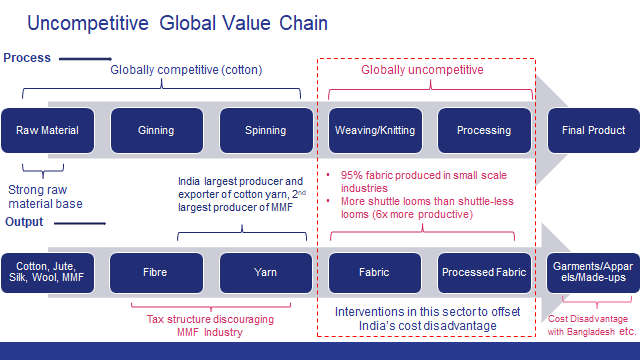
Approximately 95% of the weaving sector in India is unorganized in nature. The decentralized power loom and hosiery sector contributes 85% of total fabric production. The processing segment is also dominated by a large number of independent, small-scale enterprises. Since, the weaving/processing sector in India is dominated by small-scale enterprises, it has challenges such as inadequate know-how, low focus on research, innovation in new product development and low technology upgradation. Further, low productivity and automation levels also remain one of the biggest woes for the weaving industry. Due to these factors, the overall performance of fabric production in India is getting dampened. The weaving sector still remains one of the weakest links of the Indian textile and apparel industry.

India has one of the largest installed production bases in the world in weaving sector but at the same time it uses old technology with low productivity and quality levels. In terms of technology adoption in the weaving sector, India has only 2% share in global shuttle-less looms (i.e. modern looms) installed capacity. The cost of production in India also goes up due to poor technology levels and low scale of operations, as 95% of the weaving sector in India is unorganized and in small scale. India also lacks the presence of large fabric manufacturers when compared to China and the US.

In order to make the textile industry competitive, industry needs to focus on investing in technology upgradation and expand weaving capacity to scale-up operations. To ensure rapid transformation of the weaving sector in India, under Amended Technology Upgradation Funds Scheme (ATUFS) of the Government of India, the weaving sector may be considered to get capital subsidy at par with garmenting and technical textiles. At present, the weaving sector is getting subsidy at 10% subject to cap of 20 crore under ATUFS, whereas for garmenting and technical textiles, subsidy is provided at 15% subject to cap of 30 crore. For creating few global champions in weaving sector in India, the Government of India may consider providing some enhanced subsidy under ATUFS, for select players, purely on outcome basis. Further, state governments should aggressively promote infrastructure and provide plug and play parks for the industry. Lands should be allotted in such parks for long-term lease. The supply of uninterrupted quality power at fixed price for a tenure of 15 years may also be considered in these parks. To ensure rapid scaling up of business, state governments should provide all the approvals in place, including the provision of CETPs/ZLD, as per need basis, in these parks.

The weaving sector is the backbone of the textile industry. On the one hand, promoting the weaving industry gives impetus to the domestic spinning industry and on the other, it makes our garment’ sector globally more competitive. With focused interventions in this sector, we might enhance its performance in terms of more investment, employment generation and export earnings.

Market Size

India’s textiles industry contributed 13% of the industry production in FY20. It contributed 2.3% to the GDP of India and employed more than 45 million people in FY20. The sector contributed 12% to India’s export earnings in FY20.

Textiles industry has around 4.5 crore employed workers including 35.22 lakh handloom workers across the country.

Cotton production in India is estimated to have reached 35.7 million bales in FY20.

The domestic textiles and apparel market stood at an estimated US$ 100 billion in FY19.

The production of raw cotton in India is estimated to have reached 36.04 million bales in FY20^. During FY19, production of fibre in India stood at 1.44 million tonnes (MT) and reached 1.60 MT in FY20 (till January 2020), while that for yarn, the production stood at 4,762 million kgs during same period.

Investment

The textiles sector has witnessed a spurt in investment during the last five years. The industry (including dyed and printed) attracted Foreign Direct Investment (FDI) worth US$ 3.45 billion from April 2000 to June 2020.

Government Initiatives

Indian government has come up with several export promotion policies for the textiles sector. It has also allowed 100% FDI in the sector under the automatic route.

Initiatives taken by Government of India are:

  • Government launched production linked incentive scheme to provide incentives for manufacture and export of specific textile products made of man-made fibre.
  • On September 2, 2020, the Union Cabinet approved signing an MOU between textile committee, India and M/s Nissenken Quality Evaluation Centre, Japan, for improving quality and testing Indian textiles and clothing for the Japanese market. This India-Japan pact on cooperation in textiles will facilitate Indian exporters to meet the requirements of Japanese importers as per the latter’s technical regulations.
  • Under Union Budget 2020-21, a National Technical Textiles Mission is proposed for a period from 2020-21 to 2023-24 at an estimated outlay of Rs. 1,480 crore (US$ 211.76 million).
  • In 2020, New Textiles Policy 2020 is expected to be released by the Ministry of Textiles.
  • CCEA approved mandatory packaging of foodgrains and sugar in jute material for the Jute Year 2019-20.
  • In September 2019, textiles export witnessed a 6.2% increase post GST as compared to the period pre-GST.
  • The Directorate General of Foreign Trade (DGFT) has revised rates for incentives under the Merchandise Exports from India Scheme (MEIS) for two subsectors of Textiles Industry – readymade garments and made-ups – from 2% to 4%.
  • The Government announced a special package of US$ 31 billion to boost export, create one crore job opportunity and attract investment worth Rs. 80,000 crore (US$ 11.93 billion) during 2018-2020. As of August 2018, it generated additional investments worth Rs. 25,345 crore (US$ 3.78 billion) and exports worth Rs. 57.28 billion (US$ 854.42 million).
  • The Government of India has taken several measures including Amended Technology Up-gradation Fund Scheme (A-TUFS), estimated to create employment for 35 lakh people and enable investment worth Rs. 95,000 crore (US$ 14.17 billion) by 2022.
  • Integrated Wool Development Programme (IWDP) was approved by Government of India to provide support to the wool sector, starting from wool rearer to end consumer, with an aim to enhance quality and increase production during 2017-18 and 2019-20.
  • The Cabinet Committee on Economic Affairs (CCEA), Government of India approved a new skill development scheme named ‘Scheme for Capacity Building in Textile Sector (SCBTS)’ with an outlay of Rs. 1,300 crore (US$ 202.9 million) from 2017-18 to 2019-20. As of August 2019, 16 states signed pacts with the Ministry of Textiles to partner with it for skilling about four lakh workers under the scheme.

Achievements

Following are the achievements of the Government in the past four years:

  • As of 2019, 348 technical textiles products were developed according to Bureau of Indian Standards (BIS).
  • I-ATUFS, a web-based claims monitoring and tracking mechanism was launched on April 21, 2016. 381 new block level clusters were sanctioned.
  • Under the Scheme for Integrated Textile Parks (SITP), 59 textile parks were sanctioned, out of which, 22 have been completed.
  • Employment increased to 45 million in FY19 from 8.03 in FY15.

Road Ahead

The future for the Indian textiles industry looks promising, buoyed by strong domestic consumption as well as export demand. With consumerism and disposable income on the rise, the retail sector has experienced a rapid growth in the past decade with the entry of several international players like Marks & Spencer, Guess and Next into the Indian market.

High economic growth has resulted in higher disposable income. This has led to rise in demand for products creating a huge domestic market.


Jaipur

Address:- 2nd Floor, F 18, Gautam Marg, Vaishali Nagar, Jaipur, Rajasthan -302021
Contact Person: Mr. Aman and Mr. Akbar
Contact No: 97721-99911, 0141-6656509
Email: jaipur@pahaldesign.com

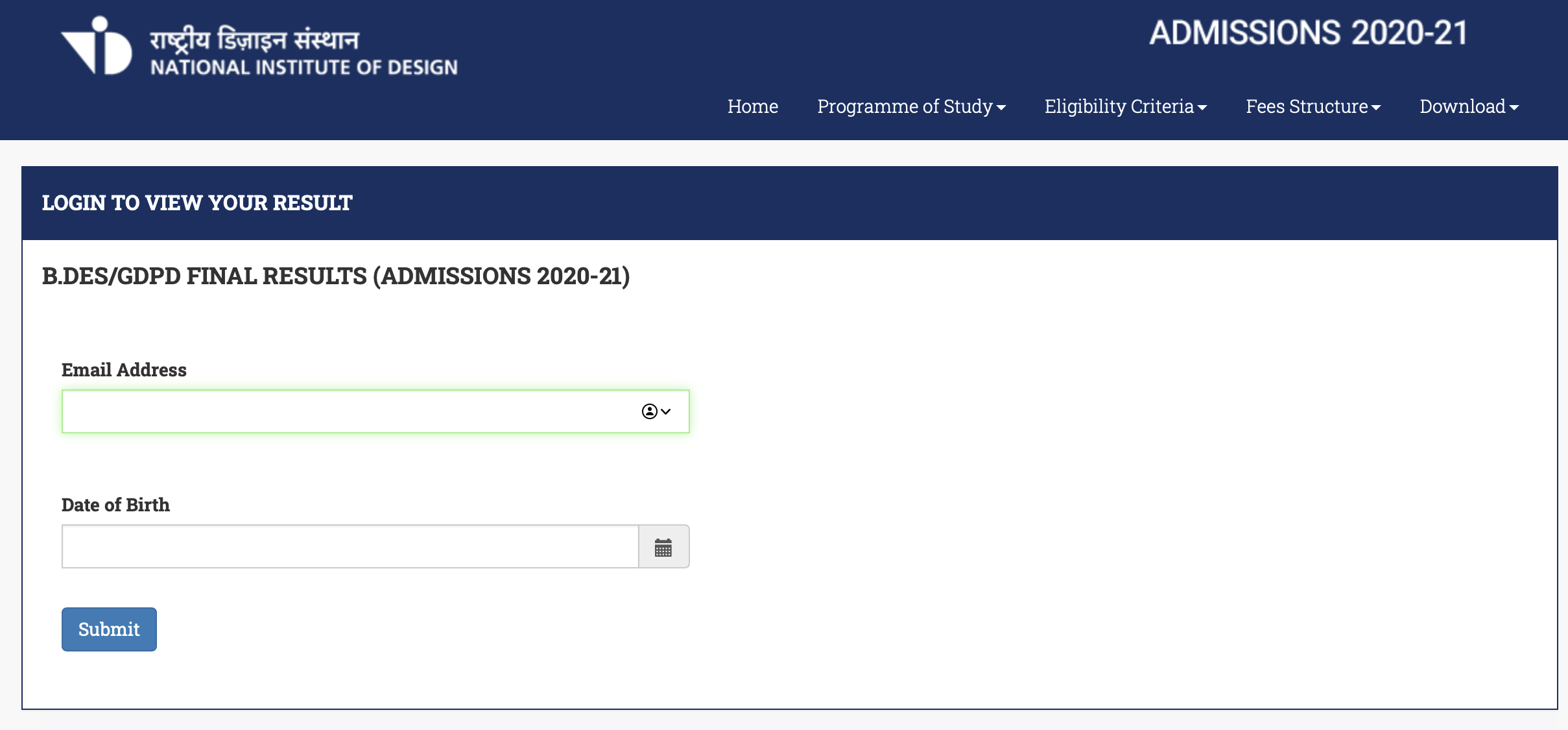
NID has made changes in the tie-break policy for BDes/ GDPD admissions 2020. NID Final result for BDes/ GDPD course admissions was declared on July 23, 2020. Candidates had to check their NID entrance exam Final result for on the official website of the exam (http://admissions.nid.edu). To check NID result 2020, candidates had to fill details like their registered email address and date of birth on the official website of NID entrance exam.  

NID result for BDes admission was expected on April 20 but the exam authorities postponed it due to COVID-19 outbreak. The NID admission cell has also changed the shortlisting criteria for NID BDes/ GDPD admissions 2020. Further, due to the current scenario, NID DAT Mains will be conducted as an online interaction.

National Institute of Design (NID) admission process requires aspirants to clear two rounds – NID DAT (Prelims) and NID DAT (Mains). Initially NID had declared 30% for DAT prelims and 70% for mains but due to covid 19 everything changed and they changed DAT Prelims 70% and DAT mains 30%. In DAT mains students had only Interview and Portfolio submission and everything was Online. Many of the Pahal Design students selected for NID. For any further details and updates. The students have to do submission of Institute Preference 23rd Just to 29th July 2020 and announcement of seat allotment, payment of Non refundable token fee and uploading of all documents in pdf format between 4th August to 11 August 2020.

The Candidates who have been provisionally shortlisted for admissions to the B.Des / GDPD programmes will have to confirm the seats by paying a non refundable token fee of:

A. INR 30,000/- Online Payment + Convenience charges as applicable for all the categories students

B. INR 75,000/ – Online Payment + Convenience charges as applicable for all the overseas students

After completion of the payment process, the candidates will be required to upload their documents related to educational qualifications, identity proof, Birth certificate, etc as a SINGLE PDF FILE of size not more than 10MB. The provisional admission of these candidates who fail to upload their documents within the deadline even after making the payment of the token fees, will be cancelled and their seat will be allotted to the next candidate in the order of merit.

List of scanned copies of the original documents uploaded by the candidates :

  1. 10th Mark sheet
  2. 12th mark sheet
  3. Birth Certificate / Proof of Birth / School Leaving certificate
  4. Category Certificates

Candidates whose class 12 results are awaited will have to upload the bonafide certificate (format available on the admission website) issued by the principal of the school last attended.

Note: In addition to the above documents , candidates in the overseas category will also have to upload the scanned copies of the following:

  1. 1st Page of passport
  2. Last Page of Passport
  3. Class XII

NID Main 2020 Date Updates:

Further to amendment as on 4 June 2020 regarding DAT mains and weightage of DAT prelims & DAT mains for final result and the link for uploading the document will be sent to student registered email id by next week.

In the wake of COVID 19 pandemic and uncertainties arising thereof, candidates will not be called to NID’s campuses for NID DAT Mains.

Consequently, the revised weightage for DAT prelims and DAT Mains is as follows:

DAT Prelims – 70% and DAT Mains – 30%

Details for uploading the creative work samples and statement of purpose and downloading of Admit Card will be intimated to the candidates on their registered email IDs, prior to the DAT Mains.

Meanwhile, Students may deliberate and prepare for the Thematic Reflective Presentations on Either one of the following Topics:

  1. An interesting story of Failure in your life and learning from it.
  2. A memorable journey you have had and why was it memorable.

The Thematic Reflective Presentation should be uploaded (when the link opens) as a single file in PDF Format, size not exceeding 10MB. The Presentation can either be done manually and scanned/Photographed or done digitally on ONE A3 size sheet.

Student would also have to prepare a digital copy of their sample of works to be uploaded (when the link opens) as a single file in PDF Format, size not exceeding 10MB.

Online NID DAT Mains exam will have mainly three parts:

  1. Online Portfolio
  2. Statement of Purpose
  3. Interview

From Pahal Design 140 Students selected for DAT Mains and Pahal Design have announced NID DAT Online Live Interactive Crash Course Batch, Which will guide students as per new exam pattern and weightage of exam.


Schedule a free counselling session WhatsApp WhatsApp Enquiry