Student Type: Class 12

Institute: Pahal Design

Exam Date: 21 December 2025 (Prelims)

Study Duration: 6 months (Oct 2025 – Mar 2026)

Perfect, thank you 🙌

You’re a Class 12 student with Pahal Design coaching (12 hrs/week), strong in Creative Thinking, and want to improve Time Management — and you’d like Weekly Mock Tests included.

Here’s your 6-Month Structured NID DAT (B.Des) 2026 Prelims Plan – Oct 2025 to Mar 2026

🗓️ MONTH 1: OCTOBER 2025 — FOUNDATION & CONSISTENCY

Goal: Strengthen sketching discipline + basics of design aptitude

Weekly Focus:

Week 1: Line quality, proportion, shading, basic objects (cups, bottles, furniture) Week 2: Human figures, gesture drawing, basic anatomy Week 3: Perspective (1-point, 2-point), indoor/outdoor spaces Week 4: Observation exercises — draw from life (daily 15–20 min)

Theory + Aptitude:

Daily 15–20 min GK (design, art, culture, logos, current affairs) 2 reasoning exercises (pattern, analogy, visual puzzles) each week

Mock Test: 1 every Sunday (2 hours)

→ Focus on completing all questions within time.

Creative Challenge: “Everyday Object, New Use” — redesign an object with a new function.

🗓️ MONTH 2: NOVEMBER 2025 — IDEA DEVELOPMENT & SPEED

Goal: Improve idea generation + learn to draw fast & clean

Weekly Focus:

Week 1: Storyboard sketches – create 4-frame visual stories Week 2: Product sketching – draw 10 everyday products in 30 mins Week 3: Scene composition – perspective + storytelling Week 4: Design thinking prompts (“How to reduce waste?”, “Redesign a classroom”)

Theory + Aptitude:

Logical reasoning: sequences, odd-one-out, spatial reasoning Visual GK: identify famous designs, logos, products

Mock Test: Every Sunday (3 hours full-length)

→ Target 90+% completion within time.

Creative Challenge: “Festival Reimagined” – redesign a festival logo/poster.

🗓️ MONTH 3: DECEMBER 2025 — EXAM SIMULATION PHASE

Goal: Full Prelims simulation, build confidence before exam

Weekly Focus:

2 full-length mocks per week Time practice: sketch completion in < 15 min per question Daily warm-up: 10-min object sketch + 1 creative idea prompt

Theory + Aptitude:

Quick revision: reasoning, GK (art movements, NID facts, design pioneers) Review all mock tests and note recurring mistakes

Mock Test:

Sunday = Full 3-hour DAT Prelims simulation Wednesday = Sectional speed test (Creative / Aptitude)

Creative Challenge: “Design for a Social Cause” – poster or visual concept.

🗓️ MONTH 4: JANUARY 2026 — FOUNDATION REVISIT + MAINS PREP START

Goal: Revisit weak areas + start early exposure to Studio Test-type activities

Weekly Focus:

Perspective + proportion refresh Quick idea thumbnails (draw 5 ideas for 1 topic) Basic model-making concepts (paper, clay, wire exercises)

Mock Test: 1 full paper weekly + 1 quick 60-min challenge midweek

Creative Challenge: “Redesign your school bag / workspace.”

🗓️ MONTH 5: FEBRUARY 2026 — ADVANCED IDEATION + MASTERY

Goal: Expand imagination and improve clarity in presentation

Weekly Focus:

Week 1: Product + environment combos Week 2: Comic strip storytelling Week 3: Unusual combinations (e.g., “Tree + Phone” design challenge) Week 4: Personal portfolio sketches

Theory + Aptitude:

Solve 1 reasoning set daily Design awareness flashcards (NID, NIFT, Indian crafts, famous logos)

Mock Test: 2 per week (alternate days)

Creative Challenge: “Nature + Technology” concept illustration.

🗓️ MONTH 6: MARCH 2026 — FINE-TUNING & MAINS BRIDGE

Goal: Maintain speed, polish creativity, and transition to Mains prep

Weekly Focus:

Time trials: finish full papers in 2.5 hours Focused improvement on weak areas from mock analysis Brainstorming drills (idea web, mind mapping)

Mock Test: Every Sunday (with peer or mentor review)

Creative Challenge: “Future Living” – visualize city life in 2050.

For any details call 8800-22-6864

Graphic designers create visual concepts, using computer software or by hand, to communicate ideas that inspire, inform, and captivate consumers. They develop the overall layout and production design for applications such as advertisements, brochures, magazines, and reports.

Duties

Graphic designers typically do the following:

  • Meet with clients or the art director to determine the scope of a project
  • Use digital illustration, photo editing software, and layout software to create designs
  • Create visual elements such as logos, original images, and illustrations to help deliver a message
  • Design layouts, including selection of colors, images, and typefaces
  • Present design concepts to clients or art directors
  • Incorporate changes recommended by clients or art directors into final designs
  • Review designs for errors before printing or publishing them

Graphic designers, also referred to as graphic artists or communication designers, combine art and technology to communicate ideas through images and the layout of websites and printed pages. They may use a variety of design elements to achieve artistic or decorative effects.

Graphic designers work with both text and images. They often select the type, font, size, color, and line length of headlines, headings, and text. Graphic designers also decide how images and text will go together in print or on a webpage, including how much space each will have. When using text in layouts, graphic designers collaborate with writers, who choose the words and decide whether the words will be put into paragraphs, lists, or tables. Through the use of images, text, and color, graphic designers may transform data into visual graphics and diagrams to make complex ideas more accessible.

Graphic design is important to market and sell products, and it is a critical component of brochures and logos. Therefore, graphic designers often work closely with people in advertising and promotions, public relations, and marketing.

Frequently, designers specialize in a particular category or type of client. For example, some designers create the graphics used on product packaging, and others may work on the visual designs used on book jackets.

Graphic designers need to keep up to date with software and computer technologies in order to remain competitive.

Some individuals with a background in graphic design become postsecondary teachers and teach in design schools, colleges, and universities.

Some graphic designers specialize in experiential graphic design. These designers work with architects, industrial designers, landscape architects, and interior designers to create interactive design environments, such as museum exhibitions, public arts exhibits, and retail spaces.

Education for Graphic Designers
A bachelor’s degree in graphic design or a related field is usually required. However, individuals with a bachelor’s degree in another field may pursue technical training in graphic design to meet most hiring qualifications.

The National Association of Schools of Art and Design accredits about 350 postsecondary colleges, universities, and independent institutes with programs in art and design. Most programs include courses in studio art, principles of design, computerized design, commercial graphics production, printing techniques, and website design. In addition, students should consider courses in writing, marketing, and business, all of which are useful in helping designers work effectively on project teams.

High school students interested in graphic design should take basic art and design courses in high school, if the courses are available. Many bachelor’s degree programs require students to complete a year of basic art and design courses before being admitted to a formal degree program. Some schools require applicants to submit sketches and other examples of their artistic ability.

Many programs provide students with the opportunity to build a professional portfolio of their designs. For many artists, including graphic designers, developing a portfolio—a collection of completed works that demonstrates their styles and abilities—is essential because employers rely heavily on a designer’s portfolio in deciding whether to hire the individual.

Graphic designers must keep up with new and updated computer graphics and design software, either on their own or through formal software training programs. Professional associations that specialize in graphic design, such as AIGA, offer courses intended to keep the skills of their members up to date.

Other Experience for Graphic Designers
Graphic designers often gain their initial experience through internships. Internships provide aspiring graphic designers an opportunity to work with designers and to experience the design process from concept to completion, in some cases while completing a design program.

Licenses, Certifications, and Registrations for Graphic Designers
Certification programs are generally available through software product vendors. Certification in graphic design software can demonstrate a level of competence and may provide a jobseeker with a competitive advantage.

Advancement for Graphic Designers
Experienced graphic designers may advance to chief designer, art director, or other supervisory positions.

Important Qualities for Graphic Designers
Analytical skills. Graphic designers must be able to look at their work from the point of view of their consumers and examine how the designs they develop will be perceived by consumers to ensure they convey the client’s desired message.

Artistic ability. Graphic designers must be able to create designs that are artistically interesting and appealing to clients and consumers. They produce rough illustrations of design ideas, either by hand sketching or by using computer programs.

Communication skills. Graphic designers must communicate with clients, customers, and other designers to ensure that their designs accurately reflect the desired message and effectively express information.

Computer skills. Most graphic designers use specialized graphic design software to prepare their designs.

Creativity. Graphic designers must be able to think of new approaches to communicating ideas to consumers. They develop unique designs that convey a certain message on behalf of their clients.

Time-management skills. Graphic designers often work on multiple projects at the same time, each with a different deadline.

Art Directors

Art directors are responsible for the visual style and images in magazines, newspapers, product packaging, and movie and television productions. They create the overall design of a project and direct others who develop artwork and layouts.

Craft and Fine Artists

Craft and fine artists use a variety of materials and techniques to create art for sale and exhibition. Craft artists create handmade objects, such as pottery, glassware, textiles, and other objects that are designed to be functional. Fine artists, including painters, sculptors, and illustrators, create original works of art for their aesthetic value, rather than for a functional one.

Desktop Publishers

Desktop publishers use computer software to design page layouts for newspapers, books, brochures, and other items that are printed or published online.

Drafters

Drafters use software to convert the designs of engineers and architects into technical drawings. Most workers specialize in architectural, civil, electrical, or mechanical drafting and use technical drawings to help design everything from microchips to skyscrapers.

Industrial Designers

Industrial designers develop the concepts for manufactured products, such as cars, home appliances, and toys. They combine art, business, and engineering to make products that people use every day. Industrial designers consider the function, aesthetics, production costs, and usability of products when developing new product concepts.

Multimedia Artists and Animators

Multimedia artists and animators create animation and visual effects for television, movies, video games, and other forms of media.

Technical Writers

Technical writers, also called technical communicators, prepare instruction manuals, how-to guides, journal articles, and other supporting documents to communicate complex and technical information more easily. They also develop, gather, and disseminate technical information through an organization’s communications channels.

Web Developers

Web developers design and create websites. They are responsible for the look of the site. They are also responsible for the site’s technical aspects, such as its performance and capacity, which are measures of a website’s speed and how much traffic the site can handle. In addition, web developers may create content for the site.

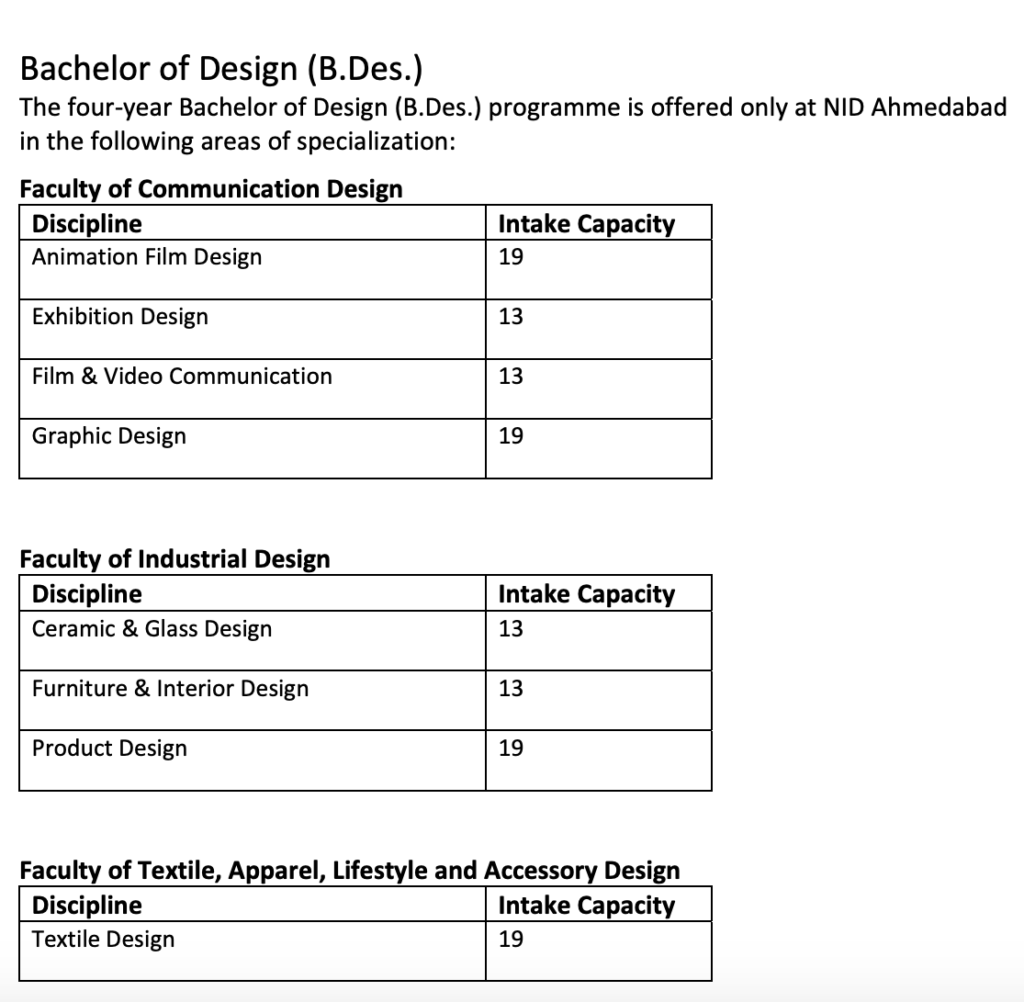
National Institute of Design (NID) at Ahmedabad and at its Bengaluru and Gandhinagar Extension campuses is an ‘Institute of National Importance’ as per the NID Act 2014 as well as an autonomous Institute under the Department for Promotion of Industry and Internal Trade (DPIIT), Ministry of Commerce & Industry, Government of India. As per the NID Act 2014, the Institute is a statutory authority empowered to award its own degrees— presently offering Bachelor of Design (B.Des.) of four-year duration, Masters of Design (M.Des.) of two-and-a-half year duration and PhD in Design. The Institute is also, a member of the Association of Indian Universities (AIU). NID Andhra Pradesh, NID Haryana, NID Madhya Pradesh & NID Assam are independent autonomous institutes under the DPIIT, Ministry of Commerce & Industry, Government of India and offer full time Graduate Diploma Programme in Design (GDPD) of four-year duration.

Admission to all the programmes at NID is on the basis of the candidates’ performance in the two-stages of Design Aptitude Test. The objective of these exams is to assess the knowledge, skills and behavioural abilities of candidates.

Stage 1: Design Aptitude Test (DAT) Prelims

Design Aptitude Test (DAT) Prelims will be conducted at various test centres across India Candidates should note that appearing for the DAT Prelims or being shortlisted for second stage of admission process does NOT guarantee automatic entitlement to admission.

Stage 2: Design Aptitude Test (DAT) Mains

Candidates shortlisted after the DAT Prelims will be invited to appear for the Stage 2 DAT Main exam at Ahmedabad or at all campuses of NID viz Ahmedabad, Bengaluru, Gandhinagar, Haryana, Andhra Pradesh, Assam and Madhya Pradesh. Exact details of the Test Centre will be mentioned in the DAT Mains Admit Card.

NID Entrance Exam 2020 Highlights

Event Details Specifications
Exam Name National Institute of Design Aptitude Test (NID DAT)
Exam Frequency Once a year
Exam Mode Offline
Exam Duration BDes/GDPD : 3 hours, MDes : 2 hours 30 minutes
Accepting Colleges 7
Official Website http://admissions.nid.edu/NIDA2020/Default.aspx

NID DAT 2020 Important Dates

Events Dates Salient Features
Release of NID admission notification 01-Oct-2019 NID released NID DAT 2020 exam dates and other admission details.
Window to fill NID application form (BDes/ GDPD) 01-Oct-2019 to 18-Nov-2019 NID application form had to be filled online for UG course admissions on the official website of the exam. No change in the application process from last year.

Last date to submit application form for BDes/ GDPD admissions at NID extended from November 7 to November 18, 2019.

Window to fill NID application form (MDes) 01-Oct-2019 to 18-Nov-2019 NID application form had to be filled online for PG course admissions on the official website of the exam. No change in the application process from last year.

Last date to submit application form for MDes admissions at NID extended from November 7 to November 18, 2019.

Download NID admit card 20-Dec-2019 Available for downloaded from the official website from 12 pm. Candidates can download NID DAT Prelims admit card by providing login details.
NID DAT Prelims 29-Dec-2019 NID Prelims was held across 21 test centres in the country for BDes admissions and 16 test centres for MDes entrance exam. NID DAT Prelims is the screening round for NID admissions 2020. 
Declaration of NID DAT (Prelims) result (MDes) 21-Feb-2020 Result for NID DAT 2020 for MDes admissions online on the official website of the exam by providing details like email address, date of birth and verification code.
Declaration of NID DAT (Prelims) result (BDes/ GDPD) 19-Mar-2020

10-Apr-2020 03-May-2020

Check the result for NID DAT 2020 for BDes/GDPD admissions online on the official website of the exam by providing details like email address, date of birth and verification code.
NID DAT (Mains) for BDes/ GDPD) 29-Apr-2020 to 03-May-2020 

22-Jun-2020 onwards

Candidates who clear NID DAT Prelims need to appear for NID DAT Mains which comprises of Studio Test and Interview round. NID DAT Mains is held at NID campuses at Ahmedabad, Bengaluru and Gandhinagar.
NID DAT (Mains) for MDes 06-Jul-2020 Candidates who clear NID DAT Prelims need to appear for NID DAT Mains which comprises of Studio Test and Interview round. NID DAT Mains is held at NID campuses at Ahmedabad, Bengaluru and Gandhinagar.
Declaration of NID admission test result for BDes & GDPD 28-May-2020 

24-Jul-2020

Aspirants need to check their result for NID DAT 2020 for BDes/GDPD admissions online on the official website of the exam by providing details like email address, date of birth and verification code.

NID DAT 2020 Eligibility Criteria

Candidates who want to apply for BDes or GDPD course at NID meet the eligibility criteria if they have cleared or are appearing for their higher secondary (10+2) qualifying examination from any stream (from any recognised board such as CBSE IB, ICSE or their equivalent in the year 2019-2020 can apply for the exam.

On the other hand, candidates are eligible to apply for MDes course if they have completed their bachelor’s degree from a recognised college/ university. Apart from this, aspirants applying for NID admission in MDes course should not be more than 30 years of age as on June 30, 2020.

NID Admission Process 2020

As part of NID admission process, candidates need to first fill their application form. Candidates who meet the eligibility criteria for this design entrance exam are then eligible to appear for NID DAT Prelims. Aspirants who clear the first stage of NID admissions then need to appear for NID DAT Mains. Finally, candidates who clear this admission round as well are offered admission in the course/ college of their choice.
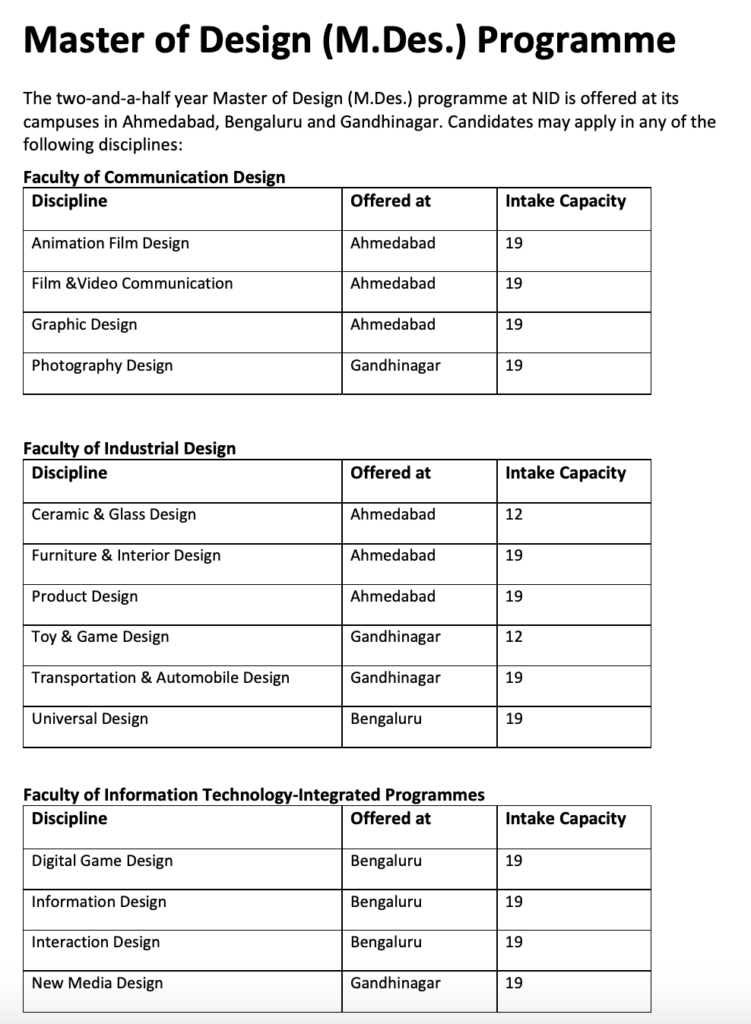
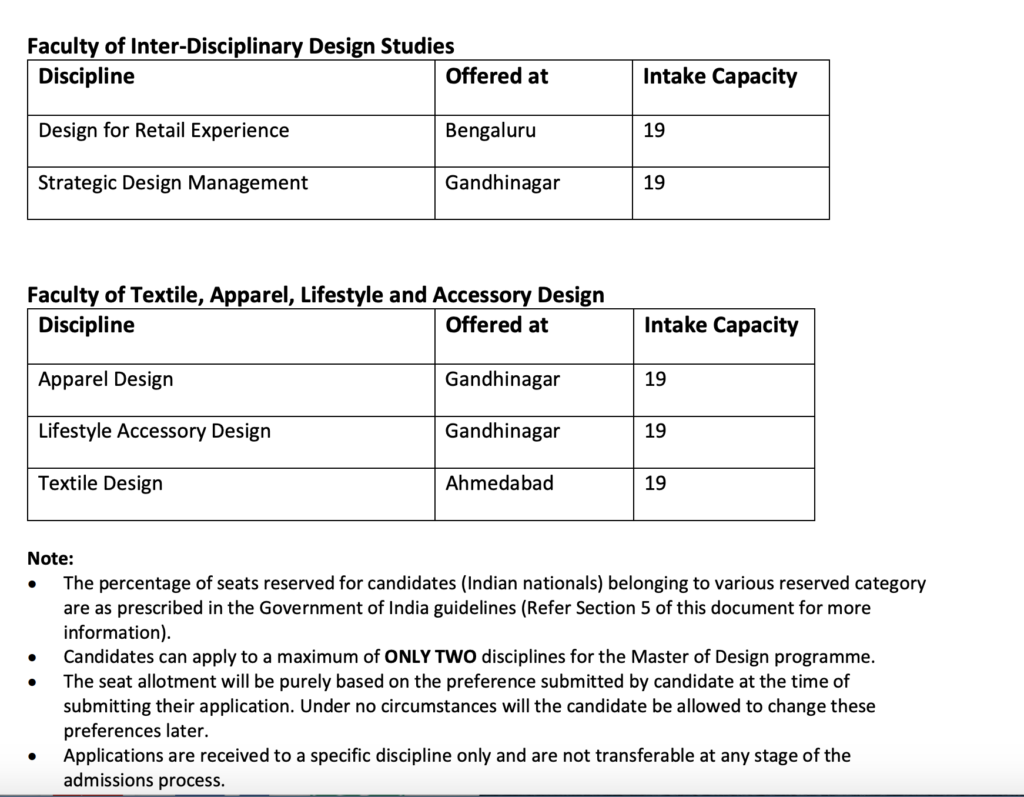
NID admissions 2020 is a two tier process. Thus, for NID admissions candidates need to appear for NID DAT (Prelims) and NID DAT (Mains). The objective of conducting both these tests is to assess knowledge, skills as well as behavioural abilities of candidates.

Graduate Diploma Programme in Design (GDPD) The four-year-long Graduate Diploma Programme in Design (GDPD) is offered at NID Andhra Pradesh, NID Haryana, NID Madhya Pradesh & NID Assam in the following areas of specialisation:

1. Industrial Design

2. Communication Design

3. Textile & Apparel Design

The details about the GDPD Programme and fees structure of respective campus can be viewed on official website of NID’s admission. The Handbook of all NID campuses are available for download on website http://admissions.nid.edu

SOUTH DELHI
CORPORATE BRANCH – HAUZ KHAS
 
Address:- G-8, G Block Market, 2nd Floor, Hauz Khas, New Delhi-110016
Nearest Metro Station Hauz Khas Gate No-3, Mayfair Garden / RBI Colony
Landmark –
 Near Punjab National Bank
Contact No: 88-00-22-6864, 011-40106405
Contact Person: Ms Yashika 
Email: corporate@pahaldesign.com
 
South Extension

Address:- E-17, Ground Floor, South Extension Part 1, New Delhi – 110049
Landmark: Mcdonald’s Lane, Nearest Metro – South Ex Metro Gate No 2
Contact No : 98994-29749, 011-41350505
Contact Person : Ms. Neha Siddiqui
Email : info@pahaldesign.com

EAST DELHI
Preet Vihar

Address:- C-57, Second Floor, Preet Vihar, Vikas Marg, Metro Pillar No-81.
(Near by Metro – Nirman Vihar / Preet Vihar ), New Delhi – 110092
Contact No : 011-45142542, 88264-92570, 93540-52529
Contact Person : Ms. Kanika Jain
Email : delhi@pahaldesign.com

NORTH WEST DELHI
Pitampura

Address:- 3rd Floor, 21 Kapil Vihar, Pitampura, Metro Pillar No.352
(Near by Metro-Kohat Enclave Gate 3), Opp. GULAB
Contact No : 011-42345936, 90311-70312
Contact Person :Ms. Kanika Bansal
Email : pitampura@pahaldesign.com

WEST DELHI
Janakpuri

Address:- 2nd Floor, S-4/63A, Shivaji Marg, New Mahavir Nagar, Janakpuri, New Delhi – 110018
Opposite – Metro Pillar No. 552, Landmark – Janakpuri East Metro Station
Contact Person: Ms Kanika Bansal
Contact No: 011-49879573, 90311-70312
Email : janakpuri@pahaldesign.com

DELHI NCR
Gurugram

Address:- M-44, Ground Floor, Old DLF Colony,
Sec-14 Market, Gurugram – 122001
Landmark – Opposite Ganpati Honda
Contact Person: Ms. Akanksha Pal
Contact No: 0124-4359032, 991060-9749
Email : gurugram@pahaldesign.com

Sonipat, Haryana

Address:- 2nd Floor, Atlas Road, Opposite Central Bank,
Above Verma Dental Clinic, Sonipat, Haryana – 131001
Contact Person: Ms. Kanika Bansal
Contact No: 90311-70312
Email : sonepat@pahaldesign.com

This year 2019 NID had new exam pattern.

NID DAT 2019 Preliminary New Exam Pattern:

Objective (Part – 1) : Multiple Choice Questions: 30 Marks
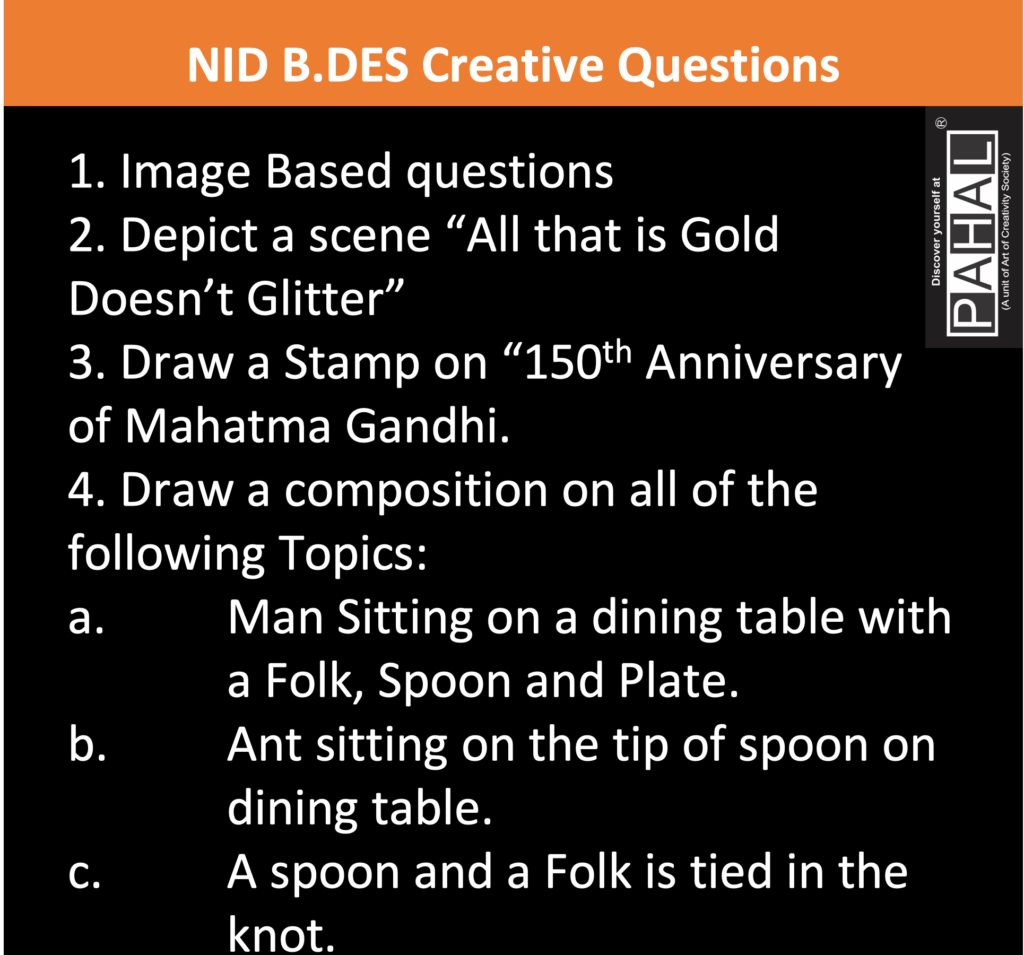
Subjective (Part – 2): Creative Questions: 70 Marks

Total Score: 100 Marks
Mode of Exam : Offline (Pen and Paper Based Test)
Nature of Questions : The Part 1 will include the Multiple choice Questions while part 2 is of Subjective Type
Duration : 3 Hours
Language : English Only
Negative Marking : No Negative Marking

NID_Sample Paper for B.Des

For Last 10 Year Sample Papers visit

Download Last 10 Years Original Exam Papers

For Further details visit www.pahaldesign.com or Call 8800-22-6864

Pre-Entrance Examination Registration

visit http://pahaldesign.com/iit-uceed-free-mock-test/

Schedule a free counselling session WhatsApp WhatsApp Enquiry