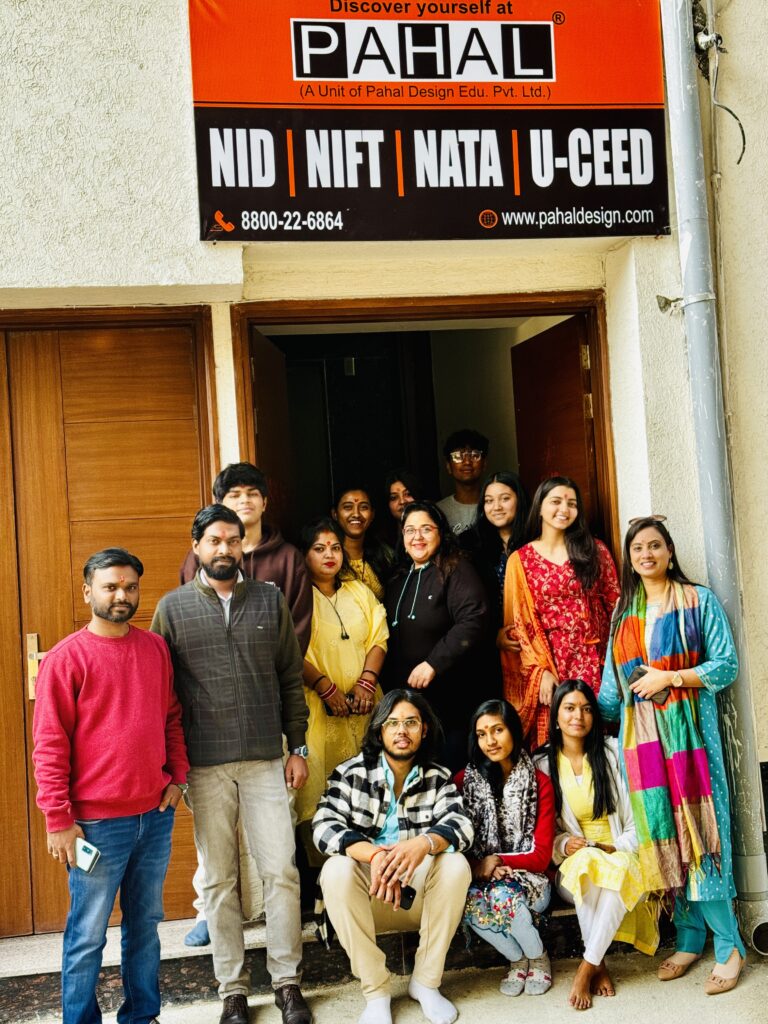
Pahal Design Hauz Khas is now at better location with great infrastructure. The new address for Centre is G-13, G Block Hauz Khas, New Delhi-110016 at Ground Floor. 

Pahal Design Hauz Khas centre is just 5 minutes away from Hauz Khas Metro Station. Hauz Khas centre is 500m from NIFT, Delhi Campus. Pahal Design offering coaching classes for NIFT Undergraduate and Post Graduate Coaching Classes.

NIFT Undergraduate Courses for Coaching Classes:

  1. B Design
  2. B Ftech
  3. NIFT Situation test

NIFT Postgraduate Courses for Coaching Classes:

  1. MFM
  2. M Des
  3. M Ftech
  4. Personal Interview

If you are looking for any Further guidance you can reach us at 8800-22-6864. 

G-13, Ground Floor, Hauz Khas, G Block New Delhi – 16


NIFT Admissions 2024

Frequently Asked Questions

  1. Is NIFT Degree recognized?

Yes. NIFT has been granted statutory status under the Act of Parliament of India in 2006, empowering the Institute to award degrees and other academic distinctions. NIFT is also a member of the Association of Indian Universities (AIU).

2. What is the Admission Schedule?

The admissions schedule for Admissions- 2024 is available on NIFT website/ Portal. www.nift.ac.in `

3. When are NIFT Admissions announced?

Admission to various programmes of NIFT is announced in the month of November / December every year. The admission announcements are widely publicized through National, regional print media, social media platforms and NIFT web site www.nift.ac.in

Q.4. What are the programmes offered by NIFT?

The programmes to be offered by NIFT are as given below :

  1. Bachelor of Fashion Design

     2. Bachelor of Fashion Technology

  1. Masters of Design (M.Des.)
  2. Masters of Fashion Management (M.F.M)
  3. Masters of Fashion Technology (M.F.Tech.)
  4. Ph.D

Q 5. What is the Minimum Age required for Undergraduate & Post Graduate course

Maximum age of the applicant should be less than 24 years as on 1st August of the year of admission for Undergraduate Programmes. The upper age limit may be relaxed by a period of 5 years for candidates of SC/ST/PWD categories.

There is no age limit for Postgraduate programmes.

Q.6  What are the Eligibility criteria for admission?

Kindly refer Prospectus (available on NIFT website ( www.nift.ac.in ) for Programme wise eligibility criteria.

Q.7  How can I get a prospectus?

The prospectus is available on NIFT website under the Admissions Tab ( www.nift.ac.in ).

Q.8 Can I apply manually?

No, candidates can only apply online through admission portal available on NIFT Website ( www.nift.ac.in ).Q.8  How do I pay the fees? What is the mode of payment when applying online?

Payments of application fees can only be paid online through payment gateway. The link is provided on the admission portal.

Q.9  What is an auto generated Application Number?

Once the application form is filled by an applicant, an application number will be generated ,which will be communicated to the candidate.

Q.10 WhatifIforgettotakeprintoutofOnlineApplicationformaftersubmission?

Candidate can take the print out of their Application form again after logging into the admission portal.

Q.11 Howmanycoursescanbeselected?

For undergraduate programme, the applicant is able to enroll for all B Des and B F Tech Programmes.

Candidates applying for B.F.Tech Programme (with Physics and Maths), will be eligible to enroll their candidature for B.Des courses.

The Candidates appearing for Post Graduate Programme can only apply for ONE post graduate programme.

Q. 12 How would I verify my payment?

Once the application form along with the requisite fees is submitted by the candidate, the confirmation of the same will be sent to the candidates directly through registered E mail.

Q. 13 Do you have the reservation of Seats for SC/ST?

Yes, it is as applicable as per the Government of India norms. Details can be seen in the Prospectus.

The National Institute Fashion Technology (NIFT) has been fulfilling its mission to offer a learning experience of the highest standards in fashion pertaining to design, technology and management, for the last more than three decades. We encourage remarkably creative students to draw inspiration from India’s textiles and crafts, while focusing on emerging global trends relevant to the fashion, textiles and accessories industries.


IMPORTANT INSTRUCTIONS FOR CANDIDATES

1. This Admit Card is provisional & subject to changes/modifications. Candidates are advised to follow the NIFT website,
notifications, information bulletin & check their mailbox on the registered E-mail address and SMS in their registered Mobile
No. for any latest updates and information.

2. Candidates are suggested to visit the examination venue, a day in advance, so that they can reach the venue on time on the day of the examination.

3. Candidates are required to present the following documents to the examination officials, for identity verification:
A. Admit Card downloaded from the NIFT website (a clear preferably colour printout on A4 size paper)
B. Any one of these original and valid Photo Identification Proof issued by the government — Passport/Aadhaar Card
(With photograph)/E- Aadhaar/Voter Card / Driving License.
Note: No Candidate would be allowed to enter the Examination Centre, without valid identity proof & verification.

4. Candidates are requested to carry their own Pen/ Pencil / Erasers /Ruler (In a transparent pouch). Candidates appearing for
CAT also need to carry their Colouring & Drawing material. For CAT a physical Question Booklet with space for responses
will be provided at the Centre. Candidates are NOT allowed to carry any personal belongings [except those listed above]
including electronic devices, mobile phone and other banned materials listed in the Information Bulletin/ NIFT Website / NIFT
Notice, to the Examination Centre. Examination Officials will not be responsible for safe keep of personal belongings and
can also debar the candidate for carrying any banned items.

5. Candidates should reach the Venue well before the reporting time given in the Admit Card. No candidate will be allowed
inside if he/she does not adhere to the reporting time.

6. Candidates are to sit at the designated seat allocated by the Centre Head. They can login using the credentials given on
their Admit Card and read instructions, before the commencement of the examination. In case of any issues they can report
the same immediately to the Invigilator. Candidate will be able to start ONLY after the Examination is started as per schedule
by the Centre Head. An announcement will also be made to that effect once the test is started.

7. Candidates will NOT be permitted to leave the Examination Room/Hall before the end of the examination. After the
completion of the examination, candidates should hand over their Question Booklet, Answer Sheets & Rough sheet to the
invigilator on duty (CAT Only).

8. An electronic attendance will be taken by the invigilator by scanning the QR Code of the Admit card carried by the candidate.

9. No Candidate should adopt any unfair-means, or indulge in any unfair examination practices. Speaking to others / Over
seeing another person’s responses / screen, trying to open other applications on the PC, carrying any form of electronic
device / peripheral / accessory, not obeying the instructions of the Centre Head / Invigilator are all fit ground for cancellation
of your examination.

10. Appearing for both GAT and CAT is mandatory. If a candidate does not appear for one or the other he/she will not be
shortlisted for the Situation Test/ PI (Personal Interview).

11. General Ability Test (GAT) is a Computer Based Test & Creative Ability Test (CAT) is a Paper Based Test.

For any further details connect us at 880022-6864.

  1. Tell me about yourself?
  2. Why do you think we should give you admission in our college/What special quality do you possess that we should consider you for our college?
  3. What are your greatest strengths?
  4. What is your greatest weakness?
  5. What are your career goals, and how do you plan to achieve them?
  6. Where do you see yourself 5 years down the line?
  7. What are your hobbies and interests?
  8. Who is your role model/Who inspires you?
  9. What does fashion mean to you? Is it important? Why is it important?
  10. What fashion designer’s design? What is fashion design?
  11. Why did you decide to choose fashion design as a career?
  12. How would you relate past and present fashion trends?
  13. How would you describe your personal style?
  14. What are your expectations from this design course?
  15. According to you, who is the most stylish celebrity?
  16. Name some of your favourite fashion writers, stylists, photographers etc.
  17. Describe something that excites you about the fashion Industry?
  18. Are you passionate about something apart from fashion?
  19. How do you stay up to date with fashion?
  20. Should fashionable clothes be allowed in colleges or should there be uniform clothing for all?
  21. What Fashion Means To You? Is It Crucial For You? If Yes, Then Justify.
  22. Why Do You Want to Enter the Fashion Industry as A Professional?
  23. How Would You Describe Your Style?

24. What Are Your Expectations From This Specific Course?

25. Why Do You Think That You Are The Most Suited Candidate For College Admission/ What Quality You Embody That We Should Consider Your Admission In Our Esteemed College?


Here is a list of questions that have been asked and you should prepare:

1.Why MFM or Masters of Fashion Management ?
2.Why National Institute of Fashion Technology or NIFT?
3.Questions from Graduation?
4.Where do you see yourself in a few years from now.
5.Define Fashion ?
6.How would you contribute to the fashion industry after MFM from NIFT?
7.Basic Fashion Terminology like haute couture etc.
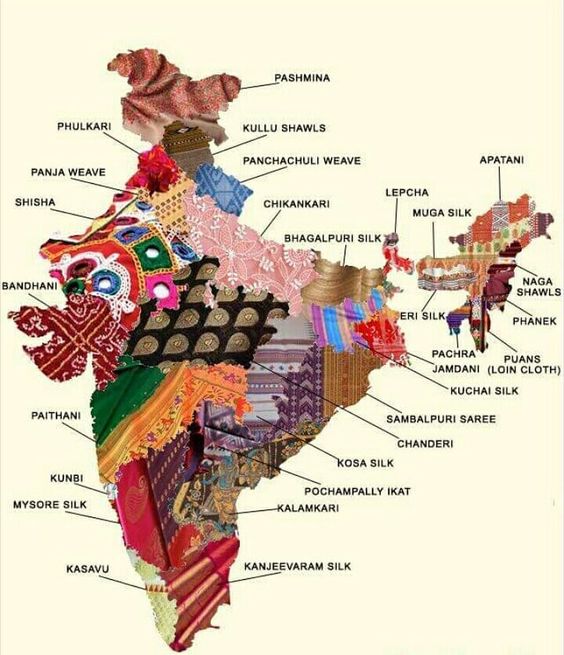
8.Knowledge about some apparel/textile specialty of the state you belong
9.Would you join Masters of Fashion Management (MFM)if you don’t get a center of your choice?
10.Current textile minister
11.Textile/Retail terminology
12.Knowledge about the brand of clothing you are wearing to the interview
13.Retail and Textile brands. Who owns what?
14.Fashion GK/Fashion current Affairs is a must.
15.Also,brush up your static GK and General current affairs.
16.Questions from Work Experience if any.

Graphic designers create visual concepts, using computer software or by hand, to communicate ideas that inspire, inform, and captivate consumers. They develop the overall layout and production design for applications such as advertisements, brochures, magazines, and reports.

Duties

Graphic designers typically do the following:

  • Meet with clients or the art director to determine the scope of a project
  • Use digital illustration, photo editing software, and layout software to create designs
  • Create visual elements such as logos, original images, and illustrations to help deliver a message
  • Design layouts, including selection of colors, images, and typefaces
  • Present design concepts to clients or art directors
  • Incorporate changes recommended by clients or art directors into final designs
  • Review designs for errors before printing or publishing them

Graphic designers, also referred to as graphic artists or communication designers, combine art and technology to communicate ideas through images and the layout of websites and printed pages. They may use a variety of design elements to achieve artistic or decorative effects.

Graphic designers work with both text and images. They often select the type, font, size, color, and line length of headlines, headings, and text. Graphic designers also decide how images and text will go together in print or on a webpage, including how much space each will have. When using text in layouts, graphic designers collaborate with writers, who choose the words and decide whether the words will be put into paragraphs, lists, or tables. Through the use of images, text, and color, graphic designers may transform data into visual graphics and diagrams to make complex ideas more accessible.

Graphic design is important to market and sell products, and it is a critical component of brochures and logos. Therefore, graphic designers often work closely with people in advertising and promotions, public relations, and marketing.

Frequently, designers specialize in a particular category or type of client. For example, some designers create the graphics used on product packaging, and others may work on the visual designs used on book jackets.

Graphic designers need to keep up to date with software and computer technologies in order to remain competitive.

Some individuals with a background in graphic design become postsecondary teachers and teach in design schools, colleges, and universities.

Some graphic designers specialize in experiential graphic design. These designers work with architects, industrial designers, landscape architects, and interior designers to create interactive design environments, such as museum exhibitions, public arts exhibits, and retail spaces.

Education for Graphic Designers
A bachelor’s degree in graphic design or a related field is usually required. However, individuals with a bachelor’s degree in another field may pursue technical training in graphic design to meet most hiring qualifications.

The National Association of Schools of Art and Design accredits about 350 postsecondary colleges, universities, and independent institutes with programs in art and design. Most programs include courses in studio art, principles of design, computerized design, commercial graphics production, printing techniques, and website design. In addition, students should consider courses in writing, marketing, and business, all of which are useful in helping designers work effectively on project teams.

High school students interested in graphic design should take basic art and design courses in high school, if the courses are available. Many bachelor’s degree programs require students to complete a year of basic art and design courses before being admitted to a formal degree program. Some schools require applicants to submit sketches and other examples of their artistic ability.

Many programs provide students with the opportunity to build a professional portfolio of their designs. For many artists, including graphic designers, developing a portfolio—a collection of completed works that demonstrates their styles and abilities—is essential because employers rely heavily on a designer’s portfolio in deciding whether to hire the individual.

Graphic designers must keep up with new and updated computer graphics and design software, either on their own or through formal software training programs. Professional associations that specialize in graphic design, such as AIGA, offer courses intended to keep the skills of their members up to date.

Other Experience for Graphic Designers
Graphic designers often gain their initial experience through internships. Internships provide aspiring graphic designers an opportunity to work with designers and to experience the design process from concept to completion, in some cases while completing a design program.

Licenses, Certifications, and Registrations for Graphic Designers
Certification programs are generally available through software product vendors. Certification in graphic design software can demonstrate a level of competence and may provide a jobseeker with a competitive advantage.

Advancement for Graphic Designers
Experienced graphic designers may advance to chief designer, art director, or other supervisory positions.

Important Qualities for Graphic Designers
Analytical skills. Graphic designers must be able to look at their work from the point of view of their consumers and examine how the designs they develop will be perceived by consumers to ensure they convey the client’s desired message.

Artistic ability. Graphic designers must be able to create designs that are artistically interesting and appealing to clients and consumers. They produce rough illustrations of design ideas, either by hand sketching or by using computer programs.

Communication skills. Graphic designers must communicate with clients, customers, and other designers to ensure that their designs accurately reflect the desired message and effectively express information.

Computer skills. Most graphic designers use specialized graphic design software to prepare their designs.

Creativity. Graphic designers must be able to think of new approaches to communicating ideas to consumers. They develop unique designs that convey a certain message on behalf of their clients.

Time-management skills. Graphic designers often work on multiple projects at the same time, each with a different deadline.

Art Directors

Art directors are responsible for the visual style and images in magazines, newspapers, product packaging, and movie and television productions. They create the overall design of a project and direct others who develop artwork and layouts.

Craft and Fine Artists

Craft and fine artists use a variety of materials and techniques to create art for sale and exhibition. Craft artists create handmade objects, such as pottery, glassware, textiles, and other objects that are designed to be functional. Fine artists, including painters, sculptors, and illustrators, create original works of art for their aesthetic value, rather than for a functional one.

Desktop Publishers

Desktop publishers use computer software to design page layouts for newspapers, books, brochures, and other items that are printed or published online.

Drafters

Drafters use software to convert the designs of engineers and architects into technical drawings. Most workers specialize in architectural, civil, electrical, or mechanical drafting and use technical drawings to help design everything from microchips to skyscrapers.

Industrial Designers

Industrial designers develop the concepts for manufactured products, such as cars, home appliances, and toys. They combine art, business, and engineering to make products that people use every day. Industrial designers consider the function, aesthetics, production costs, and usability of products when developing new product concepts.

Multimedia Artists and Animators

Multimedia artists and animators create animation and visual effects for television, movies, video games, and other forms of media.

Technical Writers

Technical writers, also called technical communicators, prepare instruction manuals, how-to guides, journal articles, and other supporting documents to communicate complex and technical information more easily. They also develop, gather, and disseminate technical information through an organization’s communications channels.

Web Developers

Web developers design and create websites. They are responsible for the look of the site. They are also responsible for the site’s technical aspects, such as its performance and capacity, which are measures of a website’s speed and how much traffic the site can handle. In addition, web developers may create content for the site.

The Indian technical textiles sector has immense potential to grow both domestically as well as globally. Backed by government initiatives and support, India can emerge as a global manufacturing hub for technical textiles in the future. 
It is a massive market that remains overshadowed by its conventional cousin. And, all discussion about its scope remains confined mostly to stakeholders. But almost unnoticed-certainly by those not conversant with the sector—technical textiles have already emerged from the shadow of the overall textiles industry and is now reckoned to be an entity of its own. Plus, it is big.

The global technical textiles market was valued at $157.68 billion in 2016 and is projected to reach $220.37 billion by 2022 at a CAGR of 5.89 per cent from 2017, according to a recent report by Markets and Markets. The major factors driving this market are growing demand and government initiatives in promoting this sector. The increasing use of technical textiles in end-use industries such as automobiles, construction, healthcare and geotextiles too are driving the market. The technical textiles used in these industries is being attributed to the unique function properties—hygiene and safety, cost-effectiveness, durability, strength, versatility, user-friendliness, lightweight and logistical convenience.

Back home, the growth drivers of the Indian technical textiles markets include:
 Growing industrialisation,
 Changing lifestyles,
 Improvement in safety and hygiene,
 Increase in technology, and
 Awareness of protective wear.

The Indian market


The Indian technical textiles sector is growing along with that of the end-user industries. The sectorcontributes around 12 per cent to the overall Indian textiles market. The major factor contributing to the growth of Indian technical textiles are infrastructure and industrial development in the country.
Government initiatives too are attracting investments. The government has put in place the following policies to develop a comprehensive manufacturing base for high-value technical textiles in India.
 Export Promotion of Capital Goods (EPCG),
 Amended Technological Upgradation Fund Scheme (ATUFS),
 Schemes for agro-textile usage in the Northeast region,
 Scheme for the usage of geotechnical textiles in the Northeast,
Benefits under Special Economic Zone (SEZ) and Schemes for Integrated Textile Parks (SITP).
Domestic consumption has increased by 6.8 per cent in recent years. To make the Indian technical textiles industry competitive globally, a dual policy needs to be adopted for exports as well as domestic markets. The industry is expected to expand at CAGR of 13.11 per cent during 2018–23 to $32 billion.


Exports and imports


India is a net exporter of technical textile products, with exports touching $1,849.8 million in 2017–18. Exports will grow at a CAGR of 3.3 per cent in the five years. After two consecutive years of decline, exports recovered remarkably in 2017–18 to register a significant y-o-y growth of 18.4 per cent, increasing from $1,562.5 million in the previous year to $1,849.8 million in 2017–18.
The US was the leading destination with exports estimated at $336.8 million in 2017-18. The value of US exports recorded a healthy CAGR of 10.6 per cent in the period between 2013–14 and 2017–18. The US share in Indian exports of technical textiles increased from 13.9 per cent to 18.2 per cent in the period.
Imports of technical textile products ($1,744.8 million) increased substantially in 2017–18 at a growth rate of 21.7 per cent. Imports recorded a CAGR of 8.1 per cent between 2013–14 and 2017–18.
The largest import source of technical textile products was China, accounting for more than 50 per centshare in both 2013–14 and 2017–18. The value of imports from China recorded a CAGR of 8.2 per cent in those four years. Other major import sources in 2017–18 included Thailand, Taiwan, the US, Bangladesh, Germany, South Korea, Malaysia, Hong Kong and Nepal.

Growth as global manufacturer

India should grow as a global technical textiles manufacturing hub with the following advantages:
 Extensive availability of textile raw material;
 Technical textiles being a labour-intensive industry, the presence of a large pool of labour at a comparatively low cost can provide a competitive edge over technical textile producing countries like China, the US, and those in Europe;
 Power costs are lower than other countries, and lending rates are higher than in China and Vietnam; with government schemes, the effective cost of capital becomes comparable;
 India’s infrastructure for technical textiles is developing with investment in R&D, testing and investor facilitation from the Centre of Excellence.
Even though the global industry is dominated by European countries and China, there is potential in India to emerge as a global manufacturing hub for technical textiles in the future.
Steps needed to grow further
Indian government schemes for textiles and apparel manufacturers have been targeting technology up-gradation, infrastructure development, export promotion and many more segments. State governments should also announce their own policies for attracting investors to their respective states.
However, India is yet to exploit its potential in technical textiles sector due to reasons such as the absence of regulatory measures for technical textile usage in various industries. Moreover, the country is still dependent on imports for technology and advanced machinery and India has limited production of high-end products and specialized yarns and intricate duty structure.
To facilitate the growth of the Indian technical textiles industry, several measures need attention. Some of them are:
 Establishing regulatory norms to increase the consumption of technical textile goods;
 Developing exclusive HSN codes to identify high growth products for further development;
 Establishing and implementing Indian standards to develop high-quality products for global acceptance;
 Better operational standards;
 Focus on training, education and creating end-user awareness to boost domestic demand for high-end technical textile products.
Besides this, India should also focus on forming partnerships with other global payers for acquiring technical know-how. This will help the country to attract large-scale investments.

Q. How was the NIFT 2021 Exam? Was it lengthy, difficult or moderate? What’s your analysis of the exam?
The paper pattern of NIFT B.des entrance paper didn’t see any changes. The paper format and the number of questions were in accordance with the announced NIFT exam pattern with the difficulty levels being moderate, all in all the paper was quite doable for any consistent student. There were six passages, each passage of around 120-150 words, they were small and weren’t time consuming in reading, however comprehending was more on an inference-based questions, which was little tricky for the students. Student with a good reading habit will surely find it easily doable. the topic based was on varied subjects, ranging from opera, music and art fair, aquatic animal to weirdest profession, other section of English was easy to moderate, the easiest being to identify the plural form, same was with one-word substitution and to identify the correct spelt word, idioms and phrase was moderate and same with antonyms and synonyms

Reasoning had mix of topics like Assertion and reason, puzzles which was little time taking but doable, other topics of cubes, series, Odd ones out, blood relations, directions, coding decoding, ranking & positioning could be attempted carefully.

Quantitative on the other hand saw all major topics covered from number system to ratio & proportion, SI, CI, profit & loss, work time, mixtures & allegations, etc.

The General knowledge segment was moderately easy with questions which has question three questions from brands, two questions on noble prize and four questions from static GK everything that we have been recommending and mentoring for found its presence in the exam. It will be fit to say that there were no surprises.

GAT section was not at all lengthy , 100 questions could be comfortably attempted in allotted time .If all the sections were attempted properly any score above 65-70/100 could be easily achieved

Q. Creative Ability Test is conducted to judge the Design Ability and Creativity of the student. Out of the three questions asked in the NIFT exam, which one required the most efforts and was the easiest?

Analysis of question is very important and also its imperative to understand what the examiner wants , In CAT this year too there were three questions to attempt. Two were from visual communication and the third was a creative product representation based.

Question No 1: “Design a virtual space for Webinar”.
This was for some tricky but at the same time a little brain storming could have gave students edge, as everyone is now well versed with EdTech platforms like Zoom ,Google meet ,Go to meeting etc. thanks to COVID 19 , we all had learning /interactions/meetings on these

platforms ,the question demanded to design a hypothetical digital meeting / learning platform and not the one that already exist as question was not on Re-design ,it was altogether about design a new interface display ,wherein student had the liberty to coin new brand ,slogan as well as its logo altogether. Reading the question properly and inferring it, was the key , as some students even ended up drawing a physical recording studio for webinar. That’s why it’s not about “How you draw’ but it’s all about “what you draw “

Q2: Design Emojis for the following:
(a) see you again (b) I don’t know (c) good morning (d) good night (e) sh…

It was again a visual communication question, where emojis for different communication has to be designed, one need to be very particular and avoid drawing the same circular shaped emoji, instead define, what is emoji ,it’s basically a visual which interpret a message or a communication , many of students would have interpreted it only as emoji face , which is very conventional.

This was the most easiest question in CAT but at the same time your creativity is being judged ,
how much you think “ out of the box”

Q3: choose any musical instrument and depict any four festivals each in a given box.

The challenge in any design exam is “ what you interpret” from the question.
There was clear instructions to innovate, design, change shape, colour, pattern of the instrument. Students were confused as to whether they had to choose one instrument and interpret it for four different festivals differently or four different instruments has to be used for each festival separately. Since the instrument could be completely renovated in terms of its
shape and form as well, it would be very interesting to see one instrument take four completely different forms. Ideally musical instrument is classified by the method of producing sound i.e. . Wind instrument, stringed instrument , percussion instrument etc . so ideally the question demands using a musical instrument type for different festivals, so if you choose string instruments then it could be guitar, violin, sitar and harp for different festival.

Knowledge on musical instrument as well as festival was the key , this question can be a decider for range of marks the students are expecting in their CAT part.

Q. Which were the toughest sections in the NIFT 2021 General Ability Test (GAT)?

Students found quantitative section tough as compared to other sections in GAT, this year the questions were more on application based rather than on implied basis, it was little time taking as one need to apply their understanding of the topic. Questions were from average, percentage, time & speed, S.I & C.I, Profit & loss, Ratio proportion and Number system.

Q. Was there anything unexpected in the NIFT Entrance Exam? If yes, then what was it?

Not at all, there was nothing unexpected as such, it was in line with what NIFT had notified in their notification

Q. How should students prepare for the Situation Test? What are important aspects they must keep in mind?

After student clears the CAT and GAT exam (CAT 50% and GAT 30%) weightage is given to this test, NIFT situation test is conducted (20% weightage). It is to evaluate the candidate’s skills for material handling and innovative ability in a given situation with a provided set of materials. Candidates must know how to crack NIFT situation test as their admission also based on the performance in the situation test which is the final round of the admission process. A total of 3038 seats across Bachelor of Design (B.Des.) programmes will be offered admission to the
shortlisted candidates across the across 16 campuses of the NIFT institute.

The following are the key to do for NIFT Situation test.
1- Make yourself familiar with materials, materials could be anything that you usually find
at your home i.e. Plastic (bags, bottles, packaging, utensils), Cloth fabrics, strings ( jute, rubber bands, plastic etc.) ,scarp metals, needles & threads ,different papers etc
2- Always learn and practice in group especially in classroom , as there will be lots and lots
of brainstorming ,boosting your ideations and creativity
3- Exchange thoughts, ideas with your mentor and also be very open to learning.
4- Explore unconventional use of materials, handling them effectively and productively is something requires time, so start your Situation test preparation early.

Its very important to acknowledge that situation test will definitely a key to boost up the ranking, and getting top NIFT Campus is altogether based on your ranking. even a small difference in marks , creates a wide gap in the ranking . so take the situation test very “ SERIOUSLY “

Q. According to you, when must a NIFT aspirant start preparing to get the best results?

Start early, stay ahead with your strategy and make a Strategic plan to get an edge over others. Successful are those who knows what they are meant for, where is their interest & which field they are passionate about. Once you make yourself clear that your goal is to pursue art &
design as a career devise productive time management strategies with a view of acing the NIFT
exam with good rank.

Ideally it is recommended that one should start preparation at high school level , but do not assume it to be mandatory , as NIFT exam is all about your ability to effectively execute your ideas and creativity in a piece of paper ,so first identify your existing skill set and what level you need to take these skill sets to score good ranking in exam . as your school grades are not indicator of these skill sets , so it becomes imperative for NIFT aspirants to choose a mentor & guide, who would actually identify your skill set and at the same time hone up the your own set of competencies.

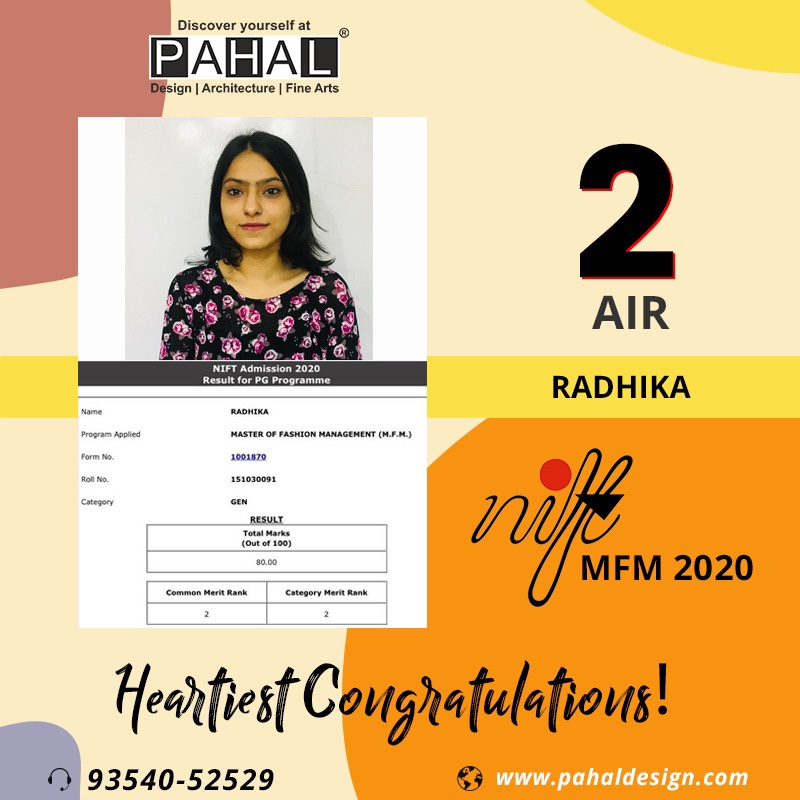
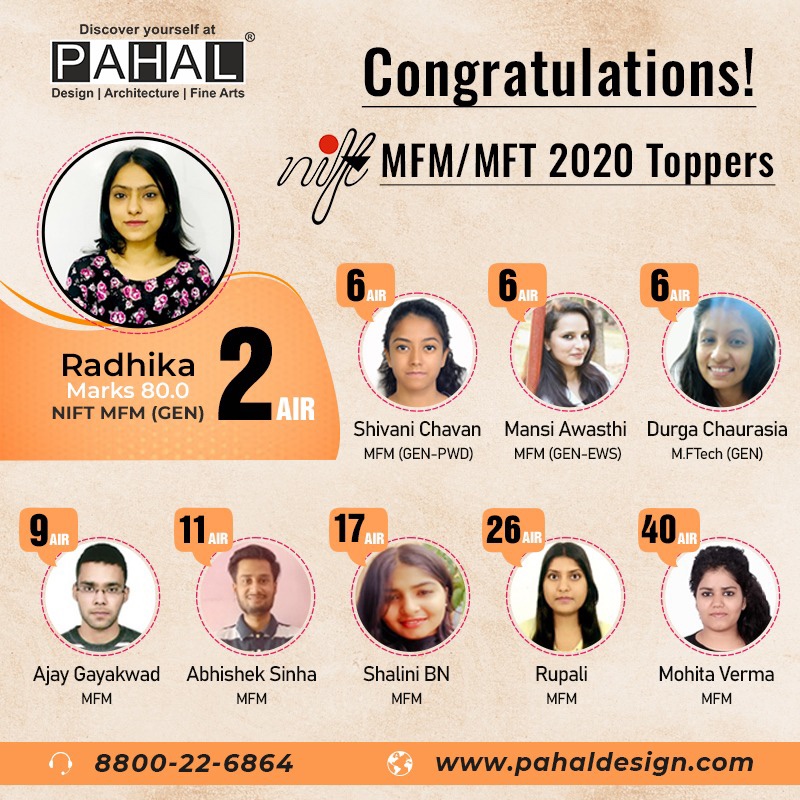
Radhika ahuja, AIR 2, Marks 80, MFM, NIFT 2020
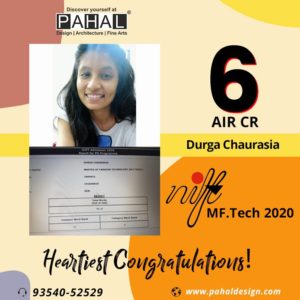
Durga Chaurasia, AIR 6, MFT, NIFT 2020

Durga, AIR 6, NIFT, MFTech, 2020

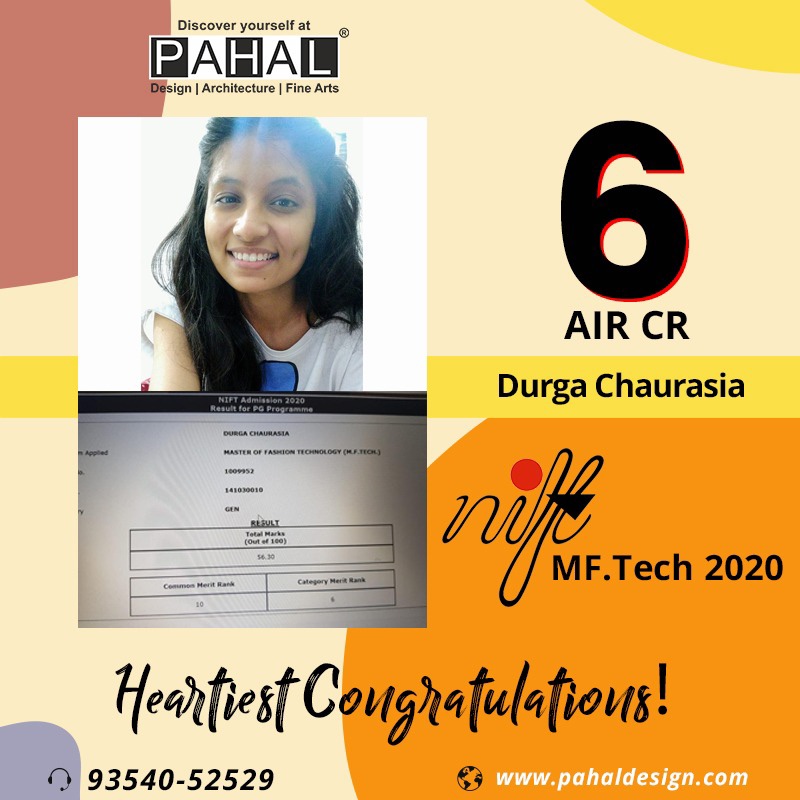
With a score of 56.30, Durga Chaurasia secured common merit rank 10 and General Category Rank 6 in NIFT Entrance Exam 2020 conducted for Master of Fashion Technology (MFTech) course admissions.

In a candid interview with Pahal Design, NIFT 2020 MFTech topper, Durga Chaurasia shared her prep strategy, GD/PI experience, success mantras, future plans, and a lot more. Go through the detailed interview below:

Pahal Design – Hi! Durga How are you?

Durga – All good. How about you.

Pahal Design – All good. After seeing your smiling faces and the position you have secured has made us Proud. Congratulations, so did you expect to be a topper?

Durga – Thank you so much for the topper 2 didn’t expect to be a topper but yes deep down in my heart I was just feeling that my hard work will really pay off and I will get some good rank and to get admission into NIFT. I was really happy about it.

Pahal Design – What was your score in NIFT?

Durga – In the written exam my score was 56.30 out of 100 I scored AIR 6.

Pahal Design – How did you prepare for written exam?

Durga – For the written examination, I prepared it on my own because the time was less. it was like 4-5 months left and I had my college assignment, college projects & exams as well so I just mutually prepared myself and I studied about like 3-4 hours a day along with my college stuffs and I just wanted my admission into NIFT and I somehow did it.

Pahal Design – Tell us about your journey, how did you prepare for it?

Durga – Yes, this year this entrance exam was full of surprises like that entry of negative marking and online scenario. If I say online it is the present demand so it can be fulfilled and it is necessary so you just need to be friendly with your phone and the person you are talking to and I was bit aware of negative marking in my graduation also so I was not really scared of  the negative marking but I was prepared only to put points on those questions which I am confirmed so yes it all want good up and down.

Pahal Design – How was your GDPI preparation. How did you go ahead with it?

Durga – For the GDPI sessions I was new to all of these things and I didn’t face anything like that before so for that I joined a crash course, I joined it by Pahal Institute. One of my teachers is in front of me and taking my interview. It really helped me a lot I was personally an anxious person but now I have that sense of confidence that I can speak in front of a strange people and having those coverage of wide variety of topics, subjects, the pdfs, the lectures , the day to day updation and everything was so in practice and in flow that I gave my best at the point when I needed it. So it was all because of you all.

Pahal Design – It was your hard work as well Durga so what mistakes you did and you want the future aspirants to avoid it.

Durga – So, mistakes I used to get blank at some point of time, and you get blank because you do not know about the content that you have been asked for so for that work on your content part, work on your subject part, work on your basics so it is not a very rocket science kind of a thing that you have to need to focus on small basics part and second thing is that the aspirants should practice a lot.  practice makes a man perfect so you just need to focus on what you need to do.

Pahal Design – How much time should every aspirant contribute or dedicate in a day?

Durga – First thing I would say that it fully depends on individual’s ability and how much dedicate you are towards your goal. During my written exam I used to study for like 3-4 hours a day honestly. I am not studious, not at all, but to get that opportunity of being fully flourished. I just studied and prepared anyway to make my dream come true. I remember the time when I used to stand in front of the mirror daily and tell myself daily that you have to do it & you will do it, and this thing motivated me to do it in spite of making me anxious.

Pahal Design – How was your PI?

Durga – Yes, if I talk about the present scenario, in this Covid-19 situation it was all lockdown and I had ample of time to prepare. It was a good opportunity and good time to get prepared for all of the Interview so I was not very confident about GD and interview  I used to prepare for 4-5 hours like not doing 5-6 hours straight but like 2 hours after that taking break and then after 1 hour just like that.

Pahal Design – What was the reaction of your family when you told them that you want to be in fashion industry.

Durga – I would say that I am lucky in this case my parents are really convincing and they are always supportive and at the same time encouraging me every time to do whatever I want, I remember I told them that I want to pursue a degree in master of fashion technology then my father and mother just smiled and they just said that you really want it you will get it your mom and dad are always by your side you just don’t worry you just work hard and put your efforts and we are always there so it was not that difficult for me to convince them.

Pahal Design – Is there anything else you would want to share or any tip you want to give to the future aspirant who are preparing for M.F.Tech?

Durga – I would give my tip which I inculcated into myself very strongly and very strictly I would say that there are 3 things that needs to be mentioned that needs to be in your head forever and ever – First thing is practice second thing is the determination and in simple words I would say stubbornness your eagerness your excitement for the thing that you want and the third thing is your dedication like dedication is the one thing like if you are not doing it for the one time try for the second time it is like that nothing is impossible you can achieve it if you want it.


ngg_shortcode_1_placeholder 


NIFT final result for MDes, MFM and MFTech course admissions was declared on July 16, 2020. Aspirants could check their final results for Master’s programmes by providing their login credentials on the official website of National Institute of Fashion Technology (NIFT). The final merit list for NIFT admissions 2020 is released on the official website (https://nift.ac.in/) of the design school. NIFT results are released in the form of a scorecard containing subject-wise marks, All India Rank (AIR) and category rank. 

Earlier, NIFT final result for BDes admissions was declared on June 25NIFT written exam result 2020 for BDes, MDes, MFTech, and MFM courses was declared on March 13. Candidates could check NIFT exam result for their respective course on the official website of the institute by providing any twodetails from their roll number, application numberand date of birth

This year, due to COVID-19 outbreak, National Institute of Fashion Technology has made major changes in its admission process. The Situation Test for NIFT BDes admissions 2020 was cancelled and admission in the programme was offered based on an aspirant’s performance in NIFT CAT and GAT exam only. Similarly, Group Discussion round was cancelled for MDes, MFM and MFTech course admissions 2020.

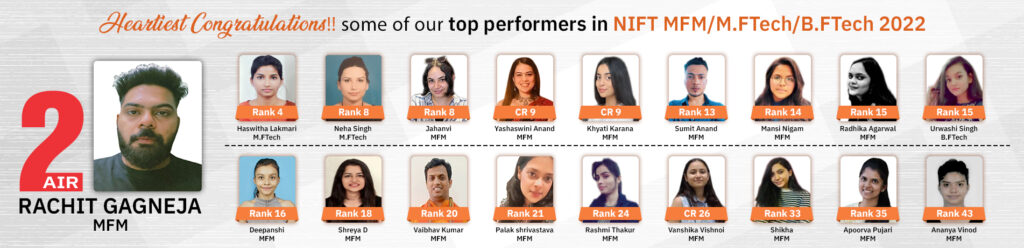
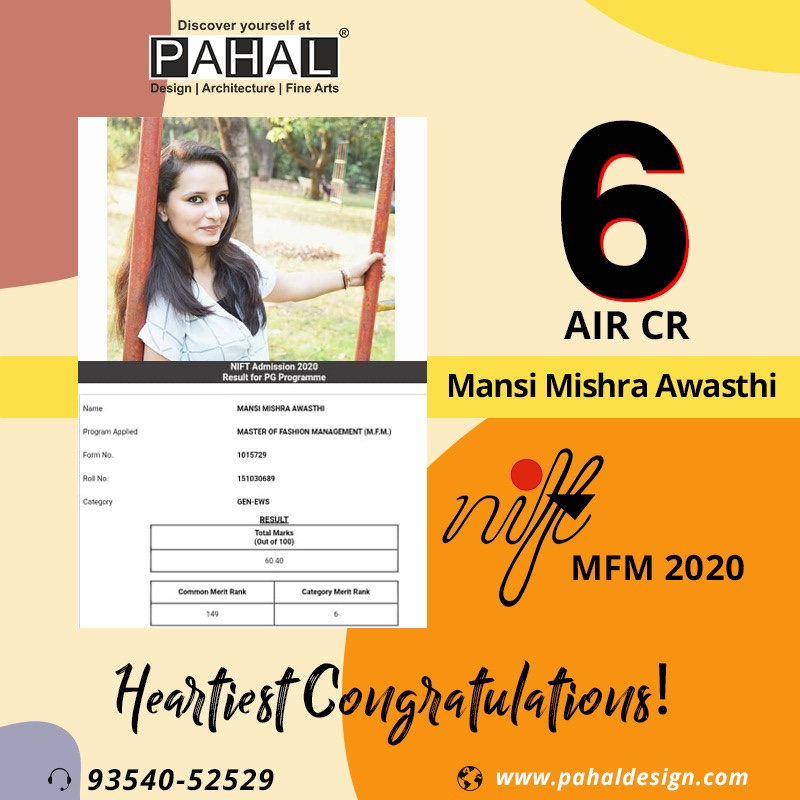
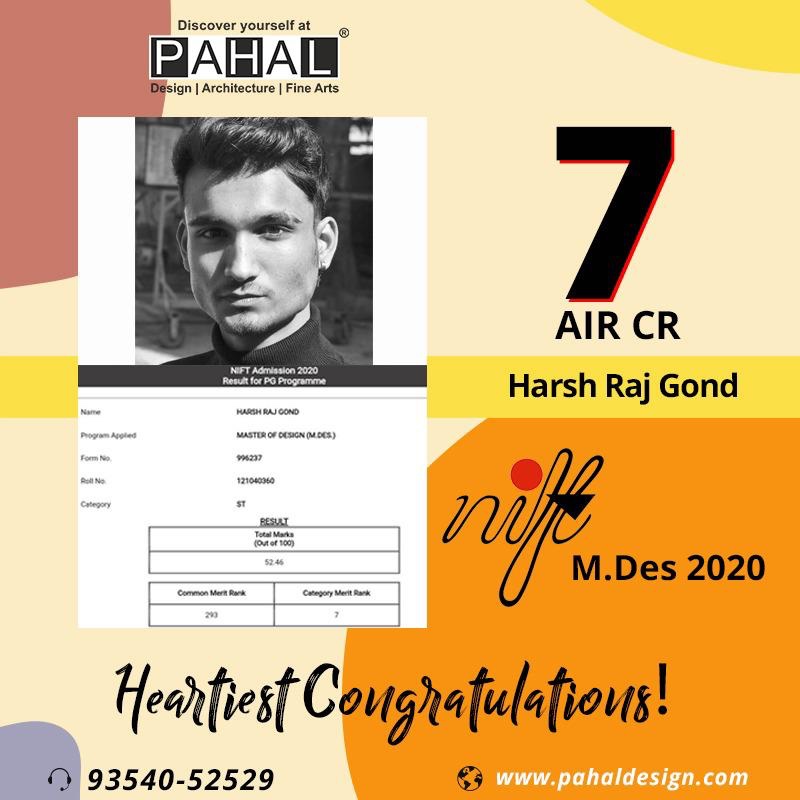
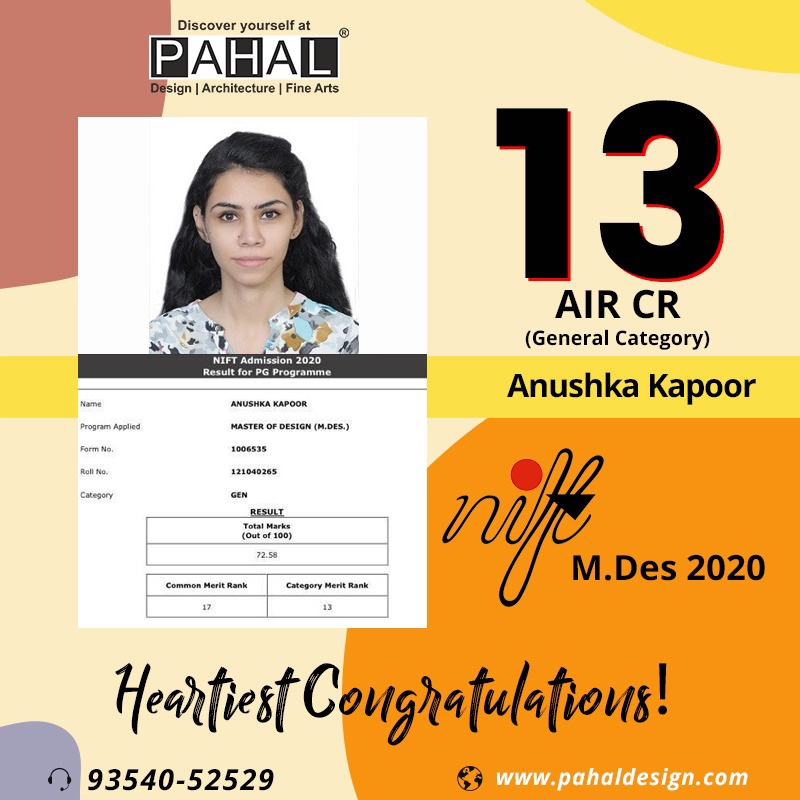
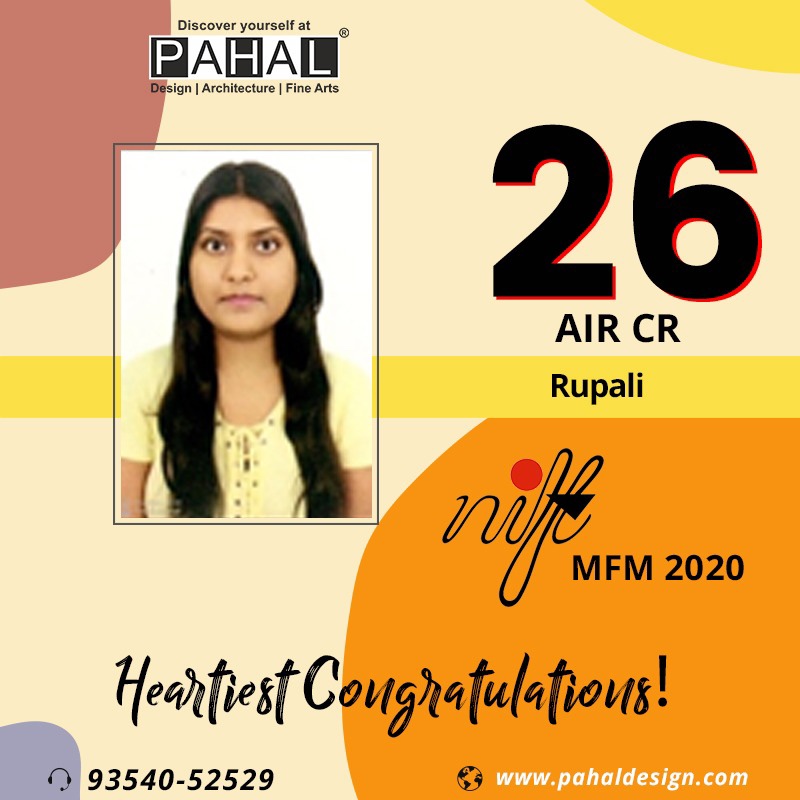
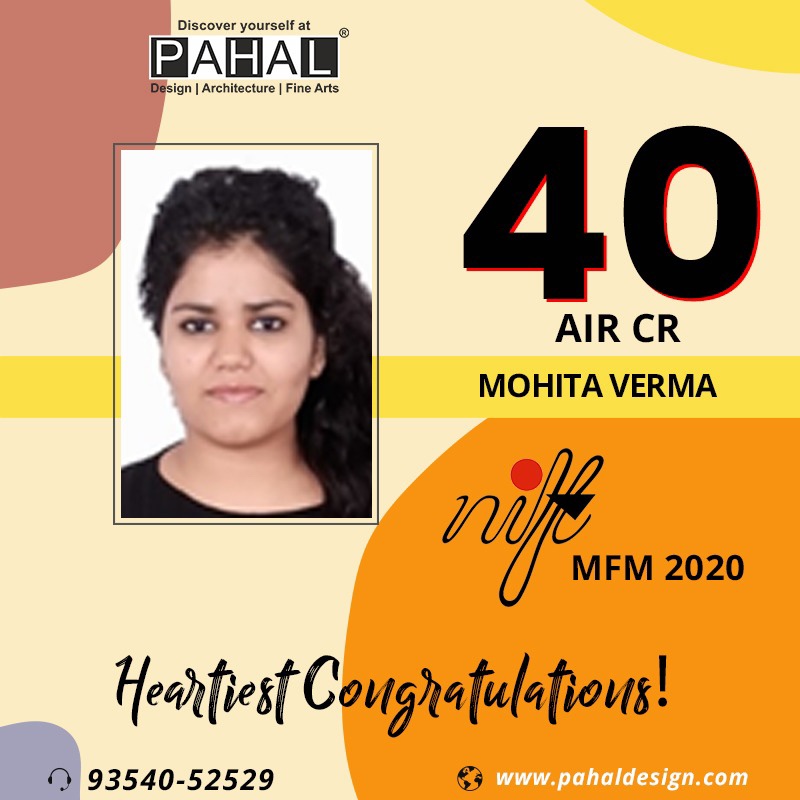
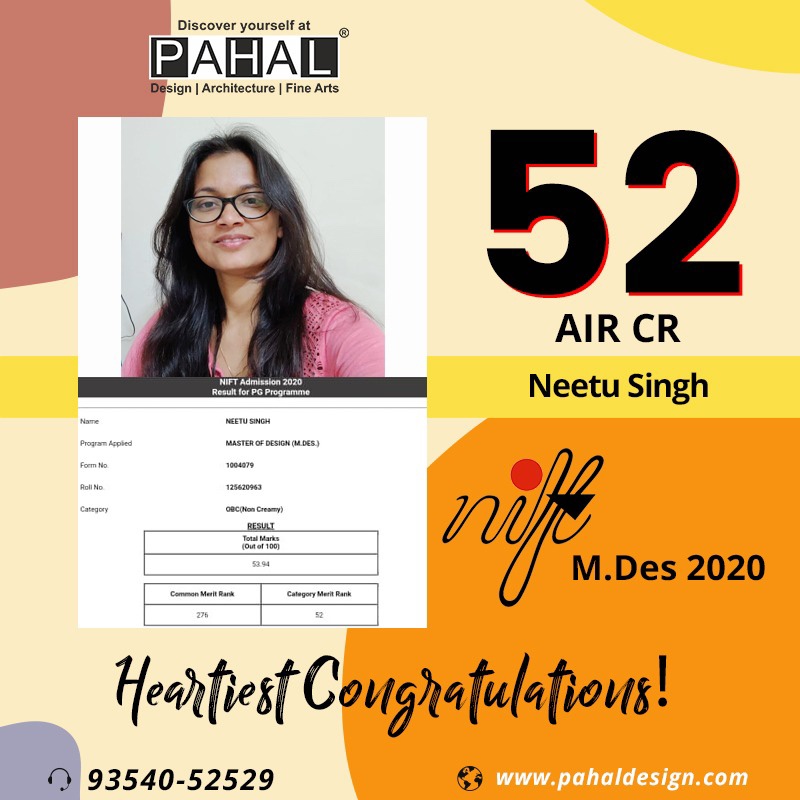
Again Pahal Design has shown excellence in NIFT Masters result 2020 15 students in NIFT Top 50 for different courses of Masters Program. More than 100 students are being selected for NIFT Final result of Master Program.

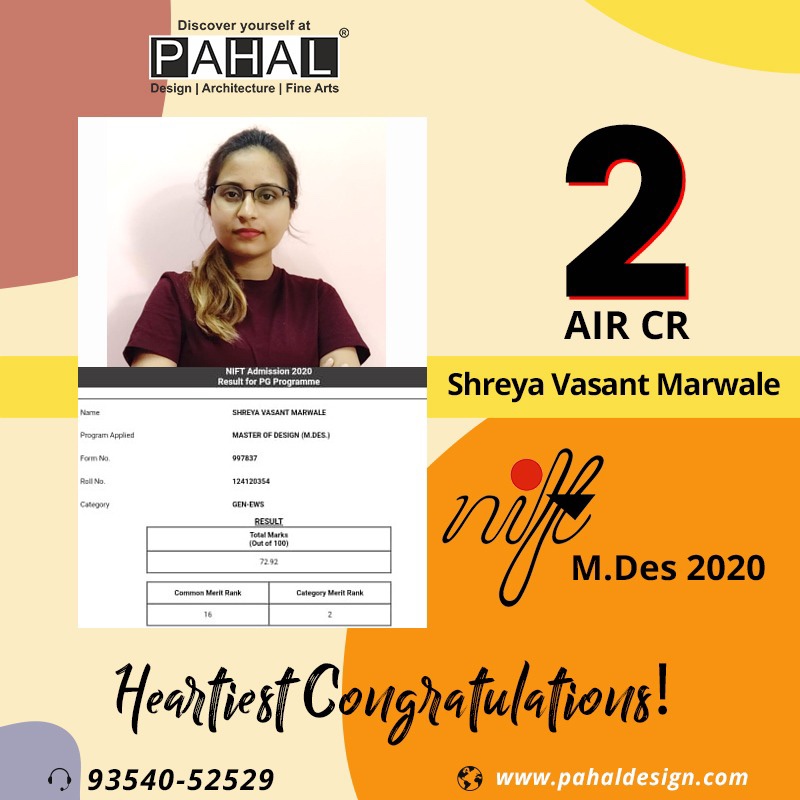
Radhika Ahuja from MFM General Category Got AIR 2 with total 80 marks and she graduated from DU in English literature. Durga Chaurasia from MFT has AIR 6 in General Category and Shreya from M Des AIR 2 category Rank with total marks 72.92.

Durga Chaurasia, AIR 6, NIFT MFT 2020 Sharing her success story with Pahal Design
Radhika Ahuja AIR 2, NIFT MFM 2020 sharing her success story with Pahal Design


Schedule a free counselling session WhatsApp WhatsApp Enquiry